





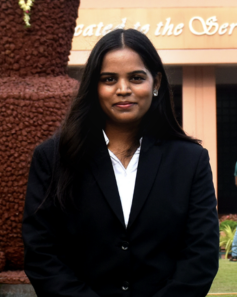
Akanksha Verma
Assistant Professor
Akanksha Verma is an Assistant Professor at the Yogananda School of AI, Computer, and Data Sciences, Shoolini University, Solan, Himachal Pradesh. She completed her M. Tech in Computer Science and Data Processing from the Department of Mathematics, Indian Institute of Technology Kharagpur, in 2026. She also holds an MSc in Mathematics, providing a strong analytical and quantitative foundation to her academic and technical work, along with a B Ed, reflecting her formal grounding in teaching practice.
Her academic record includes a GATE All India Rank of 299 and a CSIR-NET JRF All India Rank of 137. Her academic interests span Artificial Intelligence, Machine Learning, Generative AI, and Retrieval-Augmented Systems, with hands-on project experience in deep learning for medical imaging, large language model fine-tuning, agentic AI, and applied business analytics.
She has developed and deployed a Medical Assistant application using Graph RAG and Agentic AI, integrating LangChain, LangGraph, Gemini, NetworkX, FAISS, and Sentence Transformers. The application was progressively developed from a basic PDF question-answering system into an agentic, tool-calling assistant with a Gradio front end hosted on Hugging Face Spaces. Her work with large language models also includes fine-tuning GPT-2 using LoRA/PEFT on financial sentiment data, achieving strong accuracy while training only a small fraction of the model’s total parameters.
Her other project work includes a Brain Tumor Classification System based on convolutional neural networks, with a comparative analysis of Particle Swarm Optimization and the Adam optimiser. She has also developed a Customer Lifetime Value and Churn Prediction model, combining BG/NBD-style probabilistic modelling with XGBoost across a transaction dataset containing more than 276,000 records.
During her M. Tech, Akanksha served as a Teaching Assistant for an Optimisation Techniques laboratory, where she worked with concepts and methods including the Gauss-Seidel method, Simplex and Dual Simplex methods, Big-M method, and degeneracy. Her teaching approach reflects an emphasis on analytical thinking, conceptual understanding, and practical application.
She continues to develop her expertise through self-directed study of the Model Context Protocol (MCP), advanced Retrieval-Augmented Generation techniques, and transformer architecture fundamentals, reflecting her continued engagement with emerging developments in Artificial Intelligence and related technologies.
Publications
Contact Details
Email: akankshaverma1@shooliniuniversity.com
LinkedIn Profile: linkedin.com/in/akanksha-verma-52bb57301
GitHub Profile: github.com/vakanksha98