

The best science courses after Class 12 in India in 2026 span biotechnology, physics, chemistry, life sciences, biomedical engineering, and environmental sciences — each one leading to strong careers backed by government investment and growing industry demand.
Science has always been a gateway to meaningful careers. But in 2026, the scale of the opportunity has changed significantly. India’s bioeconomy reached $195.3 billion in 2025, growing at 18% annually, according to BIRAC’s India Bioeconomy Report 2026. The National Quantum Mission has committed ₹6,003.65 crore to the development of quantum infrastructure. The medical devices market is heading to $50 billion by 2030. And the Union Budget 2025-26 allocated ₹99,858 crore to healthcare — one of the largest allocations in India’s history.
The best science courses are the ones that align your interests with where this investment is going. This blog breaks down every major option — what each course covers, where it leads, and how to choose the right one.
Which Are the Best Science Courses After Class 12 in India?
Science courses fall into three broad categories — life sciences, physical sciences, and applied sciences. All three have strong career scope in 2026.
Here is a course-by-course breakdown:
- B Tech Biotechnology with AI: The strongest combination of biology and technology available to science students today. Trains you to apply AI and machine learning to drug discovery, genomics, biomanufacturing, and precision medicine. India’s BioE3 Policy is building Bio-AI Hubs specifically needing graduates with this skill set. Starting salary ₹4–8 LPA, senior roles ₹20–40 LPA.
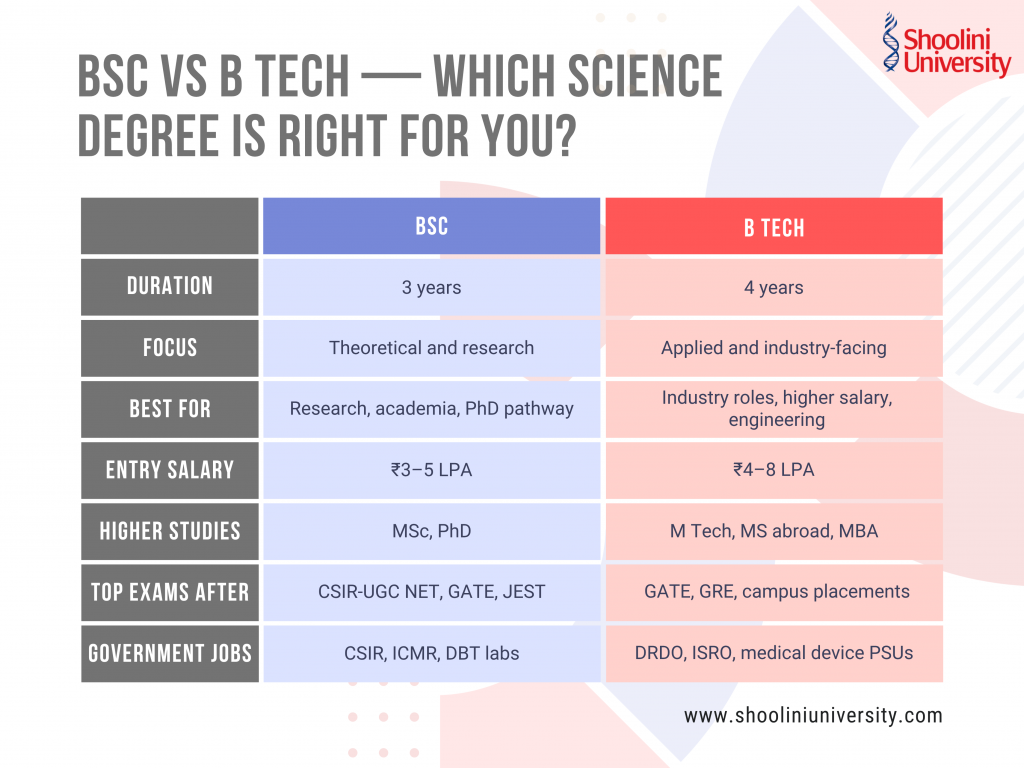
- B Tech Biotechnology: A 4-year engineering degree combining biological sciences with engineering principles. Covers bioprocess engineering, molecular biology, genetics, and industrial biotech. Graduates work in pharma, healthcare, agricultural biotech, and government research. Starting salary ₹4–7 LPA.
- B Tech Biomedical Engineering: Combines medicine, biology, and technology to design healthcare systems and medical devices. India’s medical devices market is heading to $50 billion by 2030 according to IBEF. Global companies like Siemens Healthineers and Medtronic have invested heavily in Indian engineering centres. Starting salary ₹3.5–6 LPA.
- B Tech Bioinformatics: Applies computational tools to analyse biological data — genomics, proteomics, and drug design. One of the most cross-disciplinary science degrees available, with demand growing in pharma, research, and health-tech. Starting salary ₹4–7 LPA.
- BSc (Hons) Biotechnology: A 3-year science degree building strong foundations in molecular biology, genetics, microbiology, and biochemistry. Strong pathway to MSc, research careers, and PhD programs. Starting salary ₹3–5 LPA.
- BSc (Hons) Microbiology: Covers the study of microorganisms and their applications in medicine, agriculture, and industry. Growing demand in diagnostics, pharma, food safety, and environmental science. Starting salary ₹3–5 LPA.
- BSc (Hons) Physics: Builds deep foundations in electrodynamics, quantum mechanics, optics, and computational physics. Strong pathway to MSc Physics, quantum computing research, and government science roles at DRDO, ISRO, and BARC. Starting salary ₹4–8 LPA (quantum roles).
- BSc (Hons) Chemistry: Covers organic, inorganic, physical, and analytical chemistry. Strong demand in pharma, speciality chemicals, agrochemicals, and materials science. Pathway to MSc Chemistry, CSIR-UGC NET, and research careers. Starting salary ₹3–5 LPA.
- BSc (Hons) Botany: Focuses on plant biology, ecology, plant physiology, and genetics. Growing demand in agricultural biotech, environmental science, conservation, and research. Starting salary ₹3–4.5 LPA.
- BSc (Hons) Zoology: Covers animal biology, genetics, ecology, and wildlife science. Career paths include research, conservation, government wildlife services, and pharmaceutical testing. Starting salary ₹3–4.5 LPA.
- BSc (Hons) Nutrition and Dietetics: Covers human nutrition, food science, clinical dietetics, and public health nutrition. Growing demand in hospitals, the wellness industry, FMCG, and sports nutrition. Starting salary ₹3–5 LPA.
Which Science Course Has the Best Scope in 2026?
Three courses stand out for growth, government backing, and salary potential.
- B Tech Biotechnology with AI is the strongest option for students who want to enter a high-growth, technology-facing career without moving away from biology. India’s bioeconomy is targeting $300 billion by 2030, and the BioE3 Policy is building infrastructure that directly employs this skill set.
- BSc Physics leading to MSc is the strongest pathway for students interested in research, government labs, and the emerging quantum computing sector. The National Quantum Mission is creating roles at ISRO, DRDO, and BARC that specifically need physics-trained professionals.
- B Tech Biomedical Engineering is the best option for students who want to work at the intersection of medicine and engineering — designing medical devices, healthcare systems, and clinical technology in one of India’s fastest-growing manufacturing sectors.
What Are the Career Options After Science Courses?
Each science course maps to specific roles across research, industry, government, and healthcare.
- After B Tech Biotechnology with AI — Bioinformatics Analyst, AI Drug Discovery Researcher, Biodata Scientist, Bioprocess Engineer
- After B Tech Biotechnology — Research Scientist, Quality Control Analyst, Bioprocess Engineer, Regulatory Affairs Specialist
- After B Tech Biomedical Engineering — Clinical Engineer, Medical Device Designer, AI Healthcare Engineer, Biomedical R&D Engineer
- After B Tech Bioinformatics — Computational Biologist, Genomic Data Analyst, Bioinformatics Scientist, Clinical Data Analyst
- After BSc Biotechnology or Microbiology — Lab Analyst, Research Associate, Quality Assurance Analyst, Clinical Research Associate
- After BSc Physics — Quantum Computing Engineer, Research Scientist, Data Analyst, Medical Physicist
- After BSc Chemistry — Pharmaceutical Chemist, Analytical Chemist, Quality Control Specialist, Materials Scientist
- After BSc Botany or Zoology — Environmental Scientist, Wildlife Researcher, Agricultural Research Officer, Conservation Scientist
- After BSc Nutrition and Dietetics — Clinical Dietitian, Public Health Nutritionist, Sports Nutritionist, R&D Executive in FMCG
Which Science Course Is Right for You?
| Your Interest | Best Course |
| Biology and technology combined | B Tech Biotechnology with AI |
| Medical devices and healthcare systems | B Tech Biomedical Engineering |
| Biological data and computation | B Tech Bioinformatics |
| Core biology with research focus | BSc Biotechnology or BSc Microbiology |
| Quantum physics and defence research | BSc Physics leading to MSc |
| Pharmaceuticals and materials | BSc Chemistry leading to MSc |
| Plants, ecology, conservation | BSc Botany or BSc Zoology |
| Health, food, and wellness | BSc Nutrition and Dietetics |
What Is the Summit Research Program at Shoolini University?
It is one of the most unique undergraduate science programs available in India — and worth understanding separately.
The Summit Research Program (SRP) at Shoolini University is a B Tech program that integrates deep research exposure into the engineering curriculum from year one. Unlike standard programs where research happens only in the final year, SRP students begin working on live research projects from their very first semester — under the guidance of faculty ranked among the top 2% of scientists globally per Stanford University’s list.
SRP students work in government-funded laboratories, contribute to published research, and are guided to file patents under the university’s One Student One Patent policy. It is designed specifically for students who want to build a serious research career or pursue a PhD after graduation.
Shoolini University — Best University for Science Courses in India
Shoolini University is ranked No. 1 private university in India by QS World University Rankings, No. 1 in Asia for Research by QS Asia Rankings 2026, and India’s first Biotechnology University.
For science students, Shoolini offers one of the most comprehensive ranges of science and life sciences programs available at any private university in India — across five dedicated schools.
Science Courses Available at Shoolini University:
- School of Biotechnology — BSc (Hons) Biotechnology, BSc (Hons) Microbiology, BSc (Hons) Nutrition and Dietetics, B Tech Biotechnology with AI, MSc Biotechnology, MSc Microbiology, M Tech Biotechnology, PhD Biotechnology, PhD Microbiology, PhD Genetics
- School of Bio-Engineering — B Tech Biotechnology, B Tech Biomedical Engineering, B Tech Bioinformatics, B Tech Summit Research Program, M Tech Bioinformatics, MSc Nutrition and Dietetics
- School of Physics and Materials Science — BSc (Hons) Physics, MSc Physics, MSc Physics Research, PhD Physics, PhD Material Science
- School of Biological and Environmental Sciences — BSc (Hons) Botany, BSc (Hons) Zoology, BA/BSc (Hons) Psychology, MSc Botany, MSc Zoology, PhD Botany, PhD Zoology, PhD Environmental Sciences
- School of Advanced Chemical Sciences — BSc (Hons) Chemistry, MSc Chemistry, PhD Chemistry
The Shoolini Advantage for Science Students
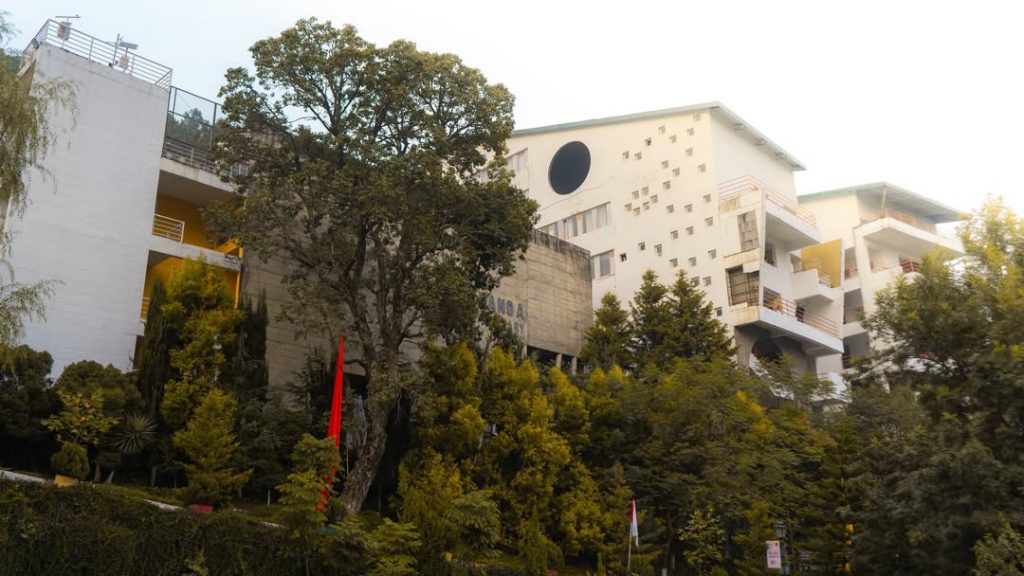
- 104+ laboratories and 11 Centres of Excellence — including DRDO, DST, and DAE-sponsored labs where students work on nanofibers, solar cell materials, ceramics, and healthcare sensors
- One Student One Patent policy — students have filed over 1,900 patents, guided by faculty ranked among the top 2% of scientists globally
- Summit Research Program — undergraduates begin live research from year one, not year four
- 250+ international collaborations — including University of Melbourne, University of Arkansas, Western Sydney University, Royal Holloway University of London, Lanzhou University China, and Gachon University Korea. BSc (Hons) Biotechnology students can also opt for a Dual Degree with the University of Melbourne
- Research grants from DST SERB, DST PURSE, DST FIST, BIRAC, DRDO, DAE, HIMCOSTE — students work in actively funded labs producing real, publishable research
- The SPRINT™ (Skill Progression through Rapid, Intensive & Innovative Training) Bootcamp: Inspired by Stanford’s mini-MBA program, this dedicated career readiness initiative covers CV building, mock interviews, and job-readiness sessions.
Science Courses in India — Is It the Right Choice in 2026?
Science graduates in India are entering one of the most well-funded, government-backed, and industry-supported job markets the country has seen in decades.
India’s bioeconomy is growing at 18% annually. The National Quantum Mission is building quantum infrastructure with ₹6,003.65 crore. The medical devices sector is on track to reach $50 billion. And the government has committed nearly ₹1 lakh crore to healthcare and biotech research and development.
The best science courses are the ones that align your natural strengths with where this growth is going. Choose a course that matches your interests, a university with strong labs and real research exposure, and start building your portfolio from day one.
Science Admissions 2026 at Shoolini University are open. Ranked No. 1 private university in India by QS World University Rankings 2026. Apply now.
Sources:
- BIRAC India Bioeconomy Report IBER 2026 https://www.birac.nic.in/webcontent/IBER_2026.pdf
- DD News — Biotechnology to Power Next Industrial Revolution, April 2026 https://ddnews.gov.in/en/biotechnology-to-power-next-industrial-revolution-india-targets-1-trillion-bioeconomy-by-2047-dr-jitendra-singh/
- IBEF Medical Devices Industry India 2026 https://www.ibef.org/industry/medical-devices
- PIB National Quantum Mission, February 2026 https://www.pib.gov.in/PressReleasePage.aspx?PRID=2223187
- PIB Union Budget 2025-26 Healthcare Allocation https://www.pib.gov.in/PressReleaseIframePage.aspx?PRID=2048569
- ManpowerGroup 2026 Talent Shortage Survey https://cxotoday.com/media-coverage/talent-shortages-rise-to-82-in-india-in-2026-as-ai-skills-claim-top-spot/
FAQs:
Q1. What are the best career options after 12th science?
Biotechnology with AI, Biomedical Engineering, Physics leading to quantum research, Chemistry, and Life Sciences are among the strongest career options in 2026 — all backed by active government investment and growing industry demand across healthcare, pharma, and research.
Q2. Which science courses offer a high salary in India?
B Tech Biotechnology with AI and B Tech Biomedical Engineering offer the highest starting salaries at ₹4–8 LPA and ₹3.5–6 LPA, respectively. BSc Physics leading to MSc and quantum roles offers entry-level salaries of ₹8–14 LPA — among the highest for any science graduate.
Q3. Can PCB students choose non-medical courses?
Yes. B Tech Biotechnology with AI, B Tech Biomedical Engineering, B Tech Bioinformatics, BSc Microbiology, BSc Nutrition and Dietetics, and BSc Botany are all strong non-medical options open to PCB students — none of which require NEET.
Q4. Which science course has the best future scope?
B Tech Biotechnology with AI has the strongest future scope in 2026 — directly aligned with India's BioE3 Policy, Bio-AI Hubs, and a bioeconomy targeting $300 billion by 2030. BSc Physics leading to quantum research is a close second, given the National Quantum Mission's ₹6,003.65 crore investment.
Q5. How do I choose the right science course after 12th?
Match your interest to the field — biology and technology for biotechnology, medicine and engineering for biomedical, computation and data for bioinformatics, physics for quantum and research, and chemistry for pharma and materials. Then choose a university with strong labs, research exposure, and placement support.
Q6. Does Shoolini University offer life science programs?
Yes. Shoolini offers a comprehensive range, including BSc and B Tech Biotechnology, BSc Microbiology, BSc Botany, BSc Zoology, BSc Nutrition and Dietetics, B Tech Bioinformatics, B Tech Biomedical Engineering, and MSc and PhD programs across all life science disciplines — through five dedicated science schools.
Q7. Is research a good career after science courses?
Yes — and 2026 is a particularly strong time to enter research in India. The National Quantum Mission, BioE3 Policy, and government grants from DRDO, DST, BIRAC, and ICMR are actively funding research positions across biotechnology, physics, chemistry, and life sciences.