

Not long ago, biology and coding lived in completely separate worlds. One was about living organisms, lab coats, and microscopes. The other was about computers, algorithms, and lines of code. Bioinformatics is what happens when those two worlds collide, and in 2026, that collision is producing some of the most exciting career opportunities in Indian science.
India’s Department of Biotechnology has already made its genome sequencing work AI-enabled. CSIR-CCMB, one of the country’s most respected research institutes, is actively hiring professionals who can both code and understand biology. And Google DeepMind added 80,000 protein complex predictions to the AlphaFold Database in May 2026, making the world’s largest open-access biological dataset even bigger.
This is an interesting time for bioinformatics students. So let’s understand this in detail.
What Exactly Is Bioinformatics?
It is the science of using computers and data to understand biology.
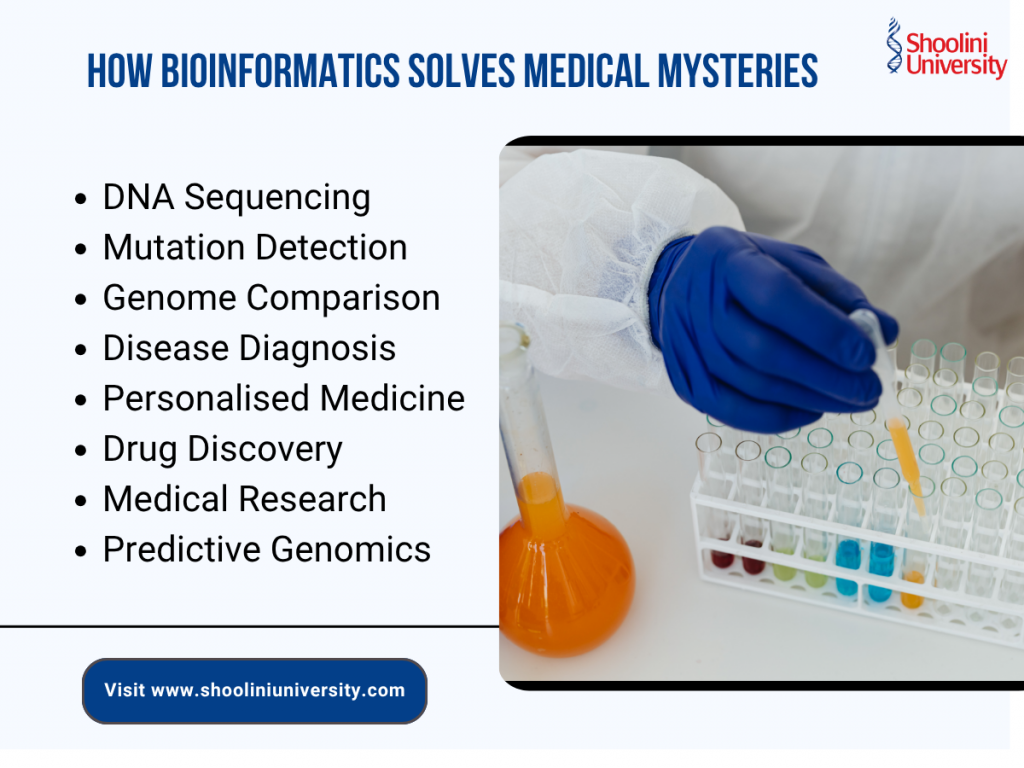
Think about what happens when a doctor sends a patient’s blood sample for genome sequencing. Millions of data points come back. Someone has to make sense of them, find the patterns, identify the mutations, and connect the dots to a disease or a treatment. That someone is a bioinformatician.
Bioinformatics is used in drug discovery, cancer research, agricultural science, diagnostics, and now increasingly in personalised medicine, where treatment is tailored to your specific genetic makeup rather than a one-size-fits-all approach.
Why Are Students Choosing Bioinformatics in 2026?
Because the timing has never been better, and the real-world demand is visible right now.
In February 2026, Union Minister Dr Jitendra Singh said at the India AI Impact Summit that India is entering a new era of genomics and gene therapy. AI-driven diagnostic analytics combined with genomic data will soon allow doctors to personalise treatment for each patient, according to News on Air. The infrastructure for it is already being built this year.
CSIR-CCMB is reorganising itself around what scientists are calling ‘big biology’: high-throughput sequencing, large-scale genomic data, and the computational tools to make sense of it all, according to Neo Science Hub’s March 2026 report. The institute’s Phenome India project links the genetic profiles of thousands of Indians with their clinical data, the kind of work that requires someone who understands both biology and code.
ICAR posted a bioinformatics project associate position as recently as June 12, 2026, seeking experience with Python, R, Linux, and NGS data analysis, which together make up the standard skill set of a trained bioinformatics graduate.
What Do Bioinformatics Students Actually Learn?
A mix of biological science and practical computing, built around real research tools.
The core of any good bioinformatics program covers:
- Python, the go-to language for data analysis, automation, and building machine learning models in biology
- R, used for statistical analysis and making sense of large genomic datasets
- Linux, the operating system behind most of the servers that bioinformatics work runs on
- NGS data analysis, learning to work with raw sequencing data from Next Generation Sequencing machines
- Machine learning, building predictive models for disease diagnosis, drug design, and protein behaviour
- Bioinformatics tools, including BLAST, GATK, Galaxy, and Bioconductor, the platforms researchers use daily
The goal is to produce someone who can sit in a research lab, run a genomic analysis pipeline, interpret the results, and explain what they mean to a clinical or scientific team. That combination is rare, and right now, it is in short supply.
What Is AlphaFold and Why Does It Matter for Bioinformatics Students?
It is the most significant shift in structural biology in decades, and it relies entirely on the skills bioinformatics students learn.
For most of scientific history, figuring out the 3D structure of a protein, how it folds and what shape it takes, required years of expensive lab work. AlphaFold, built by Google DeepMind, changed that. It predicts protein structures using AI, in minutes, with remarkable accuracy.
In May 2026, EMBL-EBI announced that Google DeepMind, NVIDIA, and Seoul National University had added 80,000 high-confidence protein complex predictions to the AlphaFold Database. The database now holds over 200 million protein structure predictions, all openly available to researchers worldwide.
For a bioinformatics student, this is the world they are going to be a part of. The tools they learn, including Python, machine learning, and structural analysis, are the same ones being used to build and interpret this database. A graduate with the right training can contribute to work like this from relatively early in their career. That is an exciting prospect.
What Careers Can Bioinformatics Students Build?
The roles are varied, and they span more industries than most students expect.
- Bioinformatics Analyst, working with genomic and proteomic data in research or clinical settings
- Computational Biologist, building models to understand how biological systems work
- Genomic Data Scientist, making sense of large-scale sequencing datasets in hospitals or research institutes
- Drug Discovery Researcher, using molecular data and AI to identify new medicines faster
- Agricultural Bioinformatician, applying genomics to crop improvement and food security
- Clinical Data Analyst, managing and interpreting data from clinical trials
- AI Research Scientist in Life Sciences, building machine learning models for diagnostics and drug design
Where are they getting hired? Government research institutes like CSIR-CCMB, ICAR, and ICMR. Pharma companies like Biocon, Dr Reddy’s, and Cipla. Health-tech startups like MedGenome, Niramai, and SigTuple.
IT companies with dedicated life sciences divisions. And increasingly, in India’s growing network of biotech startups, over 11,800 of which are active right now according to BIRAC’s India Bioeconomy Report 2026.
What Is the Salary After a Bioinformatics Degree?
It reflects how specialised the skill set is and grows meaningfully with experience.
| Experience Level | Role | Salary Range |
| Fresher (0–2 years) | Bioinformatics Analyst, Junior Researcher | ₹4–8 LPA |
| Mid-level (3–5 years) | Computational Biologist, Data Scientist | ₹10–18 LPA |
| Senior (6+ years) | Research Lead, AI Life Sciences Specialist | ₹20–35 LPA |
| Government research | CSIR, ICMR, ICAR scientist positions | ₹6–18 LPA + benefits |
Graduates who combine strong coding skills with biological knowledge consistently earn more than those who specialise in only one side of the equation.
Which is the Best University for Bioinformatics?
Shoolini University, situated in the Kasauli hills of Himachal Pradesh, is among the best. Let’s find out why.
Shoolini is ranked No. 1 private university in India by QS World University Rankings 2027 and No. 1 in Asia for Citations per Paper by QS Asia Rankings 2026. It is also India’s first Biotechnology University, which places bioinformatics inside a full life sciences research ecosystem rather than treating it as a computer science course with some biology added on.
B Tech Bioinformatics and M Tech Bioinformatics are offered through the School of Bioengineering and Food Technology, with access to 104+ laboratories, 11 Centres of Excellence, and DRDO, DST, and DAE-sponsored research labs where students work with real biological data rather than textbook examples.
The One Student One Patent policy means every student is guided toward original research: filing patents, contributing to published work, and building a portfolio that matters in the job market. Faculty have research backgrounds from NIH, Oxford, IITs, and IISc. The Summit Research Program gets students into funded labs from year one.
Shoolini also offers 250+ international exchange opportunities, helping bioinformatics students connect with universities and research groups worldwide.
B Tech and M Tech Bioinformatics Admissions 2026 at Shoolini University are open. Apply now.
Is Bioinformatics Right for You?
If you enjoy biology but also like the idea of writing code, working with data, and solving problems computationally, bioinformatics is your go-to course.
The field is growing. The government is investing in it. Research institutes are hiring for it. And the kind of work being done, from India’s Phenome India genomics project to AlphaFold’s global protein database, carries real weight.
The students who build these skills now will graduate into a job market that is actively looking for exactly what they have.
Sources
- News on Air — DBT Genome Sequencing AI-Enabled, February 2026 https://www.newsonair.gov.in/union-minister-jitendra-singh-says-large-scale-genome-sequencing-initiatives-supported-by-dbt-already-ai-enabled
- News on Air — India Entering New Era of Genomics, February 2026 https://www.newsonair.gov.in/union-minister-jitendra-singh-says-india-is-entering-a-new-era-of-genomics-and-gene-therapy
- Neo Science Hub — CSIR-CCMB and India’s Genomic Future, March 2026 https://neosciencehub.com/csir-ccmb-ramps-up-training-and-talent-for-indias-genomic-future/
- EMBL — AlphaFold Database Update, May 2026 https://www.embl.org/news/science-technology/first-complexes-alphafold-database/
- IndiaBioscience — CSIR-CCMB Genome Research, February 2026 https://indiabioscience.org/news/discipline:bioinformatics
- ICAR-IISR Bioinformatics Jobs, June 2026 https://www.biotecnika.org/2026/06/bioinformatics-jobs-at-icar-iisr-candidates-apply-now/
- BIRAC India Bioeconomy Report 2026 https://www.birac.nic.in/webcontent/IBER_2026.pdf
FAQs
Q1. What is bioinformatics, and why is it important?
Bioinformatics combines biology, computer science, and data analysis to study biological data. It helps in drug discovery, disease research, and genomics.
Q2. Do biology students need coding skills for bioinformatics?
Basic coding skills are helpful but not mandatory to start. Most bioinformatics programs include programming in their curricula.
Q3. What programming languages are used in bioinformatics?
Python, R, Perl, and Java are commonly used for data analysis, visualisation, and biological research.
Q4. Is bioinformatics a good career option in India?
Yes, bioinformatics offers growing opportunities in healthcare, pharmaceuticals, biotechnology, and research organisations.
Q5. What is the salary of a bioinformatics professional in India?
Entry-level professionals typically earn ₹4–8 LPA, while senior specialists can earn ₹20–35 LPA or more.
Q6. Which is better: Biotechnology or Bioinformatics?
Both have strong career prospects; biotechnology focuses on laboratory research, while bioinformatics emphasises data analysis and computational biology.
Q7.Does Shoolini University offer opportunities in bioinformatics research and training?
Yes, Shoolini University provides hands-on training, research opportunities, industry collaborations, and access to advanced bioinformatics tools and technologies.