

Both PhD Data Analytics vs PhD Data Science are doctoral paths worth taking seriously in 2026 — but they are not the same degree, and choosing the wrong one can cost you years of misdirected effort.
India is currently facing a 51% talent shortage in AI and tech. It will need over 1 million more experts by the end of 2026. At the doctoral level, that shortage is even sharper.
This blog breaks down the key differences, career outcomes, salary expectations, and how to decide which PhD is actually right for you.
PhD Data Analytics vs PhD Data Science — What’s the Core Difference?
Most students get this wrong — they assume the two are interchangeable. They’re not.
Data Science builds algorithms and models for predictions, while Data Analytics translates raw data into actionable insights for immediate business decisions.
At the doctoral level, this difference becomes even more pronounced:
PhD in Data Analytics focuses on developing techniques for data interpretation, statistical modelling, business intelligence, and decision support systems. Research tends to be applied — solving real problems in sectors like finance, healthcare policy, and supply chain management.
PhD in Data Science focuses on building and advancing algorithms, machine learning models, AI systems, and large-scale computational methods. Research is more foundational — contributing to the science of how intelligent systems learn and predict.
Both degrees lead to similar job titles — Data Scientist, Research Analyst, AI Researcher, Data Engineer — but the depth, direction, and industry fit differ significantly.
PhD in Data Analytics Eligibility — Who Can Apply?
A Master’s degree in a relevant field is the standard minimum requirement. Accepted backgrounds typically include Statistics, Mathematics, Computer Science, Economics, Engineering, or Management with a quantitative focus.
Most universities in India require a minimum aggregate of 55% for postgraduate degrees. Candidates also need to clear a national-level entrance exam — NET, GATE, or the university’s own PhD entrance test — followed by a research proposal and interview.
Working professionals with strong industry experience in analytics are increasingly being considered at several institutions, often through part-time or flexible doctoral programs.
Data Analytics vs Data Science Career — What Do PhD Graduates Do?
A PhD opens doors that a Master’s degree doesn’t — particularly in research, leadership, and specialised industry roles.
PhD Data Analytics graduates typically move into:
- Chief Data Officer (CDO) or Head of Analytics roles
- Policy research and government advisory positions
- Research Scientists at consulting firms like McKinsey, Deloitte, or EY
- Faculty and academic research positions
- Senior roles in BFSI, healthcare analytics, and e-commerce
PhD Data Science graduates typically move into:
- AI Research Scientist at Google, Microsoft, Amazon, or NVIDIA
- Principal Data Scientist or ML Lead in product companies
- Independent researcher or postdoctoral fellow
- Founder of AI or deep tech startups
- Faculty in IITs, IIITs, or central universities
Candidates with a PhD in data science often earn above ₹40–50 LPA, and combining a PhD with strong research publications significantly improves prospects for research-oriented positions.
Both paths also offer opportunities in government — NIC, DRDO, ISRO, and various PSUs are actively building data teams and hiring doctoral-level professionals.
PhD in Data Science India — Salary Expectations
| Level | Role | Salary Range |
| Post-PhD (Entry) | Research Scientist / Senior Analyst | ₹20 – ₹35 LPA |
| Mid-Career | Principal Data Scientist / AI Researcher | ₹35 – ₹50 LPA |
| Senior / Leadership | Head of Data Science / CDO | ₹50 LPA – ₹1 Cr+ |
According to Glassdoor, the average data scientist salary in India is ₹15.5 LPA, with top earners reaching ₹36.74 LPA — and doctoral-level professionals with specialised skills consistently command the upper end of these ranges.
For Data Analytics roles at the doctoral level, senior positions in consulting and BFSI regularly offer ₹25–₹40 LPA, with leadership roles going higher.
The salary ceiling for PhD Data Science is higher, but PhD Data Analytics offers faster entry into senior industry roles, especially in business-facing organisations.
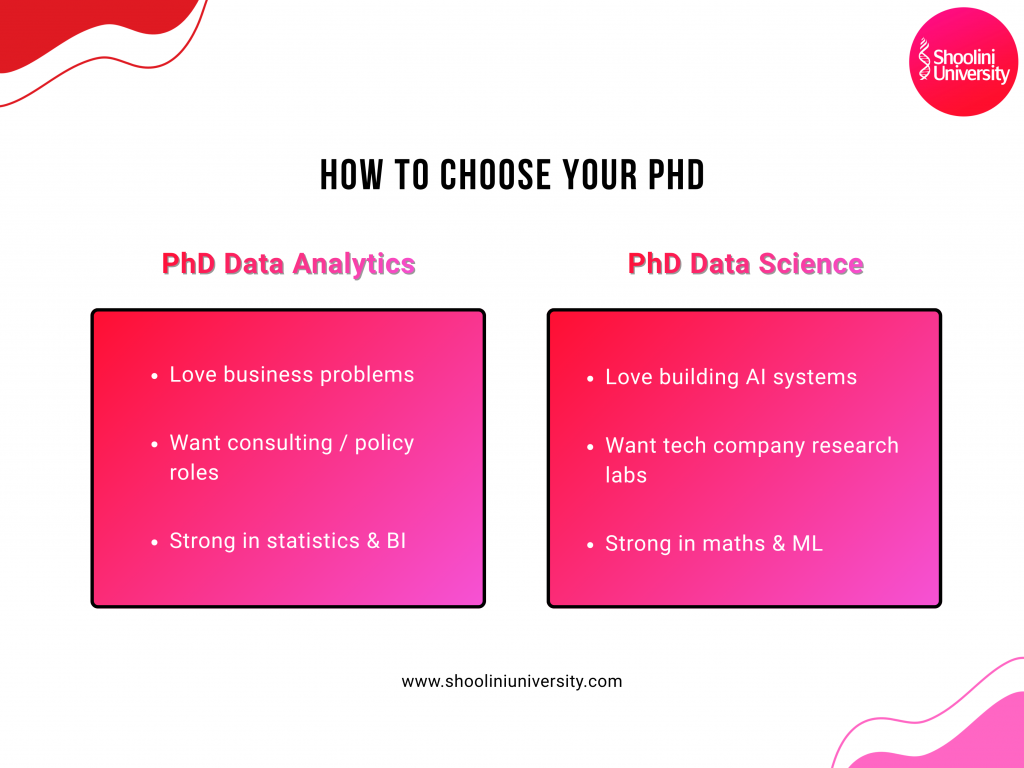
How to Choose — PhD Data Analytics or PhD Data Science?
Here’s a practical way to decide:
Choose PhD Data Analytics if:
- You want to work in business, policy, or decision-making contexts
- Your research interest lies in extracting insights from structured data
- You prefer applied research with clear, measurable outcomes
- You want to move into consulting, finance, or healthcare analytics leadership
Choose PhD Data Science if:
- You are deeply interested in machine learning, AI, and algorithm design
- You want to contribute to foundational research or build new AI systems
- You’re comfortable with advanced mathematics and theoretical computer science
- You see yourself in a tech company research lab or founding a deep tech startup
In 2026, data science is expanding faster due to the rise of AI, but data analytics remains a strong, stable option — the right choice depends on your strengths and long-term goals.
Most importantly, don’t choose based on salary alone. A PhD is a 3–5 year commitment. The research area needs to engage you genuinely, or you won’t finish it.
Challenges of Pursuing a PhD in Data Science or Analytics
The doctoral path is not linear — and most students underestimate this going in.
Research takes longer than expected. Even well-defined problems hit dead ends. Building resilience into your plan matters as much as building your methodology.
Publication pressure is real. Most universities require peer-reviewed publications before thesis submission. Starting to publish early — even at conferences — is a strategic advantage.
Industry vs academia tension. Many PhD students get lucrative industry offers mid-program. Deciding whether to complete the degree or exit early with an M Phil or equivalent requires careful thought about your long-term goals.
Supervision matters more than the university brand. A strong, active research supervisor in your specific area will do more for your career than the name on your degree certificate.
Research Infrastructure for PhD Data Science and Data Analytics
Shoolini University is ranked No. 3 in Engineering in the Times Higher Education World University Subject Rankings — and its doctoral programs reflect that research focus.
Both Shoolini University PhD Data Science and Shoolini University PhD Data Analytics are offered through a research ecosystem built for depth and outcomes. Students have access to 11 Centres of Excellence and 104+ state-of-the-art laboratories, including the AI and Futures Centre and the XR and AI Research Centre — infrastructure that directly supports advanced data research. Now, the university also has a robotics centre on campus in collaboration with Sirena Technologies.
The One Student One Patent Policy is particularly relevant at the doctoral level, where original contributions are the foundation of the degree. Students are actively encouraged to convert research into intellectual property. The Shoolini University’s Intellectual Property Rights Office (SIPRO) helps them in the process.
Faculty mentorship comes from professionals with experience at NIH, NCI, Berkeley, UPenn, Stanford, Oxford, IISc, IITs, and IIMs — giving PhD scholars access to supervision that spans both academic rigour and real-world application.
Shoolini also offers 250+ international exchange opportunities, helping doctoral students build global research networks. Collaborations with IIT Kanpur, Punjab Engineering College, and Ikigai Lab open up interdisciplinary research pathways that strengthen both analytics and data science work.
Merit-based scholarships are available, making doctoral-level education more financially accessible for deserving candidates.
For students seeking the best university for PhD Data Science in India, Shoolini’s combination of infrastructure, faculty depth and publication support makes it a strong contender.
Conclusion
Choosing between a PhD in Data Analytics and a PhD in Data Science depends on what truly interests you. Both fields offer strong career opportunities, good salaries, and the chance to work on meaningful, real-world problems. What matters most is picking a path that keeps you curious and motivated for the long journey of research.
If you are passionate about building a career in this space, finding the right university is just as important as choosing the right field. With its strong research culture, experienced faculty, modern labs, and global exposure, Shoolini University provides a supportive environment where PhD scholars can truly grow and succeed.
Sources:
- UpGrad — Data Scientist Salary India: https://www.upgrad.com/blog/data-scientist-salary-india-freshers-experienced/
- Taggd — Data Science Jobs India 2026: https://taggd.in/blogs/data-science-jobs/
- Cambridge Infotech — Data Science vs Data Analytics Career Guide: https://cambridgeinfotech.io/data-science-vs-data-analytics-career-guide/
FAQs
Q1. Which PhD is better for industry roles — Data Analytics or Data Science?
PhD Data Science leads to higher-paying research roles in AI and tech companies, while PhD Data Analytics is better suited for senior business-facing roles in consulting, finance, and healthcare.
Q2. Can working professionals pursue a PhD in Data Science or Analytics?
Yes — many universities, including Shoolini, offer flexible and part-time doctoral programs designed for professionals who want to continue working alongside their research.
Q3. Do PhD graduates get roles outside academia?
Absolutely — PhD graduates in data fields are actively hired by tech companies, research labs, consulting firms, government organisations, and AI startups for senior and leadership roles.
Q4. How long does a PhD in Data Science or Analytics take in India?
Typically 3–5 years, depending on the research area, publication requirements, and whether you're pursuing it full-time or part-time.
Q5. Does Shoolini University offer interdisciplinary research opportunities in these PhD programs?
Yes — through collaborations with IIT Kanpur, Ikigai Lab, and Punjab Engineering College, students can pursue research that crosses disciplines, including AI, biotech, engineering, and business analytics.
Q6. Is publication mandatory during the PhD?
At most Indian universities, at least one peer-reviewed publication is required before thesis submission — making it important to start engaging with research output early in the program.