


Biomedical engineers combine knowledge of the human body with engineering to develop medical devices, improve diagnostic tools and solve problems in patient care. In India, investment in health research and medical technology is creating scope for this work.
On 15 July 2026, the Government of India launched Phase III of the Biomedical Research Career Programme (BRCP) with a total budget of ₹1,500 crore. The Department of Biotechnology is contributing ₹1,000 crore and the UK-based Wellcome Trust ₹500 crore. The funding will support fellowships, research grants and team-based research in health science.
India’s medical devices market was worth USD 15.2 billion in 2025. It is expected to reach USD 50.1 billion by 2030, according to a report by Rubix Industry Insights. Yet India still imports 70 to 80% of the medical devices it uses.
Developing and manufacturing more of these devices in India requires biomedical engineers with skills in design, testing and clinical applications. This blog explains the biomedical engineering career paths you can work towards by studying the subject after Class 12, the skills you need, the jobs you can get and what to check before choosing a course.
What Is Biomedical Engineering?
Biomedical engineering applies engineering principles to medicine and healthcare. Biomedical engineers design, build, test and maintain the machines, devices and software that doctors and patients use. Examples include an MRI scanner, a pacemaker, an artificial knee and a blood sugar monitor.
How Does Biomedical Engineering Connect to Healthcare?
Doctors use medical technology to diagnose conditions, plan treatment and monitor recovery. Biomedical engineers work with healthcare professionals to develop these tools and keep them safe and reliable.
When a patient gets an ECG, the machine records the heart’s electrical activity. Clinical engineers help manage and maintain hospital equipment, including ventilators used in intensive care. When a person loses a leg in an accident, a rehabilitation engineer can help develop or adapt a prosthetic limb to support their mobility.
This work forms part of the wider field of healthcare engineering. Whether based in a hospital, a research lab or a manufacturing facility, biomedical engineers contribute to the technology used in patient care.
Why Are New Jobs Opening Up in This Field?
India is supporting domestic medical device manufacturing through the National Medical Devices Policy and the Production Linked Incentive (PLI) scheme. Growth in manufacturing creates demand for engineers in design, testing and quality control.
BRCP Phase III will support scientists, clinician researchers, public health experts and research managers. According to the Wellcome Trust, this phase will place greater emphasis on teams working across disciplines to turn lab findings into healthcare solutions. Biomedical engineers can contribute expertise in medical technology, device development and testing.
Healthcare providers are also adopting technologies such as AI-assisted scan analysis, wearable heart rate monitors, continuous glucose monitors and 3D-printed custom implants. Engineers help develop and test these technologies, assess their safety and support their use in patient care.
The demand is global as well. The US Bureau of Labor Statistics projects employment of bioengineers and biomedical engineers to grow 5% between 2024 and 2034, faster than the average for all occupations. These developments are shaping the biomedical engineering future across manufacturing, research and clinical practice.
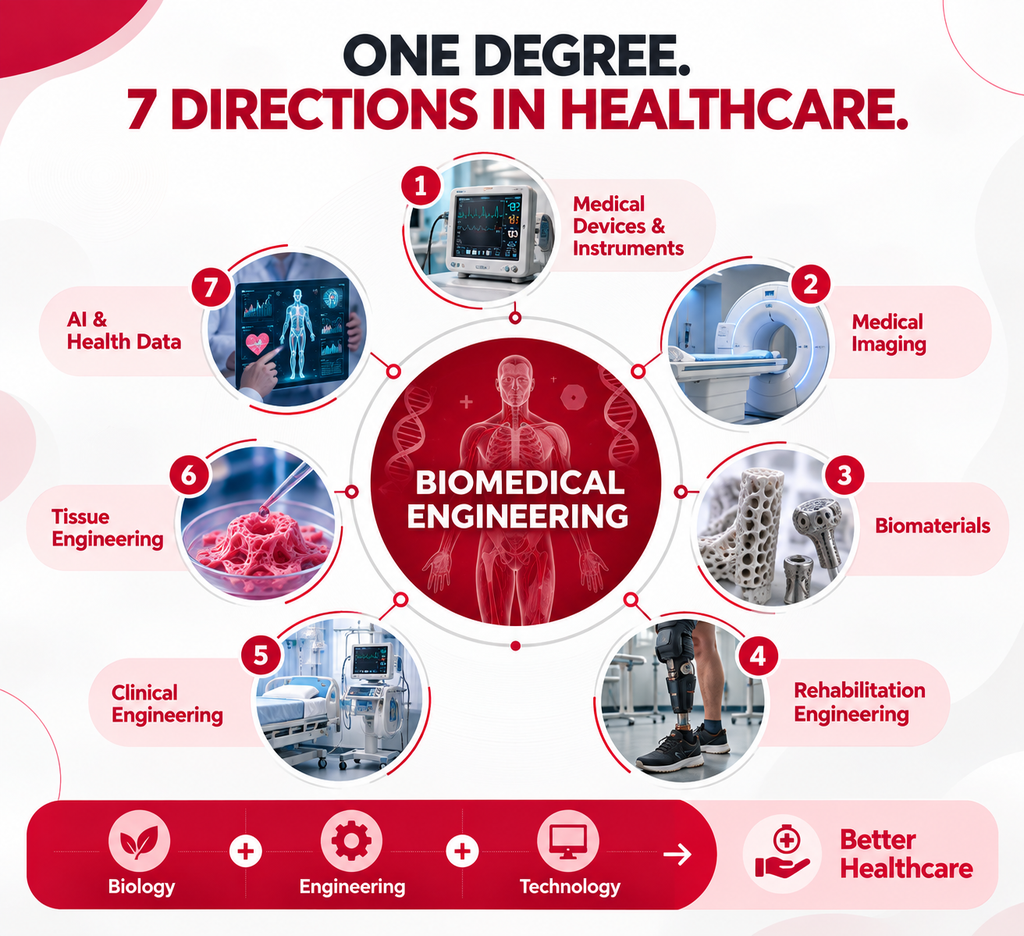
What Are the Main Biomedical Engineering Specialisations?
Medical imaging focuses on technologies that produce images of the inside of the body, including MRI, CT, X-ray and ultrasound systems. Engineers work on imaging equipment and software that processes and analyses the images.
Biomaterials focuses on developing materials that can interact safely with the body. Applications include implants, stents, artificial joints and wound dressings.
Medical devices and instrumentation covers the design and development of equipment such as ECG machines, ventilators, infusion pumps and patient monitors.
Rehabilitation engineering focuses on technologies that support people with injuries or disabilities. These include prosthetic limbs, wheelchairs, assistive communication tools and hearing devices.
Clinical engineering involves managing medical equipment in healthcare settings. Engineers help select, evaluate and maintain equipment used in wards, ICUs and operating theatres.
Tissue engineering combines cells, biomaterials and engineering methods to develop tissue substitutes. Researchers aim to repair or replace damaged tissue, including skin and cartilage.
AI and health data involves developing software that analyses medical images and patient data to support diagnosis, treatment decisions and patient monitoring.
What Biomedical Engineer Job Roles Can You Get?
Biomedical engineer job roles span product development, research, hospital equipment management, regulatory compliance and technical support. The roles open to you depend on your qualifications, technical skills and experience. Research positions may require postgraduate study.
Roles in Design and Research
Biomedical Design Engineer: Designs new medical devices and improves existing products, from early prototypes to testing. Employers include medical device companies and R&D centres.
Biomaterials Developer: Develops and tests materials for implants, wound care products and other medical applications. Employers include research laboratories and medical device manufacturers.
Biomedical Research Scientist: Investigates healthcare problems and evaluates new technologies, materials or methods. Employers include universities, research institutes and industry R&D teams.
Roles in Hospitals and Rehabilitation
Clinical Engineer: Helps select, manage and maintain medical equipment, with responsibility for its safety and performance. Employers include hospitals and healthcare chains.
Medical Imaging Engineer: Installs, tests, maintains and troubleshoots imaging equipment such as MRI and CT systems. Employers include equipment manufacturers, service providers, hospitals and diagnostic centres.
Rehabilitation Engineer: Develops or adapts assistive devices to meet users’ mobility and daily living needs. Employers include rehabilitation centres, research organisations and assistive technology companies.
Roles in Safety, Regulatory Compliance and Support
Regulatory Affairs Specialist: Prepares technical documentation and coordinates submissions required for medical device registration or approval. Employers include medical device companies and regulatory consultancies.
Quality Assurance (QA) Engineer: Develops and monitors processes that help medical devices meet quality and safety requirements. Employers include medical device manufacturers.
Application Specialist: Demonstrates medical equipment and trains healthcare professionals to use it correctly. Employers include medical device manufacturers and distributors.
How Much Do Biomedical Engineers Earn in India?
Starting salaries in this field are modest. According to PayScale India, the average base salary for a biomedical engineer is about ₹3.47 lakh a year in 2026. Early career engineers earn about ₹3.06 lakh a year on average. The top 10% earn close to ₹9.86 lakh a year.
Pay goes up with experience and a clear specialisation. Engineers who move into medical imaging, regulatory affairs or R&D at large device companies usually earn more. A master’s degree such as an M Tech or MS also helps.
What Biomedical Engineering Skills Do You Need?
- Biology basics. You need to know how the heart, brain, bones and muscles work.
- Maths and physics. These help you understand how machines and signals behave.
- Electronics. Most medical devices run on circuits and sensors.
- Coding. Python and MATLAB are common for data analysis and device software.
- Design software. CAD tools help you draw and test a device before it is built.
- Knowledge of rules and standards. In India, medical devices are regulated by the Central Drugs Standard Control Organisation (CDSCO).
- Clear communication. You will often explain technical ideas to doctors and nurses.
Is This Course Right for You?
This course may be a good fit if you:
- Enjoy biology, physics and maths
- Like building things and figuring out how they work
- Want to develop technology used in healthcare
- Are willing to learn programming and data analysis
- Enjoy practical work in labs and workshops
Before choosing a course, check its syllabus. Biomedical engineering combines biology with subjects such as electronics, mechanics and computing, so you should be ready to study across these areas.
Studying B Tech Biomedical Engineering at Shoolini University
Here are answers to common questions about this program.
Who Can Apply and How? B Tech Biomedical Engineering is a four-year program. You need to pass Class 12 with at least 60% marks and any three subjects from a list that includes physics, chemistry, maths, biology, biotechnology, computer science and electronics. You can apply with CUET, NEET, JEE or SAT scores, or take Shoolini’s multiple-choice entrance test.
Will You Get Hands-on Practice? Students train in labs with medical instruments and diagnostic tools. The university has 11 Centres of Excellence, including those focused on biotechnology, AI and nanotechnology. Under the One Student, One Patent policy, every student is encouraged to develop a patentable idea during their time at the university. Shoolini has filed over 2,000 intellectual property applications so far.
Which Companies Hire From Campus? Campus recruiters include Abbott, Biocon, Glenmark, Macleods Pharmaceuticals, LifeCell and Xcelris.
Can You Study Abroad? Students can apply for exchange programs with partner universities in the USA, UK and other countries.
How Is Shoolini Ranked? Shoolini is ranked 452nd in the world and 10th in India in the QS World University Rankings 2027. It is the No. 1 private university in India for the fourth consecutive year. In the THE World University Rankings by Subject 2026, it is No. 3 in India for Engineering and No. 3 in India for Life Sciences. It is also NAAC A+ accredited, with a CGPA of 3.33 on a 4-point scale.
Conclusion
Healthcare in India needs more machines, more devices and more research. It also needs trained people to develop the equipment and carry out the research. Biomedical engineering prepares you for this work by combining biology, electronics and coding.
Starting pay can be modest, but specialist skills and experience can widen your career options. You can design devices, manage and maintain hospital equipment, work in research or help get new products approved.
For more details, click here. https://shooliniuniversity.com/
Sources
FAQs
Q1. Is biomedical engineering a good career choice in terms of job growth?
Yes. India's medical devices market is expected to grow from USD 15.2 billion in 2025 to USD 50.1 billion by 2030. Globally, the US Bureau of Labor Statistics expects biomedical engineering jobs to grow by 5% between 2024 and 2034, which is faster than average.
Q2. What is biomedical engineering, and how does it relate to healthcare?
Biomedical engineering uses engineering to solve health problems. Biomedical engineers design and maintain the machines, devices and software that hospitals use, such as MRI scanners, pacemakers, ventilators and artificial limbs.
Q3. What are the emerging fields in biomedical engineering?
Growing areas include AI in medical imaging, wearable health devices, 3D-printed implants, tissue engineering, rehabilitation engineering and health data analysis.
Q4. What skills are important for a career in biomedical engineering?
You need a good base in biology, maths, physics and electronics. Coding in Python or MATLAB, CAD design, knowledge of device regulations and clear communication with doctors are also important.