


Physics helps us understand how the world works. We use mathematics to write the rules of nature, and experiments to see them in action. But not everything in the universe is easy to calculate or easy to test. Some systems — like storms on the Sun, billions of stars in a galaxy, or thousands of atoms inside a new material — are far too complex for simple formulas. Others are too dangerous, too expensive, or simply impossible to recreate in a real laboratory.
This is where computational physics becomes important. Computational physics blends physics, mathematics, and computer programming to create digital models of real-world systems. These models follow the actual laws of physics, but computers do the heavy calculations.
In a way, it creates a virtual lab — a place where we can experiment safely on a screen. We can zoom into the tiniest particles, fast-forward the motion of planets for millions of years, or change physical conditions to see what might happen.
Thanks to these abilities, computational physics has become one of the most important tools in modern science. In this blog, let’s see how this powerful field is changing the way we learn, experiment, and build the future — and how students in India, including at Shoolini University, can become part of it.
Why It Matters — What Computational Physics Lets Us Do
Explore What’s Otherwise Unreachable
Stars, galaxies, black holes: With computational astrophysics (a branch of computational physics), scientists simulate how stars form, how galaxies evolve, how matter behaves near black holes — situations impossible to recreate in a lab.
Atoms and materials: At these tiny scales, we can simulate interactions of atoms, molecules, or electrons to predict how a new material might behave — even before we build it. This helps design new materials and semiconductors, and understand quantum-level behaviour.
Simulate Complex Systems — Fluids, Plasmas, Weather and More
Some systems — fluids flowing in a river, gases swirling in space, plasma inside stars, or climate patterns on Earth — are extremely complex. Computational physics lets us approximate and simulate them. Methods such as ‘mesh-free’ approaches (for example, Smoothed Particle Hydrodynamics, or SPH) are used to model fluids and gas flows, even when shapes and interactions are complex.
Similarly, in plasma physics (the study of charged particles and electromagnetic fields), computational methods such as the Particle-In-Cell (PIC) method allow researchers to track individual particles under forces — something nearly impossible by hand.
Because of this, computational physics is essential across fields ranging from astrophysics and cosmology to materials science, climate science, fluid dynamics, nuclear physics, and more.
What Computational Physics Has Helped Discover or Build
Here are a few concrete examples of computational physics at work today — this helps show the ‘real science’ behind the idea.
- Evolution of galaxies & cosmic structures: Scientists use computer simulations (called Nbody simulations) to model how thousands or millions of stars and dark matter particles interact under gravity over billions of years. This helps us understand how galaxies form, evolve, collide, or even how clusters of galaxies behave.
- Star formation, supernovae, and other extreme astrophysical phenomena: Using computational astrophysics, researchers simulate gas clouds collapsing into stars, or massive stars exploding as supernovae, including effects like gravity, fluid flow, magnetic fields, radiation, etc. Without computers, solving such complex multi-physics problems would be impossible.
- Material and atomic-scale simulations: To know how a new material behaves — its strength, conductivity, behaviour under stress or temperature — scientists simulate atomic-level interactions. Computational solid state physics (or condensed-matter simulations) uses techniques similar to chemistry but at scale, helping design semiconductors, new alloys, or nano-materials.
- Fluid flows, weather, environmental physics: For fluid dynamics (the flow of air, water, and gases) or for studying environmental systems, computational physics helps simulate flows, turbulence, and gas mixing — problems difficult to solve otherwise. SPH and other numerical fluid methods are used here.
- Bridging theory and experiment — virtual testing: Sometimes, performing a real experiment is too costly, dangerous, or slow. Instead, by building a computer model and simulating the system, scientists can test hypotheses, explore variations, and narrow down what’s worth doing in a real lab. This saves time and costs and allows exploration of extreme conditions.
What Computational Physics Means for Students & Future Scientists
If you study physics — for example, via BSc (Hons), MSc, or plan for a PhD — then learning computational physics adds several advantages:
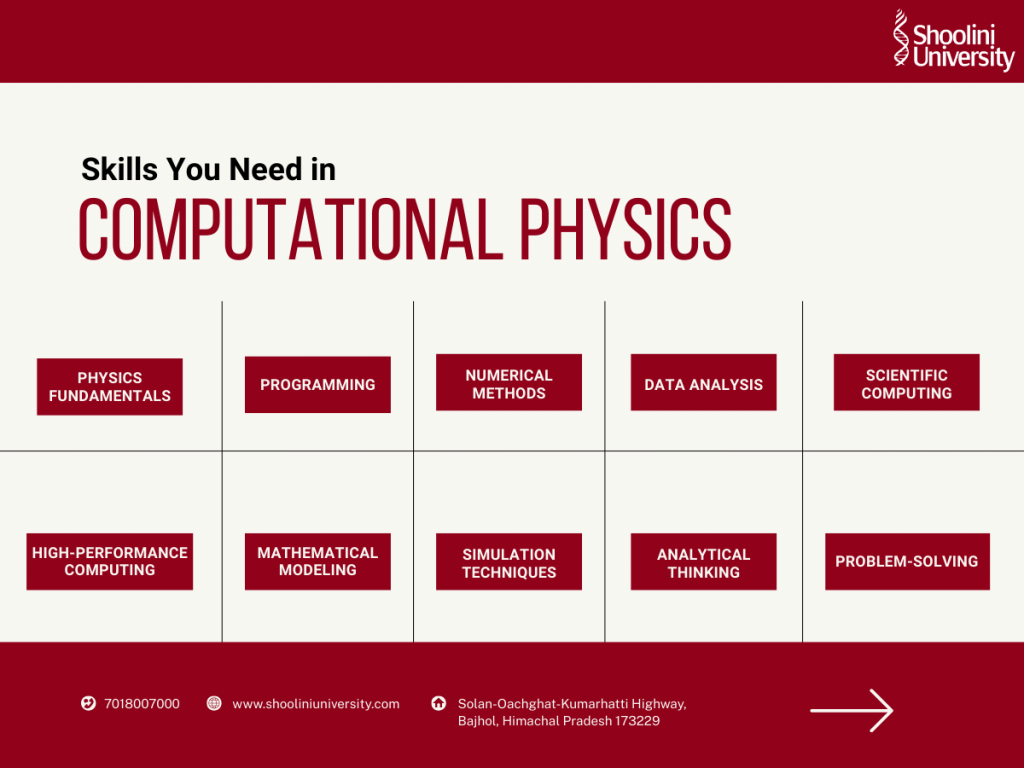
- You get a robust tool-set: Math + physics + coding + simulations = ability to tackle modern problems. You’re not limited to ‘textbook-only’ or ‘theoretical-only’ physics. You can simulate real systems — materials, stars, fluids — and test ideas yourself.
- You become valuable for many fields: astrophysics, materials science, engineering, climate science, environmental studies, technology research, etc.
- You learn problem-solving in a practical, hands-on way: building models, adjusting parameters, running simulations, and analysing results. That’s often more rewarding than only solving pencil-and-paper problems.
In short: for someone passionate about science, computational physics turns physics into a living, dynamic, and deeply relevant subject.
Why & How Computational Physics Keeps Evolving
Because of its power and flexibility, computational physics continues to advance — thanks to better computers, smarter algorithms, and new computational methods. Actually, the growth of high-performance computing (HPC) has played a central role: more computing power means larger simulations, more particles, finer details, and longer timescales.
At the same time, researchers continue to improve numerical methods, simulation techniques (such as SPH, PIC, N-body, and fluid solvers), and tools. That means more accurate, realistic simulations in less time.
As computing becomes more accessible and software gets better, computational physics is no longer restricted to elite labs — it becomes more widely usable. For students, this means more opportunities to contribute, even from universities or small research groups.
Why Study Physics & Materials Science at Shoolini University?
Shoolini University is the No.1 Private University in India as per QS World University Rankings and No.2 Private University in India by Times Higher Education World University Rankings. Not only that, Shoolini is also the No.1 Research University in Asia by QS World University Asia Rankings.
Shoolini University’s Faculty of Science is a place where learning and discovery go together. The university has filed over 1800 patents, showing its strong focus on innovation. Students get to learn from scientists who have worked or trained at leading institutions like Oxford, NIH, IISc, and top universities in the USA and Europe. Many Shoolini researchers are also among the top 2% scientists in the world, as listed by Stanford University.
Shoolini provides research exposure right from the undergraduate level. With 104+ high-tech laboratories and 11 Centres of Excellence, students gain practical experience in advanced fields such as nanotechnology, solar energy, green chemistry, molecular biology, sensor technology, and more. This hands-on learning has helped Shoolini emerge as one of the best universities for science in India.
When it comes to Physics and Materials Science, Shoolini is a strong and future-focused choice.
The programs that the School of Physics and Materials Science offers include: BSc (Hons) Physics, MSc Physics, MSc Physics Research, PhD Material Science, and PhD Physics.
The school also has DRDO, DST, and DAE-supported laboratories, where students work on cutting-edge materials including nanofibers, ceramics, solar-cell materials, and healthcare sensors. Students here also perform well in national exams such as the CSIR-NET, and many secure Junior Research Fellowships (JRFs) to support their research careers.
Apart from this, the faculty members provide excellent academic training in areas like Electronics, Electrodynamics, Nuclear physics and Computational physics (a growing modern field).
Shoolini University also provides:
- Global collaborations with top universities in the USA, UK, Italy, China, South Korea, Turkey, Taiwan, and more
- Research opportunities for both bachelor’s and master’s students
- Early research training to help young learners become future scientists
Rankings That Build Trust
- No. 1 in India for Physical Sciences — Times Higher Education (THE) World University Subject Rankings 2025
- 137th Globally — THE Interdisciplinary Rankings
- 10th in India — THE Interdisciplinary Rankings
These rankings show how well the university performs in science and research, and how strong its global reputation has become.
Final Thoughts
Computational physics doesn’t replace theory or experiments. It connects the two — helping theory handle real-world complexity and allowing experiments to be tested virtually first. For students and aspiring scientists, understanding and using computational physics opens up a new world: one where equations become simulations, and imagination turns into virtual reality — letting you explore, predict, and maybe contribute to real scientific breakthroughs. So what are you waiting for? Join Shoolini and be a part of this exciting field now.
Sources: