


We sit for longer than we used to. We spend more time on screens, sleep at irregular hours, and carry work stress home. India also faces a high burden of chronic disease. A national study by the Madras Diabetes Research Foundation and ICMR, published in The Lancet Diabetes & Endocrinology in 2023, estimated that India had 101 million people with diabetes, 136 million with prediabetes and 315 million with high blood pressure in 2021.
People turn to yoga for exercise and spiritual practice, but also for stress, stiff backs, low mobility and support alongside medical care. Knowing how to practise yoga and knowing how to adapt it to someone’s health needs are two different skills. A yoga therapist needs training to assess those needs and understand the limits of their role.
If you are thinking about a yoga therapy career after Class 12, this blog covers what a yoga therapist does, where they work, what pay data is available, how certification works and what to check when choosing a college.
What Is Yoga Therapy?
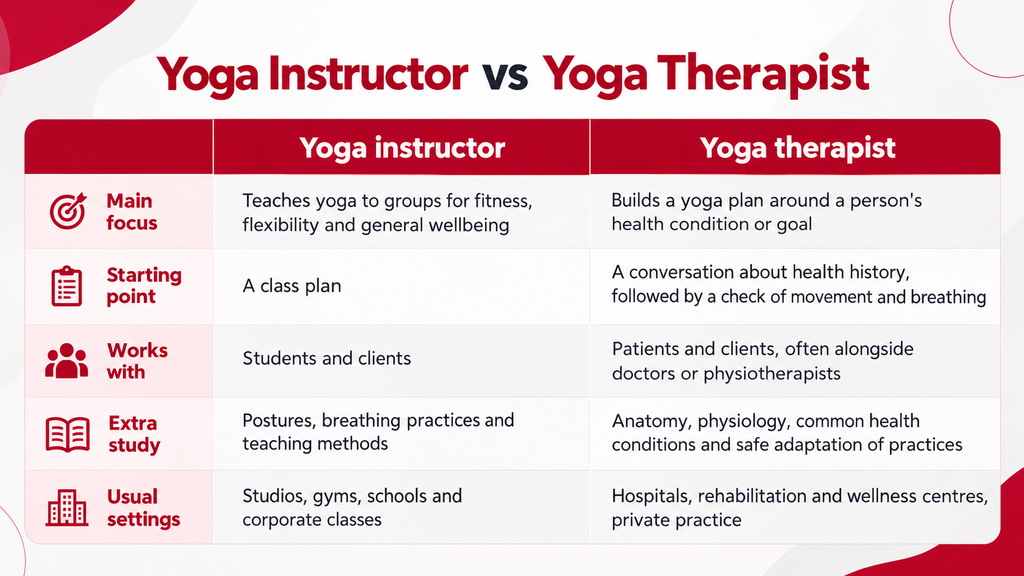
Yoga therapy uses postures, breathing, meditation and relaxation to support health. A yoga therapist builds a plan around a person’s health needs and goals and may work with their doctor or physiotherapist. It supports medical care and does not replace it.
A regular yoga class is planned for a group. A yoga therapy session starts with the person. The therapist asks about their health history, pain, sleep and daily routine, selects practices that suit them and adjusts the plan as their needs change. NIMHANS in Bengaluru began bringing yoga into clinical care in 2007, with patients referred for yoga by its physicians.
Why Are Yoga Therapists Getting More Attention?
Three factors stand out.
Health needs: India’s high prevalence of prediabetes points to a need for early intervention. An article in the National Medical Journal of India describes this as a chance for prevention if lifestyle changes are encouraged early. Yoga is relevant here because it combines movement, breathing and stress management.
Public health programmes: Ayushman Arogya Mandirs are primary care centres under Ayushman Bharat. A Rajya Sabha reply in August 2025 reported 1,78,154 operational centres and 5.79 crore wellness sessions held there, including yoga, cycling and meditation. In August 2026, the Rajya Sabha was told that 12,500 Ayush dispensaries and sub-health centres had been upgraded to Ayushman Arogya Mandir (Ayush), where yoga-related activities run alongside outpatient services.
Hospital adoption: A published review of yoga therapy in India notes that AIIMS and NIMHANS have set up yoga therapy centres. It also identifies gaps. Many people still see yoga as a wellness habit rather than clinical support, and training and certification standards are not uniform.
The wider Ayush sector, which includes yoga, grew from USD 2.85 billion in 2014 to USD 43.4 billion in 2023, according to a government statement in December 2024. That figure covers all Ayush systems, so it does not measure yoga therapy alone or establish how quickly yoga therapy jobs are growing.
Where Can Yoga Therapists Work?
Career opportunities in yoga therapy are spread across health and wellness settings. Yoga therapy jobs in India fall mainly into the six areas below.
| Setting | What the work involves |
| Hospitals and integrative medicine departments | Supporting care for conditions such as stress, pain and lifestyle disease, with referrals from doctors |
| Government wellness centres | Yoga sessions and lifestyle guidance at Ayush and primary health centres |
| Rehabilitation and physiotherapy clinics | Mobility, posture and recovery plans alongside physiotherapists |
| Corporate wellness programs | Sessions for desk related back pain, stiffness and stress |
| Private practice | One-on-one consultations, small groups and online sessions, at your own centre or a shared one |
| Research and teaching | Studies on yoga for lifestyle disease and teaching at colleges |
What Do Yoga Therapists Earn?
Reliable pay data for yoga therapists is limited, so the figures below are indicative and apply to yoga instructors and teachers.
Indeed India lists an average of ₹20,973 a month for yoga instructors, based on 82 salaries reported by February 2026. SalaryExpert puts the average yoga teacher salary at ₹3.98 lakh a year as of July 2026. It lists ₹3.16 lakh for 1 to 3 years of experience and ₹4.43 lakh for 8 or more years. Your pay depends on your city, employer, certification, and whether you work in a hospital, a studio, or your own practice.
How Do You Become a Yoga Therapist?
There is no single route, but this is a common path.
Complete Class 12: Some yoga degrees, including Shoolini’s, accept students from any stream. Check each college’s eligibility.
Take a degree in yoga: BSc (Hons) Yoga is a four-year option that covers yoga philosophy, physiology, meditation and nutrition.
Get certified: Yoga therapist certification comes from the Yoga Certification Board (YCB), established by the Ministry of Ayush. It certifies yoga therapists at levels from Assistant Yoga Therapist to Yoga Therapy Consultant. Check the YCB website for current eligibility and exam details for each level.
Add a yoga therapy specialisation: Options include postgraduate diplomas and master’s degrees in yoga therapy. Eligibility differs by institute, so read each notification before you plan.
Train under supervision: Time in a hospital or clinic teaches you to adapt practices to one patient at a time.
Because training standards vary, choose accredited programs that teach anatomy and physiology, not just postures.
What Should You Check Before Choosing a College?
When you compare the best yoga therapy colleges in India, five checks help.
- Syllabus: Does it cover anatomy, physiology and nutrition along with yoga philosophy and practice?
- Practice: Do students get regular sessions, workshops and supervised exposure?
- Research: Does the university have a research centre in yoga?
- Accreditation: Is the university NAAC-accredited, and if so, at what grade?
- Careers: Where have graduates worked, and who has started their own practice?
Studying BSc (Hons) Yoga at Shoolini University
Shoolini University is the No. 1 private university in India for the fourth consecutive year. It is ranked 452nd in the world and 10th in India in the QS World University Rankings 2027.
BSc (Hons) in Yoga is a four-year program at the Yogananda School of Spirituality and Happiness. Here is how it answers the five checks.
- Syllabus: The program covers yoga philosophy, physiology, meditation, diet and nutrition, naturopathy and the applications of yoga. Its stated objectives include understanding anatomy and physiology in relation to common ailments and designing yoga therapy programs.
- Practice: Students train through regular yoga sessions, workshops and hands-on learning.
- Research: Shoolini has a Research Centre in Yoga and the Rekhi Centre of Excellence for the Science of Happiness. The program also trains students to evaluate research on yoga philosophy and yoga therapy.
- Accreditation: Shoolini is NAAC A+ accredited, with a CGPA of 3.33 on a 4-point scale.
- Careers: Graduates have joined Decathlon, Cult.fit and Fitelo, and others have started their own yoga and wellness centres. The program lists roles in training, instruction, consultancy, research, teaching and therapy.
You need Class 12 in any stream with at least 55% marks. Admission is through CUET, NEET, JEE, SAT or Shoolini’s multiple-choice entrance test. The campus in Solan sits in the Himalayan foothills.
Conclusion
Yoga therapy asks for two things. You need to know yoga well and understand the body and the health conditions you will work with. Your degree should teach both. Pay data for yoga therapists is limited and training standards vary, so check certification and accreditation before you decide.
If yoga and health science both interest you, BSc (Hons) Yoga at Shoolini is a place to start. Admissions for 2026 are open.
Sources
FAQs
Q1. What is the career growth potential in yoga therapy?
Job data for yoga therapists alone is limited, so it is hard to put growth into a number. Whatis clear is the need and adoption. Lifestyle disease numbers are high, yoga sessions run at Ayushman Arogya Mandirs, and AIIMS and NIMHANS have yoga therapy centres. Your own growth depends on certification, specialisation, and where you work. Roles can move from practitioner to consultant, trainer or researcher.
Q2. What is the difference between a yoga instructor and a yoga therapist?
A yoga instructor teaches yoga, usually to groups, for fitness and general wellbeing. A yoga therapist plans yoga practices around one person's health condition or goal, often alongside a doctor or physiotherapist. The therapist needs extra training in anatomy, physiology and common health conditions.
Q3. What qualifications do you need to become a yoga therapist?
Most people start with a degree or diploma in yoga, such as a four-year BSc (Hons) Yoga. Next, you need certification from the Yoga Certification Board, which certifies yoga therapists at three levels, and often a postgraduate diploma or master's in yoga therapy. Eligibility varies by level and institute, so check the current notification.
Q4. What is yoga therapy, and how is it different from regular yoga practice?
Yoga therapy uses yoga practices to support a person's health, based on their condition and needs. Regular yoga practice follows a general class plan for fitness or relaxation. Yoga therapy begins with an assessment, adapts to progress, and supports medical care without replacing it.
Q5. Where can yoga therapists find job opportunities?
Yoga therapists can work in hospitals and integrative medicine departments, government wellness centres, rehabilitation and physiotherapy clinics, corporate wellness programs, and private practice. Some move into research and teaching.