


Pick up your phone and unlock it. Sit inside a car with parking sensors. Walk past a CCTV camera in a mall. Visit a hospital where scans are analysed quickly. All these things feel normal today—but they work because AI is running directly on hardware, not somewhere far away on the internet.
Earlier, AI mostly lived in servers and data centres. Today, AI has moved inside devices. This is only possible when AI software is tightly connected with the chip inside the device. That chip is designed using VLSI.
VLSI decides how fast a device responds, how much power it consumes, and how reliable it is. AI decides how smart the device behaves. When both come together, you get real-world technology that people actually use every day.
This is why the AI and VLSI career is becoming important for engineering students. This combination gives students wider career options, better industry relevance, and long-term stability across multiple sectors. So let’s study this in detail and understand why the combo is important for aspiring engineers.
AI and VLSI Are Already Part of Students’ Everyday Lives
Most students think AI is something that runs on powerful servers or fancy software. In reality, AI is already working around them, quietly, every day — because of chips designed using VLSI.
Online Exams and Face Verification
Many students have given online exams where the system checks:
- Face movement
- Eye direction
- Background noise
This is not just software. The webcam captures live video, and AI analyses it instantly. This processing cannot always depend on the internet due to delays and privacy issues. The device’s processor — designed using VLSI — handles parts of this AI workload locally, enabling the system to respond in real time.
This is a clear example of how AI models work when the hardware is designed to handle the workload locally.
Google Maps While Travelling
When students use Google Maps:
- It predicts traffic
- Suggests faster routes
- Recalculates paths instantly
Some of this processing happens on the phone itself, especially location tracking and movement detection. Phones today include chips that are designed to handle AI tasks efficiently without draining the battery. Without such VLSI-designed chips, phones would heat up quickly or slow down.
Smartphones Taking ‘Better Photos Automatically’
Students no longer manually adjust camera settings. Phones:
- Sharpen images
- Brighten faces
- Blur backgrounds
This happens the moment a photo is taken. The phone uses AI to understand the image and a dedicated chip section to process it immediately. This is one of the most common real-life examples of AI and VLSI working together — and almost every student uses it daily.
Metro Stations, Airports, and Campus Security
Face recognition and smart surveillance are now common in:
- Metro stations
- Airports
- College campuses
These systems analyse video continuously. Sending every frame to a server would be slow and unsafe. Instead, AI runs on-site using specialised chips inside cameras and control systems. This is possible only because the hardware is designed to handle AI workloads reliably for long hours.
Again, AI needs VLSI to function at scale.
Cars Students Travel In (Even Cabs)
Even budget and mid-range cars today:
- Beep when objects are close
- Show reverse camera alerts
- Warn about lane drifting
These features use sensors and cameras that send data to an onboard chip. AI analyses the data, and the chip makes decisions within milliseconds. There is no “maybe” here — delay means danger. This is why AI must run directly on hardware.
This is not future tech. Students experience this in daily travel.
How Google Used AI to Design Chips (A Turning Point)
Google publicly revealed that it used an AI system to design the layout of its own AI chips. Chip layout usually takes engineers months. The AI explored thousands of design options and completed the task in hours.
This is a turning point because:
- AI helped design better chips
- Those chips now run AI applications
This loop explains why AI and VLSI cannot be treated as separate fields.
All these examples clearly show that AI does not work alone. It works because the hardware enables it. Students who learn only AI may build models that fail on real devices. Students who learn only electronics may design chips that cannot support intelligent features.
The AI and VLSI career prepares students to work on real systems — phones, transport, security, education tech, healthcare — not just theory.
Real Industries in India Using AI + VLSI
This combination is already active across major Indian industries:
- Automobile: Companies like Tata Motors and Maruti Suzuki use AI-enabled chips for safety features, sensors, and vehicle monitoring systems.
- Healthcare: Hospitals such as Apollo Hospitals use AI-based imaging and diagnostic machines that rely on specialised hardware.
- Manufacturing: Firms like Siemens India use AI-powered machines and vision systems in factories to detect defects and improve efficiency.
These applications have increased demand for chip design jobs in India, especially for jobs where AI logic is embedded directly into hardware.
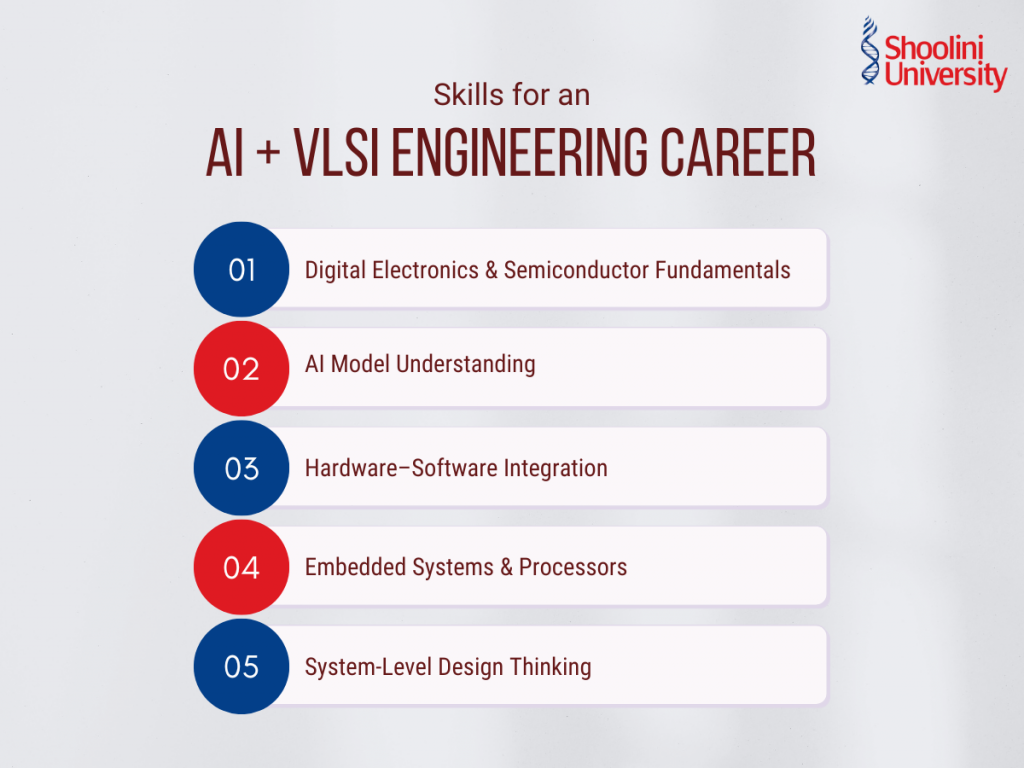
How AI and VLSI Are Already Shaping Technology Around Us
This combination of AI and VLSI is not theoretical. It is already influencing how technology is being built and discussed in mainstream news.
At global technology events like CES, companies have showcased chips explicitly designed to handle AI tasks inside real products. For instance, Nvidia recently highlighted how newer AI-focused chips are being developed to support cars, industrial machines, and consumer electronics. These chips are not general-purpose processors. They are designed to process AI workloads faster, reduce power consumption, and respond in real time — something that is only possible through advanced VLSI design.
In India, this shift is becoming visible too. The news of Indian technology firms partnering to co-develop edge AI chips — designed to process data locally within devices rather than rely on cloud servers — is gaining attention.
One such reported collaboration involves Blue Cloud Softech, which is working with an international partner to develop AI chips for use in smart cameras, industrial monitoring systems, and connected devices. This clearly shows that AI development in India is moving closer to hardware and semiconductor design.
Business news has also highlighted how rising AI adoption is directly affecting the semiconductor industry. Samsung, one of the world’s largest chipmakers, has reported increased demand for memory and advanced chips due to the growing use of AI across phones, data centres, and intelligent systems. This demand exists because AI applications need chips that can handle large amounts of data quickly and efficiently.
What all this shows is simple: AI growth is pushing companies to redesign chips, and chip design is becoming more intelligent because of AI. This is exactly where the AI and VLSI career fits in. Engineers who understand both how AI works and how chips are built are the ones who can contribute to these real, visible changes in technology.
Academic Pathways Supporting This Career
Some universities now offer integrated programs such as B Tech Artificial Intelligence with specialisation in VLSI Design, also known as B Tech AI VLSI Design, to meet industry needs.
Institutions like Shoolini University, recognised as a top engineering university in India, support this approach through interdisciplinary learning at the Yogananda School of AI, Computers and Data Science.
Studying AI and VLSI in a Future-Focused Learning Environment

When students plan a career that combines AI and VLSI, the learning environment matters as much as the curriculum. Shoolini University offers a strong academic setting for students who want to work on real technology, not just theory.
Ranked as India’s No.1 Private University by QS World University Rankings and No.2 Private University in India by Times Higher Education World University Rankings, Shoolini has built its engineering education around emerging technologies and industry needs. Set in a quiet hill campus, the university provides a focused atmosphere where students can learn, experiment, and build without constant distractions.
The university has advanced infrastructure for engineering and technology education. Its AI & Futures Centre is a dedicated space for Artificial Intelligence learning, equipped with modern labs and collaborative classrooms. Students also benefit from the XR and AI Research Centre, which houses tools such as Meta Quest 2, Irusu Play VR Plus, and Google Cardboard headsets, as well as high-performance systems for design, simulation, and research. These facilities support hands-on learning and help students understand how intelligent systems work in real-world settings.
Academic training is further supported by industry-aligned programs offered through the Yogananda School of AI, Computers and Data Science. The focus here is on building practical skills that connect software intelligence with computing systems, preparing students for roles where AI must work efficiently on real hardware.
Beyond academics, Shoolini has a dedicated Placement Cell that works closely with students from early semesters. They help students transition confidently from classrooms to professional roles in technology-driven industries.
For students planning to begin their engineering journey, Shoolini provides the right mix of academic strength, practical exposure, and career support — especially for those looking to build future-ready skills at the intersection of AI and core engineering.
Conclusion: Why This Combo Works for Students
Technology today is judged by how well it performs in real life. AI without the right hardware fails. Hardware without intelligence limits innovation.
The AI and VLSI career helps engineering students work on products that actually reach people. It offers flexibility across industries, protects against short-term trends, and builds skills that remain useful for years. So, if you are also interested in making a mark in the world of AI and VLSI, Shoolini University is the place for you.
FAQs:
1. Who should consider choosing a specialisation in AI and VLSI?
Students who are interested in future technologies, want to work in innovation-led industries, and enjoy solving real-world engineering problems can choose this specialisation.
2. How is AI and VLSI a better option than a traditional engineering degree?
It combines two fast-growing fields — artificial intelligence and semiconductor design — giving students a competitive edge over general engineering graduates.
3. Does this specialisation offer opportunities in both hardware and software sectors?
Yes. Students gain exposure to core electronics and AI-driven applications, enabling them to work in hardware, software, and interdisciplinary roles.
4. Do companies actively hire students with AI + VLSI specialisation?
Yes. The demand comes from semiconductor companies, AI startups, R&D labs, IT giants, and industries working on automation and smart devices.
5. Can students pursue research after studying AI and VLSI?
Absolutely. This specialisation opens pathways to research in chip design, automation, neural networks, semiconductor technology, and next-gen computing systems.
6. What is the future scope of AI and VLSI in India?
With India investing heavily in semiconductor manufacturing and AI innovation, the field is expected to grow rapidly over the next decade.
7. Is this specialisation suitable for students who are unsure about their career path?
Yes, because it keeps multiple career choices open — AI, electronics, data, automation, embedded systems, and chip design.
Sources:
- https://timesofindia.indiatimes.com/business/international-business/from-chips-to-cars-ai-dominates-ces-2026-as-nvidia-ceo-jensen-huang-takes-centre-stage/articleshow/126342741.cms
- https://timesofindia.indiatimes.com/technology/tech-news/blue-cloud-softech-signs-150m-deal-with-israeli-firm-to-co-develop-edge-ai-chips-in-india/articleshow/125086626.cms
- https://timesofindia.indiatimes.com/technology/tech-news/samsung-forecasts-record-q4-profit-as-ai-driven-chip-demand-lifts-prices/articleshow/126419977.cms
- https://markets.financialcontent.com/wral/article/tokenring-2025-10-10-semiconductor-sector-powers-towards-a-trillion-dollar-horizon-fueled-by-ai-and-innovation