

A BA Journalism and Mass Communication degree can give you many skills that successful content creators use every day: researching a topic, asking better questions, writing clearly, interviewing people, checking facts and turning infor mation into a story. But a degree alone will not build your audience, teach you how Instagram or YouTube recommendations work, or turn your first video into a viral hit. Those are skills you develop by creating, publishing and learning from what your audience responds to.
Look at creators such as Ravish Kumar, Faye D’Souza and Barkha Dutt. Their careers show how journalism skills can move beyond television and newspapers into independent digital platforms. At the same time, Raj Shamani shows how interviewing and research can become the foundation of an entirely different kind of digital career.
So, can studying journalism help you become a content creator? Yes. But the more useful question is: what does journalism teach you that you can actually use as a creator?
What Does a BA Journalism and Mass Communication Degree Teach You?
Journalism begins with a simple problem: you have to tell people something they do not know and make sure it is accurate.
A journalism student might be asked to cover a campus event. That means finding the people involved, asking questions, recording useful quotes, checking facts and deciding what information belongs in the final story. The same process can apply to a YouTube video about a new education policy, an Instagram Reel explaining a current issue or a podcast with a startup founder.
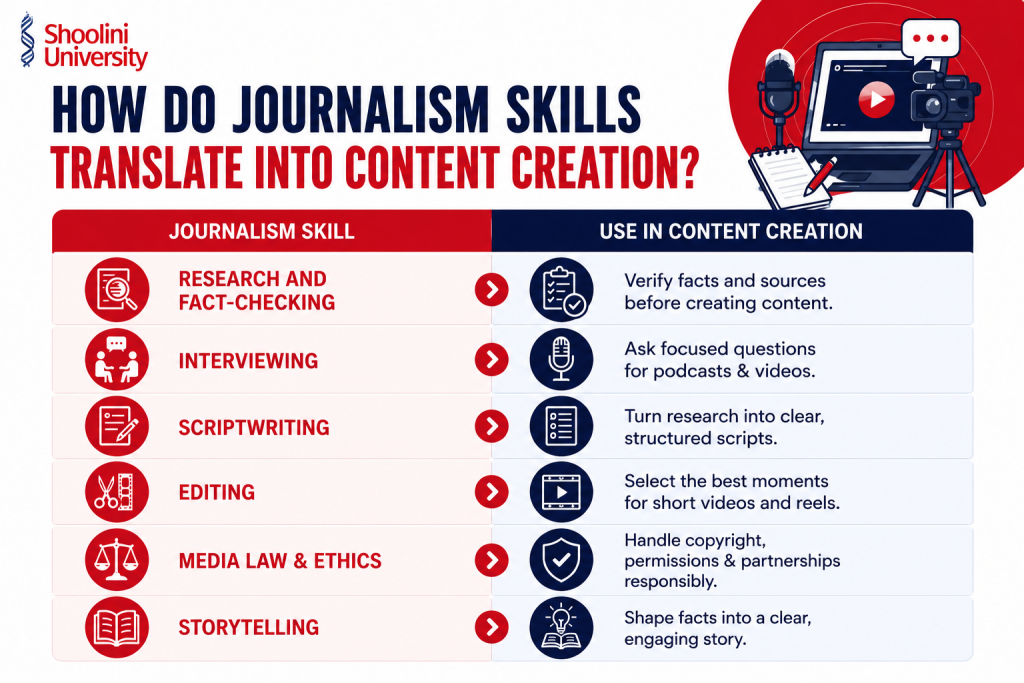
A BA Journalism and Mass Communication course typically develops skills such as:
- Reporting and research: Finding information, checking sources and identifying what is relevant to a story.
- Writing and editing: Adapting a story for different formats, from articles and news reports to scripts and digital content.
- Interviewing: Preparing questions, listening carefully and asking useful follow-up questions instead of simply reading from a list.
- Multimedia production: Working with video, audio, photography and digital platforms.
- Media law and ethics: Understanding copyright, defamation, attribution, privacy and responsible reporting.
- Practical training: Learning through assignments, internships, newsroom exposure and production work.
The same skills support both a traditional journalism career and work in digital content creation.
Consider Faye D’Souza. Before moving into independent digital journalism, she worked in television news, including as Executive Editor of Mirror Now. Her work has covered subjects such as public policy, personal finance and civic issues, often requiring her to explain complex information clearly for wider audiences. This ability is equally valuable on YouTube or Instagram, where creators need to show quickly why a topic matters. (University of Chicago, Feminism in India)
Barkha Dutt offers another example. Her digital platform, Mojo Story, publishes interviews, podcasts, ground reports and short-form videos. It shows how reporting and storytelling skills can be adapted to a digital-first publishing model. (Mojo Story)
Then there is Ravish Kumar, who moved from television news to independent journalism on YouTube after leaving NDTV in 2022. His career shows how an established journalist can retain a distinct reporting style and relationship with the audience while publishing through a platform they control more directly. (Reuters)
What Content Creator Jobs Can a Journalism Graduate Pursue?
A journalism graduate can work in both established organisations and creator-led businesses.
Employment Roles
- Digital Reporter: reporting stories for websites, YouTube channels or digital news platforms.
- Video Journalist: researching, shooting and editing news or documentary-style videos.
- Content Strategist: planning what a brand or organisation should publish, who it should reach and which formats to use.
- Social Media Editor: managing daily content across Instagram, YouTube, LinkedIn or other platforms.
- Podcast Producer: researching episodes, preparing guests, developing questions and editing conversations.
- Influencer Marketing Manager: connecting brands with creators and managing campaigns, briefs and deliverables.
Independent Careers
A journalism graduate can also work independently as a:
- YouTuber
- Podcaster
- Independent journalist
- Newsletter writer
- Video creator
- Social media educator or explainer
The difference is important. A full-time content role usually comes with an employer and a salary. Independent content creation works more like a business: you are responsible for the content, audience, partnerships and income.
Is a Journalism Degree Enough on Its Own?
No — and that is actually good news.
A journalism degree can teach you how to research a story, interview a person and communicate information. You still need to learn how to build a digital audience.
Imagine two students graduating with the same BA Journalism and Mass Communication degree. One focuses only on completing assignments. The other starts a small YouTube or Instagram page while studying. They make videos, discover which topics perform better, learn basic editing, experiment with thumbnails, and gradually understand what their audience wants.
By graduation, both have the same degree. But the second student already has something the classroom cannot provide: a body of published work and experience learning from a real audience.
That is why students interested in content creation should start while they are studying, not wait until graduation.
How Does Shoolini University’s BA Journalism and Mass Communication Prepare You for Both Paths?
Shoolini University is ranked #452 globally and 10th in India in the QS World University Rankings 2027, making it the No. 1 private university in India for the fourth consecutive year.
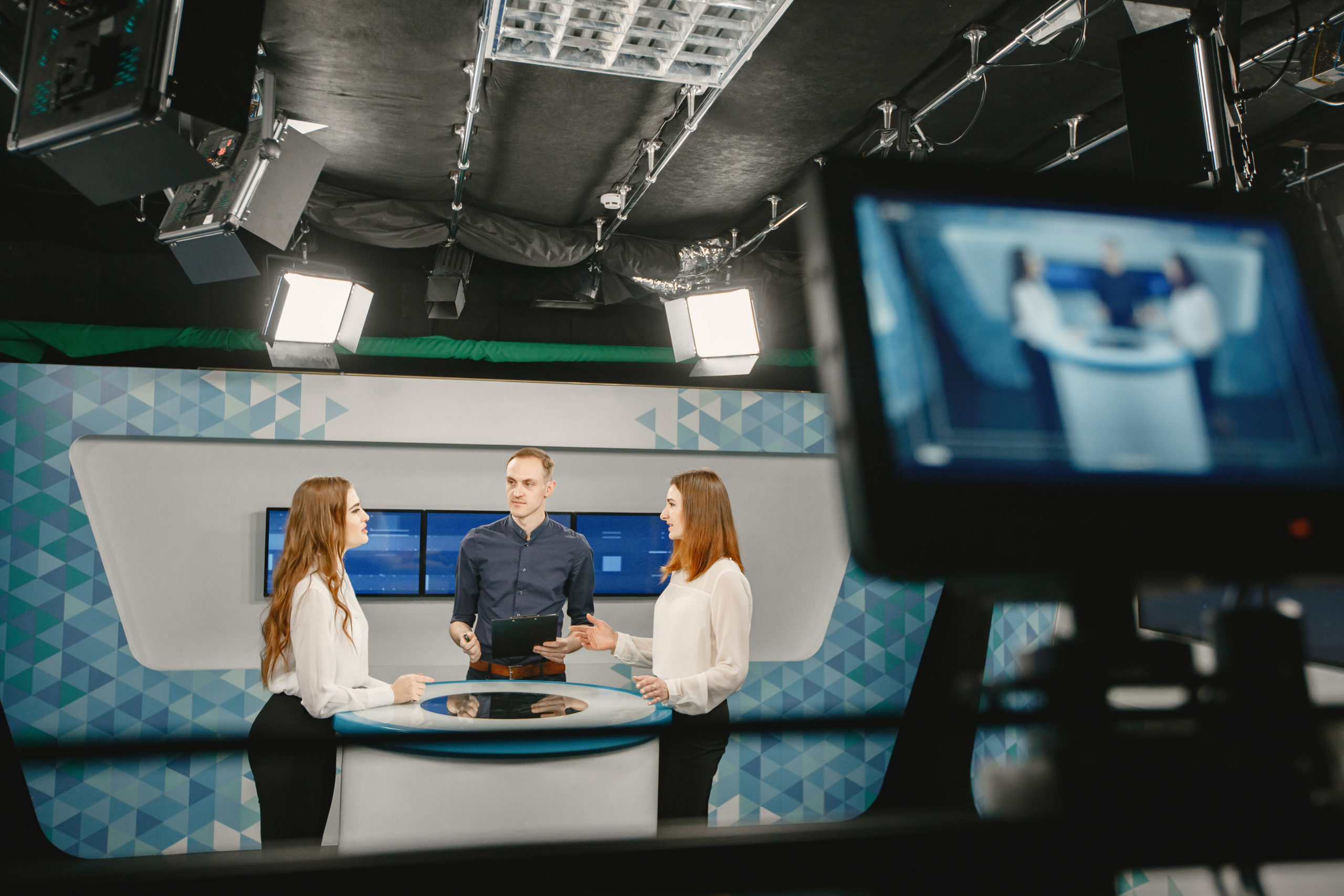
For students interested in journalism as well as digital content, the BA Journalism and Mass Communication program combines core media training with practical work across print, television, radio and digital platforms. The curriculum covers areas such as news gathering, reporting, writing, broadcasting and digital media tools.
Students contribute to the Shoolini Newsletter, where they conduct interviews, write stories and work on page layouts. Through Shoolini TV and Shoolini Samvad, they learn to write and present news, produce videos and use broadcasting equipment. Radio Shoolini gives them experience as anchors and interviewers. This work can also help students begin building a portfolio while they are still studying.
The School of Media and Communications also offers BAJMC (Hons) specialisations in Event Management and Advertising & PR. The Event Management specialisation covers event planning, team coordination, risk management, resource management and event design. Students also help organise campus events such as Creators’ Fest, Media Fest, Moksh, Manchtantra and Literature Fest.
The Advertising & PR specialisation covers advertising principles, media planning, brand management and public relations strategies. Students work on live campaigns, case studies, and practical projects that prepare them for roles in advertising, public relations, social media, and influencer marketing. For an aspiring content creator, this knowledge helps when working with brands, planning campaigns, or managing paid partnerships.
Internships and industry exposure add another layer of practical learning. Shoolini journalism and media students have interned at organisations including News18 TV, ABP, PTC Group, the Hindustan Times, The Times of India, The Indian Express, The Tribune and Dainik Bhaskar. Students learn from visiting professionals in advertising, public relations, photography, graphic design and corporate communication. Visits to newspaper offices and TV and radio stations show them how media organisations work.
They can also take part in Media Marvel Fest and Creators’ Fest. The events include media competitions, sessions with creators and discussions on technology and media careers.
For students who want to work in a newsroom, agency or media company, the program provides reporting skills, production experience and industry exposure. For those who want to build an independent YouTube channel, podcast, newsletter or social media platform, it provides regular practice in researching, scripting, presenting and publishing content.
Conclusion
A BA Journalism and Mass Communication degree will not automatically make you a successful content creator. But it can teach you many skills creators use every day, from researching and interviewing to scripting, storytelling and fact-checking.
The careers of Ravish Kumar, Faye D’Souza and Barkha Dutt show how journalism can move from traditional newsrooms into independent digital media. Raj Shamani shows how interviewing and storytelling can build a completely different digital career.
For students, the lesson is simple: learn journalism, but start creating too.
Build a portfolio while you study. Start a podcast. Make a campus video series. Interview people. Explain a subject you understand. Try a Reel, then a longer YouTube video. Learn what works and, just as importantly, why something does not work.
The degree gives you the foundation. What you build with it is up to you.
Learn more about the BA Journalism and Mass Communication program at Shoolini University and admissions for 2026.
Sources
- https://www.bcg.com/publications/2025/india-from-content-to-commerce-mapping-indias-creator-economy
- https://www.ey.com/en_in/newsroom/2026/03/india-s-media-and-entertainment-sector-grew-9-percent-to-inr-2-point-78-trillion-in-2025-driven-by-digital-and-live-experiences-ficci-ey-report
- https://www.reuters.com/world/india/critics-indias-modi-migrate-online-mainstream-media-stays-deferential-2024-04-18/
- https://global.uchicago.edu/faye-dsouza
- https://www.lemonde.fr/en/international/article/2024/05/31/india-youtube-has-become-the-last-bastion-of-freedom-of-expression_6673318_4.html
FAQs
Q1. What skills do journalism students learn that are useful for content creation?
Journalism students learn research, writing, storytelling, interviewing, editing, and communication skills that are useful for creating engaging content.
Q2. Is BA Journalism and Mass Communication a good course after Class 12?
Yes, it is a good choice for students interested in writing, media, communication, digital content, and creative careers.
Q3. Can journalism graduates become YouTubers or influencers?
Yes, journalism graduates can use their storytelling, research, presentation, and communication skills to become YouTubers or influencers.
Q4. What career opportunities are available after a journalism degree?
Graduates can work as journalists, content writers, editors, reporters, social media managers, copywriters, or digital media professionals.
Q5. What is the difference between journalism and mass communication?
Journalism focuses mainly on gathering and reporting news, while mass communication covers a wider range of communication through media such as TV, radio, digital platforms, and advertising.
Q6. Which industries hire journalism graduates?
Journalism graduates can find jobs in news media, digital media, advertising, public relations, publishing, entertainment, education, and corporate communications.