

By 2030, the world will add 170 million new jobs and lose 92 million existing ones. That is the forecast in the World Economic Forum’s Future of Jobs Report 2025, based on a survey of more than 1,000 large employers. The net gain is 78 million jobs, but there is a catch. The same report says 59 out of every 100 workers will need new training by 2030 to keep up.
If you are choosing a course after 12th, AI and future jobs should be part of that choice, because graduates will enter a job market that looks different from the one their seniors entered. This blog explains how AI is changing work, which skills employers now want, and what a university should teach to keep students ahead, using the B Tech Artificial Intelligence program at Shoolini University as an example.
Quick Answer
AI and future jobs are closely linked. AI will reduce some routine roles and create new ones in data, AI, cybersecurity, and software. Universities can prepare students by teaching AI literacy in every course, giving hands-on project work with current tools, building industry links for internships and certifications, and training the human skills AI cannot copy, such as judgement, communication, and teamwork.
How Is AI Changing the Job Market?
The impact of AI on jobs is wide, but it is not the same for every role.
In January 2024, the International Monetary Fund (IMF) estimated that almost 40% of jobs worldwide are exposed to AI. In advanced economies, the figure rises to about 60%. Exposure does not always mean job loss. The IMF found that in about half of these exposed jobs, AI is more likely to help people work faster than to replace them.
The World Economic Forum’s report shows a similar pattern. Roles like cashiers and administrative assistants are expected to shrink the most. The fastest-growing roles are big data specialists, fintech engineers, and AI and machine learning specialists. Employers also expect close to 40% of the skills needed on the job to change by 2030.
India is moving quickly too. A report by NASSCOM and Deloitte India projects that India’s AI talent pool will grow from around 6 to 6.5 lakh professionals in 2022 to over 12.5 lakh by 2027. The same report expects India’s AI market to grow 25 to 35% a year, which points to a gap between demand and supply.
The government has also stepped in. In March 2024, the Union Cabinet approved the IndiaAI Mission with an outlay of ₹10,371.92 crore. AICTE declared 2025 the “Year of Artificial Intelligence” and asked its approved colleges to plan AI courses, AI labs, and faculty training. Shoolini University’s B Tech Artificial Intelligence program prepares students for this demand, and graduates can aim for the roles in the table below.
Which AI Careers Can Graduates Aim For?
Here are eight jobs of the future in AI, with the main tasks and key skills for each.
| Role | Main Tasks | Key Skills |
| Machine Learning Engineer | Build and train models that learn from data | Python, maths, ML frameworks |
| Data Scientist | Find patterns in data to help companies decide | Statistics, Python, SQL |
| Data Engineer / Big Data Architect | Build systems that collect and store large data sets | Databases, cloud, data pipelines |
| Computer Vision Engineer | Teach machines to read images and video | Deep learning, image processing |
| NLP Scientist | Build systems that understand human language, like chatbots | Language models, Python |
| Robotics Programmer | Write code that controls robots and automated machines | Programming, sensors, control systems |
| Business Intelligence Developer | Turn company data into reports and dashboards | SQL, data visualisation |
| Automation and Optimisation Engineer | Use AI to make factories and processes run better | AI tools, process knowledge |
The tools behind every one of these roles will keep changing. A good course teaches students how to keep learning, not just how to use today’s tools.
What Skills Do Students Need in the AI Era?
Employers want two sets of skills. The first is technical. The second is human. Both matter.
Technical AI Skills for Graduates
- Programming: Python is the most common language for AI work.
- Maths and statistics: These are the base of every AI model.
- Machine learning basics: Know how models are trained, tested, and improved.
- Data handling: Cleaning, storing, and reading data is a large part of any AI job.
- Cloud tools: Most AI systems run on platforms like AWS.
Students at Shoolini can also enrol for certification through the Amazon Web Services (AWS) Academy.
Human Skills
- Analytical thinking: The World Economic Forum lists it as the top core skill employers want, with seven out of ten companies calling it essential.
- Judgement: AI tools make mistakes. Check their output before trusting it.
- Communication and teamwork: Expect to explain your work to people who do not code.
- Ethics: Understand bias, privacy, and the safe use of AI.
- Curiosity and continuous learning: Tools change every year. The habit of learning lasts longer than any one tool.
This is where AI literacy for students comes in. AI literacy means knowing what AI can do, what it cannot do, and how to use it responsibly. It is now as basic as knowing how to use a computer.
Shoolini’s One Student, One Patent policy asks every student to develop a patentable idea, which is practice in solving a problem that has no ready answer.
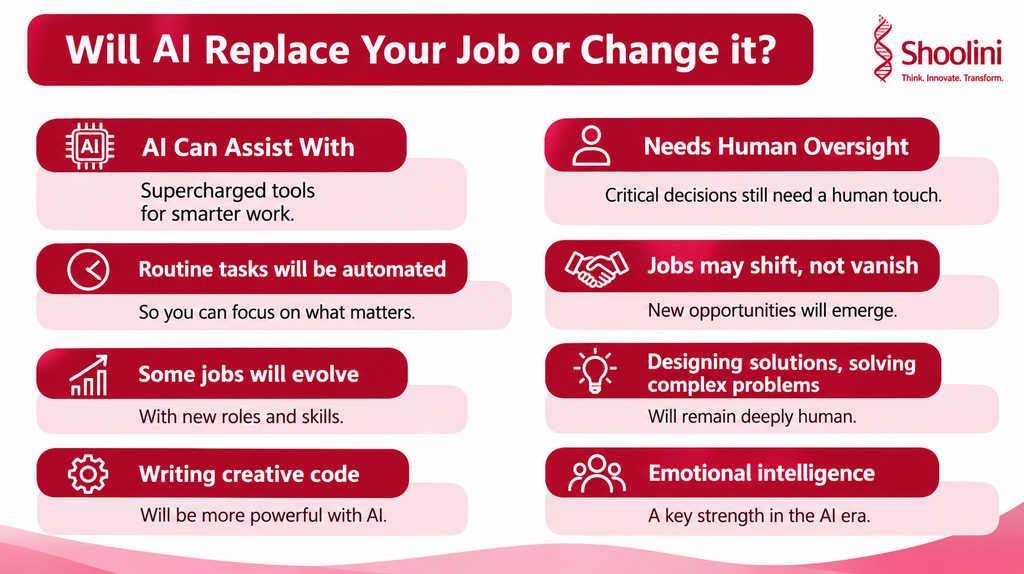
The future of work is increasingly about humans working effectively with AI.
How Should Universities Prepare Students for an AI-Driven Future?
AI in higher education is about more than adding one AI subject to the syllabus. Here are six things a university should offer. Use them as a checklist when comparing options.
AI basics in every course: Students in engineering, business, and science should all learn how AI applies to their field.
Hands-on learning: Students build projects in labs.
Industry partnerships: Links with companies bring current tools into class and open doors to internships.
Recognised certifications: Certifications from cloud and tech companies add weight to a CV.
Research exposure: Working on research and patents teaches students to solve problems with no ready answers.
Global exposure: Exchange programs and international faculty show how AI is used in other countries.
How Does Shoolini Prepare Students for AI Careers?
Shoolini University offers B Tech Artificial Intelligence (With Specialisations) through the Yogananda School of AI, Computers and Data Science. Here is how it answers the checklist above.
Is the university recognised? Shoolini is the No. 1 private university in India for the fourth consecutive year, ranked 452nd in the world and 10th in India (QS World University Rankings 2027). It is also No. 3 in India for Engineering (THE World University Rankings by Subject 2026) and joint No. 1 in Asia for Citations per Paper (QS Asia University Rankings 2027). It is NAAC A+ accredited, with a CGPA of 3.33 on a 4-point scale.
What will you study? The 4-year B Tech Artificial Intelligence program combines computer science fundamentals with AI concepts, algorithms, and applications. It includes a specialisation in Python. Students can also choose a specialisation in Smart Manufacturing, Electric Vehicles, or VLSI Design.
Is the learning hands-on? Students work in the Yogananda XR and AI Research Centre on campus. Research areas include machine learning, deep learning, robotics, natural language processing, computer vision, the Internet of Things, and AI-based health systems. As noted earlier, every student also develops a patentable idea under the One Student, One Patent policy.
Does the program have industry links? Yes. The program has a collaboration with Ikigai Lab at IIT Kanpur and industry partnerships with Algo8.AI and AADDOO.AI. AWS Academy certification, mentioned earlier, is also open to students.
Is there global exposure? Shoolini has student and faculty exchange partnerships with universities including the University of Arkansas and South Dakota Mines in the USA, Gachon University in South Korea, Taipei Medical University in Taiwan, the University of Naples in Italy, and Lanzhou University in China.
Who can apply?
| At a Glance | B Tech Artificial Intelligence |
| Duration | 4 years |
| Eligibility | 10+2 with mathematics compulsory and any two of physics, chemistry, computer science, electronics, information technology, biology, informatics practices, biotechnology, a technical vocational subject, agriculture, engineering graphics, business studies, or entrepreneurship, with at least 60% marks |
| Admission | CUET, JEE, SAT, or Shoolini University’s multiple choice entrance test |
Choosing a Degree for the AI Era
AI and future jobs will keep changing together. Some roles will fade. New ones will appear. The students who do well will be the ones who understand AI, can build with it, and can think for themselves when AI gets it wrong.
When you choose a university, look past the course name. Check for hands-on labs, industry partners, research opportunities, and certifications. These are the things that make a degree count in the job market.
Apply now at shooliniuniversity.com to secure your seat in the B Tech Artificial Intelligence program.
Sources
FAQs
Will AI replace human jobs completely?
No. AI will replace some routine tasks and roles, but it will also create new ones. The World Economic Forum expects 170 million new jobs and 92 million lost jobs by 2030, which is a net gain of 78 million.
How can universities prepare students for an AI-driven future?
Universities can teach AI basics in every course, offer hands-on lab and project work, partner with companies for internships and certifications, give research exposure, and train students in ethics and communication.
Are traditional degrees still valuable in the age of AI?
Yes. A degree still gives you strong basics in maths, science, and problem-solving. Its value grows when it also includes AI tools, practical projects, and industry exposure.
What skills should students learn to stay relevant in the AI era?
Students should learn Python, maths and statistics, machine learning basics, data handling, and cloud tools. They also need analytical thinking, judgement, communication, and the habit of learning new tools.
How is AI changing the job market?
AI is reducing demand for routine roles like cashiers and administrative assistants. It is increasing demand for big data specialists, fintech engineers, and AI and machine learning specialists. Employers expect close to 40% of job skills to change by 2030.
Are technical skills enough to get a job in the AI era?
No. Technical skills help you get started, but employers also look for analytical thinking, teamwork, communication, and the ability to check AI output. The World Economic Forum lists analytical thinking as the top core skill employers want.