


Yes, B Tech CSE Cloud Computing is worth it in 2026 — but not every graduate lands a high-paying cloud role straight out of college.
The difference is in the skills you build, the certifications you earn, and the university you choose.
Here’s everything you need to know — scope, salaries, top career paths, and what recruiters are actually looking for this year.
What Is B Tech CSE Cloud Computing?
It’s a full four-year engineering degree — not a certification course.
B Tech CSE Cloud Computing combines core Computer Science Engineering subjects. These include programming, data structures, algorithms — with specialised training in cloud architecture, virtualisation, DevOps, cloud security, and platforms like AWS, Azure, and Google Cloud.
The key subjects typically covered include Cloud Architecture & Infrastructure, Virtualisation & Containerisation, Cloud Security & Compliance, DevOps & CI/CD Pipelines, Database Management on Cloud, AI/ML on Cloud Platforms, and Serverless Computing.
This foundation is what separates a graduate who can pass a cloud certification from one who can actually design and manage enterprise-level cloud systems.
B Tech CSE Cloud Computing Scope in India — What the Numbers Say
The scope is exceptional — and backed by hard data.
NASSCOM projects that cloud computing will account for approximately 8% of India’s GDP by 2026, creating nearly 14 million jobs across the ecosystem. Cloud job openings grew 35%+ in the last two years alone, with over 100,000 active vacancies right now.
Global spending on public cloud services is projected to reach $723.4 billion by 2026, with businesses adopting AI, IoT, and edge computing driving the shift.
India’s cloud market has been growing at a 44% CAGR, outpacing global market growth rates. Every major sector — banking, healthcare, e-commerce, government, and manufacturing — is actively hiring cloud professionals. This is structural demand, not a trend.
Career After B Tech CSE Cloud Computing — Top Job Roles
A career after B Tech CSE Cloud Computing opens doors across product companies, IT services firms, startups, and MNCs. The most in-demand roles in 2026 are Cloud Solutions Architect, Cloud Engineer, DevOps Engineer, Cloud Security Analyst, Cloud Administrator, Data Engineer (Cloud), Cloud Consultant, and Site Reliability Engineer (SRE).
Top global recruiters include AWS, Microsoft Azure, Google Cloud, IBM, and Accenture. On the Indian side, TCS, Infosys, Wipro, HCL, and Tech Mahindra hire heavily in cloud roles. High-growth startups like Razorpay, Freshworks, Swiggy, and Flipkart are also major employers.
Cloud Computing Salary India — Real Numbers for 2026
| Experience Level | Role | Salary Range |
| Fresher (0–2 yrs) | Junior Cloud Engineer | ₹3.5 – ₹6 LPA |
| Mid-Level (3–6 yrs) | Cloud / DevOps Engineer | ₹8 – ₹18 LPA |
| Senior (7+ yrs) | Cloud Architect / Security Lead | ₹25 – ₹35 LPA+ |
| Certified Specialist | Solutions Architect / ML on Cloud | ₹18 – ₹40 LPA |
Freshers with AWS Cloud Practitioner or AZ-900 certification start at the higher end — ₹5–₹6 LPA versus ₹3.5–₹4 LPA without certification. A 2-year experienced professional with an Associate-level certification can command ₹8–₹12 LPA.
Adding AI/ML skills can push cloud engineering salaries up by 25–50%.
Certifications make a clear difference too—graduates with AWS Solutions Architect or Azure Administrator credentials tend to receive better offers.
Cloud Engineer Skills for Students — What Recruiters Want
Most students focus on getting the degree. Smart students focus on the skills that get them shortlisted.
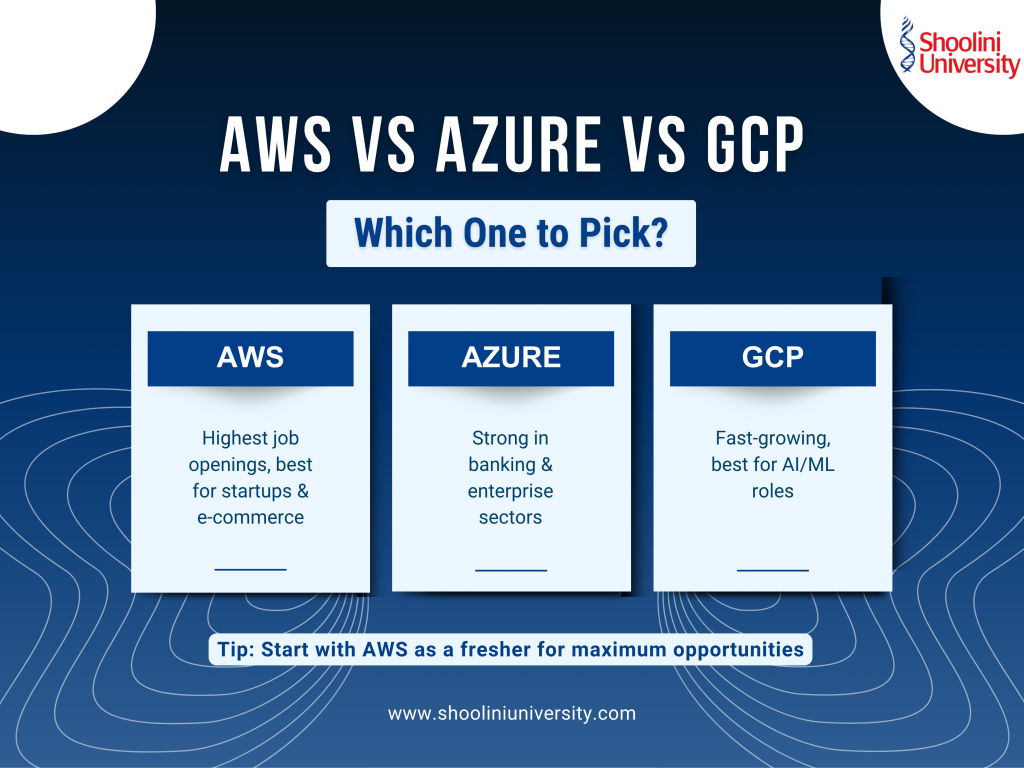
Technical skills that matter: cloud platforms (AWS, Azure, GCP), programming in Python and Bash, DevOps tools like Docker, Kubernetes, and Terraform, networking fundamentals, cloud security (IAM, encryption, compliance), and database management on cloud.
Soft skills are equally important — problem-solving, communication with non-technical teams, and the ability to learn fast as cloud tools evolve constantly.
Certifications worth targeting during your cloud computing degree: AWS Cloud Practitioner in Year 2, AWS Solutions Architect Associate or AZ-900 in Year 3, and a professional-level certification by Year 4.
Challenges of a Cloud Computing Career
The field changes fast. AWS and Azure release updates constantly — continuous learning is not optional.
Hands-on experience beats certifications alone. Recruiters can tell the difference between someone who has read documentation and someone who has actually deployed a cloud application. Build real projects, host them on GitHub, and document what you built.
Competition at the entry level is real. Your differentiators are certifications, internship experience, and a visible project portfolio — not just your degree.
How Shoolini University Prepares You for B Tech CSE Cloud Computing
Shoolini University is among India’s leading private universities, ranked No. 3 in Engineering in the Times Higher Education World University Subject Rankings — a reflection of its growing strength in technical education.
The Shoolini University B Tech CSE Cloud Computing program is built for the future. What sets it apart is direct access to industry platforms through collaborations with AWS, IBM, Google Digital Academy, and Bosch — meaning students work with the same tools that employers expect on Day 1.
A standout feature is Shoolini’s One Student One Patent Policy, which encourages every student to develop an idea into real intellectual property. This focus on innovation is backed by serious infrastructure — 11 Centres of Excellence, 104+ state-of-the-art laboratories, an XR and AI Research Centre, and an AI and Futures Centre for cutting-edge work in emerging technologies. The university also has a Robotics and AI centre launched in collaboration with Sirena Technologies.
Faculty bring experience from institutions like NCI, NIH, Berkeley, UPenn, Stanford, Oxford, IISc, IITs, and IIMs — giving students access to mentorship that goes well beyond standard classroom teaching.
For students looking at global exposure, Shoolini offers 250+ international exchange opportunities, helping you build perspective and networks that extend far beyond India.
On the industry and placement front, Shoolini has active partnerships with companies including L&T, Reliance Jio, Havells, Eicher, Microtek, Onida, Vardhman, and Window IT. Research and training collaborations with Ikigai Lab, Punjab Engineering College, and IIT Kanpur further strengthen real-world readiness. The university also supports students through merit-based scholarships, making this quality of education more accessible.
For Shoolini University cloud computing placements and admission details, prospective students can reach out directly to the admissions office for the latest updates on B Tech CSE cloud computing admission 2026.
Is B Tech CSE Cloud Computing Worth It in 2026?
Yes — if you’re committed to learning beyond the classroom.
The cloud computing engineering course in India has shifted from a niche option to one of the most future-proof engineering paths available. India’s cloud market is growing at 44% CAGR, NASSCOM projects 14 million cloud jobs.
AI adoption is increasing demand for cloud engineers — not replacing them. Every AI model runs on cloud infrastructure. As AI grows, more cloud engineers are needed.
The best university for cloud computing in India will give you the technical foundation, hands-on labs, and industry connections to get there. Choose carefully, build skills intentionally, and your B Tech CSE Cloud Computing degree will open doors that most engineering graduates don’t have access to.
Sources:
- NASSCOM & Oliver Wyman: https://nasscom.in/knowledge-center/publications/future-cloud-and-its-economic-impact-opportunity-india
- Futurense — Cloud Engineer Salary India 2026: https://futurense.com/blog/cloud-engineer-salary-in-india
FAQs:
Q1. Is B Tech CSE Cloud Computing better than traditional Computer Science?
It depends on your goal — if you want a focused, industry-ready career in cloud infrastructure and DevOps, this specialisation gives you a sharper edge than a general CSE degree.
Q2. Do I need coding experience before joining B Tech CSE Cloud Computing?
No — the program starts from the fundamentals, so you don't need prior coding experience to enrol.
Q3. Which industries hire cloud computing graduates the most?
Banking & fintech, e-commerce, healthcare, media & entertainment, and IT services are the biggest hirers of cloud computing graduates in India.
Q4. Can students pursue government jobs after B Tech Cloud Computing?
Yes — graduates can apply for roles in government organisations like NIC, ISRO, DRDO, and defence tech units that are actively building cloud and digital infrastructure.
Q5. What makes Shoolini University B Tech CSE Cloud Computing industry-focused?
Live collaborations with AWS, IBM, Google Digital Academy, and Bosch ensure students work on real industry tools, backed by the One Student One Patent Policy and 104+ laboratories.
Q6. How early do students start internships in Shoolini's cloud computing program?
Students get internship exposure from the early years of the programme through Shoolini's industry partnerships and placement cell support.