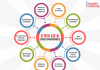


Every year, thousands of students from Nepal, Bhutan, Bangladesh, Sri Lanka, Pakistan, Afghanistan, and the Maldives cross into India for university, not because it’s the only option, but because it’s often the smartest one. Studying in India for SAARC students comes with a few specific advantages you’ll want to know early: visa exemptions for some nationalities, lower fee bands on certain admission routes, and a dedicated government scholarship scheme. This blog will answer all your questions.
Why SAARC Students Choose India
A few things make the process smoother for this group:
- Nepali and Bhutanese citizens don’t need a visa to enter India at all
- Many universities offer a dedicated SAARC/foreign-national quota with lower fees than the general international rate
- Government-run ICCR scholarships include a scheme specifically for SAARC countries
- Shared language and food culture make day-to-day adjustment faster than a move to Europe or North America
The catch: none of these advantages are automatic. You have to apply into the right quota, the right scholarship scheme, and the right visa category, which is exactly what trips people up.
Admission Process for SAARC Students: Step by Step
This is where most of the confusion happens, because India runs several parallel admission tracks, and SAARC students don’t fall into just one.
| Route | Best For | Entrance Requirement |
| Direct university admission | Most private and many public universities | Grade 12 marksheets, no Indian entrance exam |
| DASA (Direct Admission of Students Abroad) | Engineering at NITs, IIITs, CFTIs | JEE Main rank (SAT has reportedly been phased out for most DASA seats, with IIIT Hyderabad a possible exception; confirm current rules at dasanit.org) |
| IITs | Top-tier engineering | JEE Advanced only, no DASA route |
| Study in India Portal | Government-listed institutions | Varies by partner university |
Once you’ve picked your route, the sequence runs like this:
- Shortlist universities that run a dedicated SAARC/foreign-national quota
- Get your Class 12 (or equivalent) marksheet equivalence certified by the Association of Indian Universities (AIU) if your board isn’t automatically recognised
- Apply under the foreign-national/SAARC quota specifically, not the domestic Indian quota
- Pay the non-refundable eligibility/registration fee (billed separately from tuition, usually in USD)
- Apply in parallel for any scholarship you’re eligible for. Don’t wait for a scholarship decision before securing your seat
- Apply for your student visa once you have an admission/offer letter
- Arrange hostel, local registration, and travel once your visa is confirmed
This sequence matters because scholarship approval, admission, and visa processing all run on different timelines and through different offices. Treating them as one linear queue is the most common reason students lose weeks.
Scholarships for SAARC Students: What You Can Get
SAARC nationals are eligible for both government scholarships and university-specific merit scholarships, and the two are separate applications.
| Scholarship | Who Runs It | What It Covers |
| ICCR General Scholarship Scheme | Government of India, open to 180+ countries including all SAARC nations | Tuition, monthly stipend, HRA, return airfare, medical insurance |
| ICCR SAARC Scholarship Scheme | Government of India, via your Indian High Commission | A small number of postgraduate awards each year in specific subject areas (not engineering or medicine); figures vary by country, so check with your Mission |
| University merit scholarships | Individual universities | Typically 20 to 60% tuition waiver based on academic performance |
A few things people get wrong:
- The General Scheme is where most SAARC students apply. The narrower SAARC Scholarship Scheme is quite limited in the number of awards it offers each year, so don’t assume it’s your main route.
- ICCR scholarships are nominated through your country’s Indian Mission, not applied for directly to the university. Go to your embassy’s education wing first.
- You can only submit one ICCR application per academic year. Multiple applications get all of them rejected, even after an award.
- University scholarships and government scholarships are independent tracks, so apply for both.
On the university side, Shoolini University runs its own merit scholarships for SAARC nationals that sit independently of any ICCR award, so a strong academic record can earn you a tuition waiver on top of whatever government funding you secure. Separately, some admission routes carry their own SAARC-specific fee advantage. DASA, the engineering admission scheme for NITs and IIITs, applies a roughly 50% tuition reduction for SAARC nationals compared to the standard international rate. This is confirmed for DASA specifically. Whether it extends to a given university outside that scheme varies, so confirm directly with the institution rather than assuming it’s universal.
Student Visa for India: The One Exception
If you’re not from Nepal or Bhutan, you’ll need a standard Indian student visa, applied for at your nearest Indian Mission with your admission letter, proof of financial support, and a passport valid for the required period.
If you hold a Nepalese or Bhutanese passport, you don’t need a visa to enter India at all. A long-standing bilateral arrangement covers both countries. You’ll still need to complete enrolment registration with your university once you arrive, so the process isn’t entirely paperwork-free.
For everyone else: apply as soon as you have a firm offer letter. Processing commonly takes a few weeks, and starting late is the single most avoidable cause of a missed intake date. Some universities smooth this stage for you. At Shoolini University, once fees are paid and the acceptance letter is issued, the international office guides SAARC applicants through the consulate process, with visas typically arriving in two to four weeks.
How Long Does It Take to Get Started?
A rough planning guide (typical ranges to budget against, not official guarantees, since processing times vary by university and by year):
- Admission decision: often 4 to 8 weeks after a complete application
- Scholarship decision (ICCR): varies by cycle and can take a couple of months, since it routes through your Indian Mission
- Visa processing (if applicable): commonly a few weeks once you have an offer letter
- Total runway to budget: 3 to 6 months before your intended intake
Nepali and Bhutanese students can skip the visa step entirely, which shortens this timeline. Everyone else should treat the visa stage as the slowest link in the chain and start it the moment the offer letter is in hand. Confirm current timelines with your specific university and Indian Mission rather than relying on general figures.
Why Shoolini University Works for SAARC Students
If you’re comparing where in India to apply, Shoolini University earns a place on the shortlist on the strength of its record. It’s the No. 1 private university in India for the fourth consecutive year, ranked 452nd in the world and 10th in India overall (QS World University Rankings 2027), making it the only Indian private university in the global Top 500. It also holds NAAC A+ accreditation.
Beyond the scholarships, visa support, and international hostels covered above, the academic range is wide: 180+ courses across undergraduate, postgraduate, and doctoral levels, including MBA, B Tech CSE, B Tech Biotechnology, B Pharmacy, BBA, and PhD programs. Current students from Nepal, Bangladesh, and Sri Lanka have already come through the same admissions path, so incoming applicants aren’t the first to navigate it.
Admissions for the 2026–27 intake are open, and the university recommends applying at least three months before your intended intake (typically August or January), since scholarship bands are reviewed early and seats are assessed on a first-come basis. Course fees, scholarship band, and hostel costs vary slightly by program, so those are worth confirming with the international admissions office directly.
Final Verdict: Is India Worth It as a SAARC Student?
Studying in India for SAARC students comes with real structural advantages: tuition waivers, dedicated scholarship quotas, visa-free entry for Nepali and Bhutanese nationals, and a cultural adjustment that’s easier than most other study-abroad destinations. None of these advantages are automatic, though. You have to find the right quota, the right scholarship scheme, and the right embassy contact yourself, rather than assuming a generic process will surface them for you.
Do that homework before you apply, not after paying a non-refundable registration fee, and studying in India becomes a strong, well-planned option rather than a gamble. If Shoolini University is on your list, the international admissions team can confirm your quota, scholarship band, and timeline before you commit.
Sources
- ICCR (Indian Council for Cultural Relations), A2A Scholarship Portal: https://a2ascholarships.iccr.gov.in/
- ICCR Scholarship Scheme 2026-27 overview, eGovtSchemes: https://www.egovtschemes.com/iccr-scholarship-2026/
- Embassy of India, Kathmandu, Nepal, scholarship notices: https://www.indembkathmandu.gov.in/education/news/scholarship
- Consulate General of India, Jaffna, Sri Lanka, scholarship schemes: https://www.cgijaffna.gov.in/page/display/99
- Assistant High Commission of India, Rajshahi, Bangladesh, scholarships: https://www.ahcirajshahi.gov.in/page/scholarships/
- How International Students Can Apply to Study in India 2026, Edmaster (DASA, SAARC fee waiver details): https://www.edmaster.co/how-international-students-can-apply-to-study-in-india-2026/
- Study in India: Student Visas and Permits, educations.com: https://www.educations.com/study-guides/asia/study-in-india/student-visas-19128
- Embassy of India, Kathmandu, Nepal, visa page (Bhutan/Nepal visa exemption confirmation): https://www.indembkathmandu.gov.in/visa
- Consulate General of India, Birgunj, Nepal, visa page: https://www.cgibirgunj.gov.in/page/visa/