

Forensic science is often misunderstood as a career limited to crime scenes and police investigations. In reality, it is a broad scientific field that supports the justice system through evidence-based analysis. From DNA testing to digital data recovery, forensic science helps answer one crucial question: what really happened.
Over the years, advances in science and technology have transformed how crimes are investigated. DNA profiling replaced guesswork, fingerprint analysis gained legal credibility, and digital forensics emerged as a response to cybercrime. These developments have also reshaped forensic science careers, creating roles that go far beyond traditional lab work.
Today, students entering this field are not restricted to one path. They can work in research, private laboratories, cyber units, behavioural analysis, and academic institutions. Understanding these opportunities is important for anyone exploring long-term growth in forensic science. This blog focuses on such roles—careers that are critical to investigations but rarely discussed.
How Forensic Science Became a Career-Driven Discipline
Modern forensic science gained credibility when scientific evidence began influencing court verdicts. A major shift came with DNA profiling, introduced by Alec Jeffreys, which helped both identify offenders and prevent wrongful convictions. This development proved that forensic science could serve justice without relying solely on eyewitness accounts.
Fingerprint analysis also became globally accepted after early 20th-century cases showed that ridge patterns are unique and permanent. Over time, forensic toxicology, ballistics, and trace evidence analysis added depth to the field. These scientific foundations created specialised roles that require accuracy, patience, and ethical responsibility rather than dramatic investigation work.
Forensic Science Careers No One Talks About
While crime scene investigation is the most visible role, a large part of forensic work happens away from public view. Many professionals contribute to investigations through laboratory analysis, research, and specialised assessments. Some of the lesser-known but important forensic science careers include:
- Forensic Toxicology Professionals
These experts examine blood, tissue, and other biological samples to identify the presence of drugs, alcohol, or toxic substances. Their analysis helps investigators understand whether chemicals played a role in a crime, accident, or unexplained death. This role requires careful laboratory work and a strong understanding of chemical reactions in the human body.
- Digital and Cyber Forensic Experts
With crimes increasingly involving technology, digital forensic experts play a key role in analysing electronic evidence. They recover deleted files, trace online activity, and study digital devices used in cybercrime and corporate investigations. Their work often supports legal cases where digital data becomes crucial evidence.
- Forensic Psychology Specialists
These professionals focus on the human side of crime. By studying behaviour patterns and psychological traits, they help investigators understand motives, decision-making, and risk factors. Their assessments are often used in legal proceedings and long-term investigation planning.
- Forensic Research Scientists
Research scientists work behind the scenes to improve forensic techniques. They develop better testing methods, refine existing tools, and ensure accuracy in forensic analysis. Their work strengthens the reliability of evidence used across laboratories and courts.
- Private Forensic Laboratory Analysts
These analysts work with independent laboratories, legal firms, and insurance agencies. They handle evidence testing and reporting outside government settings, reflecting the growing demand for private-sector forensic jobs in modern investigations.
These roles highlight the wide range of careers after completing a forensic science degree, proving that meaningful contributions to justice are possible even without direct crime scene involvement.
Education Pathways and Career Scope
Undergraduate and postgraduate programs shape how students enter the field. The BSc Forensic Science scope includes laboratory analysis, evidence documentation, and entry-level research roles. Students gain foundational knowledge in biology, chemistry, and forensic procedures.
At the postgraduate level, MSc Forensic Science jobs often involve advanced laboratory work, research assistance, quality control, and academic or institutional roles. Specialisation becomes important at this stage, especially in digital forensics, toxicology, or DNA analysis. For students interested in innovation and long-term impact, forensic research careers allow them to contribute to method development and scientific accuracy rather than routine casework.
Forensic Science in India: Changing with the Times
With rising cybercrime and complex investigations, forensic science courses in India are slowly adapting to include technology-driven training. Modern programs focus on interdisciplinary learning, combining science with legal understanding and ethical practice.
The growing involvement of private laboratories and consulting firms has also expanded employment possibilities beyond government institutions. This shift has helped forensic science evolve into a more flexible and skill-based profession.
Skills That Shape Long-Term Forensic Careers
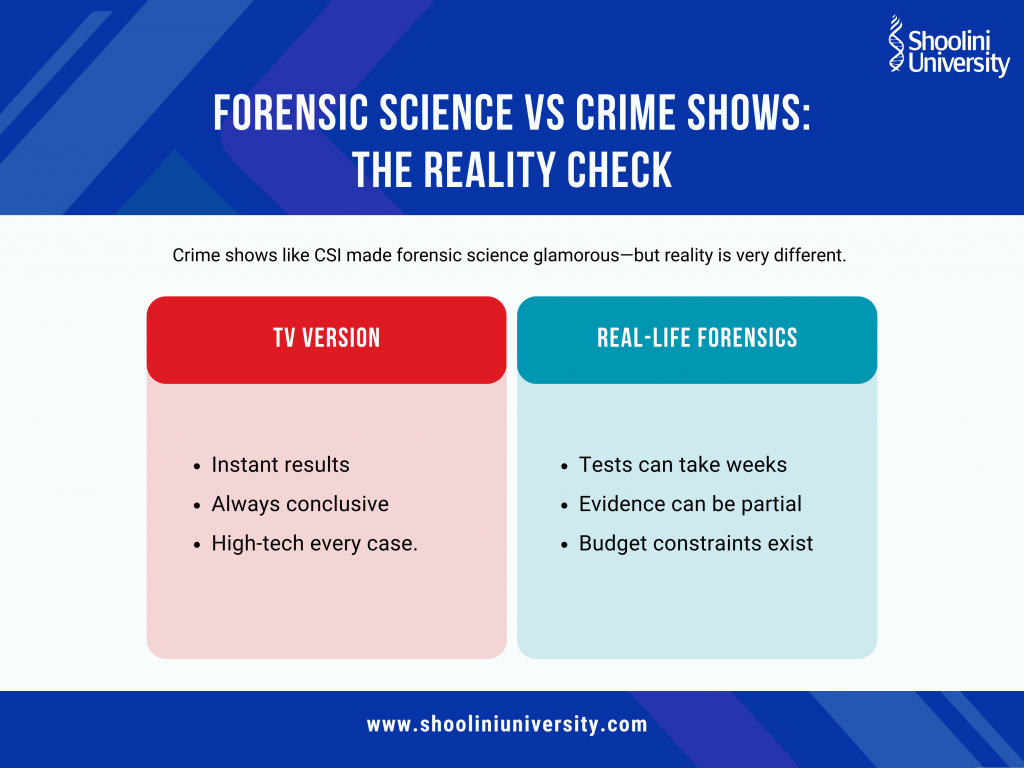
Success in forensic science depends more on skills than job titles. Attention to detail is one of the most valuable qualities, as even a small error can affect an entire investigation. Analytical thinking helps professionals interpret results without bias, while patience is essential due to the time-consuming nature of forensic analysis.
Ethical responsibility is another core skill. Forensic experts are expected to remain neutral and objective, regardless of external pressure. Communication skills also matter, especially when presenting findings in reports or explaining results during legal proceedings.
These skills remain relevant across laboratories, research centres, academic institutions, and private forensic organisations, making them valuable throughout a forensic career.
Learning Forensic Science at Shoolini University
For students planning a career in forensic science, the quality of education and infrastructure is of utmost significance. The forensic science program at Shoolini University provides students with a strong scientific foundation while preparing them for real-world investigative environments.
Shoolini is ranked No. 1 private university in India by QS World University Rankings and No. 2 private university in India by Times Higher Education World University Rankings, reflecting its focus on research-driven and outcome-based education. The forensic science program introduces students to the core scientific principles behind crime investigation and forensic analysis.
The curriculum covers essential areas such as forensic biology, forensic chemistry, fingerprints, questioned documents, toxicology, cyber forensics, serology, basic DNA science, ballistics, and crime scene investigation. This structured approach helps students understand both traditional and emerging aspects of forensic work.
The program is supported by 104+ laboratories and 10+ Centres of Excellence, offering students access to advanced forensic and analytical instruments. Hands-on training includes crime-scene mock setups, real-case simulations, and research exposure, helping students bridge the gap between theory and practice.
Students also benefit from a strong interdisciplinary ecosystem, with academic connections across biotechnology, law, chemistry, psychology, and computer science. Faculty members from premier institutions, including international experts from Austria, Germany, South Korea, and NIPER, contribute to a diverse learning experience.
With scholarships and fellowships available at both undergraduate and postgraduate levels, the program reflects the standards expected from the best private university in India.
Shoolini also has 250+ international collaborations that allow students to gain global exposure through exchange and study abroad programs.
Conclusion: Careers Built on Precision and Purpose
Forensic science is not a career of shortcuts or instant results. It demands accuracy, patience, and responsibility. The most impactful forensic science careers often remain unseen, yet they strengthen justice systems and protect truth.
For students willing to look beyond stereotypes, forensic science offers meaningful, evolving, and intellectually driven career paths—many of which deserve far more attention than they receive.
FAQs:
Q1. Are forensic science careers limited to government jobs?
No. While the CBI and State FSLs are major employers, the private sector is growing rapidly. Forensic experts are now highly sought after by law firms, insurance companies (for fraud detection), private laboratories, and corporate security firms specialising in cyber forensics and internal investigations.
Q2. Can students specialise in a particular area during forensic science studies?
Yes. While a BSc offers a broad foundation, specialisation typically happens at the MSc level. Students can choose to become experts in high-demand niches such as Digital Forensics, Forensic Toxicology, Questioned Documents, or Forensic Psychology, depending on their interest and career goals.
Q3. Is forensic science a good long-term career option in India?
Absolutely. With the rise in cybercrime and the judicial system's increasing reliance on scientific evidence, the demand for specialists is at an all-time high. The BSc and MSc Forensic Science scope is expanding into corporate auditing, data privacy, and private consultancy, offering strong stability and growth.
Q4. How does Shoolini University support practical learning in forensic science?
Shoolini University, ranked No. 1 private university in India (QS World University Rankings), emphasises hands-on experience through 104+ advanced laboratories and mock crime-scene setups. Students learn from a global faculty and benefit from international collaborations, ensuring they are industry-ready the moment they graduate.
Sources: