

The tech industry is booming — but not all B Tech CSE programs are built for the future. Here’s why Shoolini University is turning heads in 2026.
India’s technology sector is experiencing one of its most dynamic phases. With the IT and business services market expected to surpass $19.93 billion by the end of 2026, and AI engineer positions growing at 67% year-on-year, the pressure on students to choose the right BTech CSE program has never been greater.
Most conversations about top CSE universities in India begin and end with IITs and NITs. But here’s what’s changing: the gap between premier government institutions and the best private universities is narrowing fast, especially for students who want industry-aligned education, specialisation flexibility, and real-world exposure from day one.
Shoolini University, through its Yogananda School of AI, Computer and Data Sciences, is leading that charge. Let’s break down why and why the market data backs it up.
The 2026 Tech Job Market: What Students Need to Know
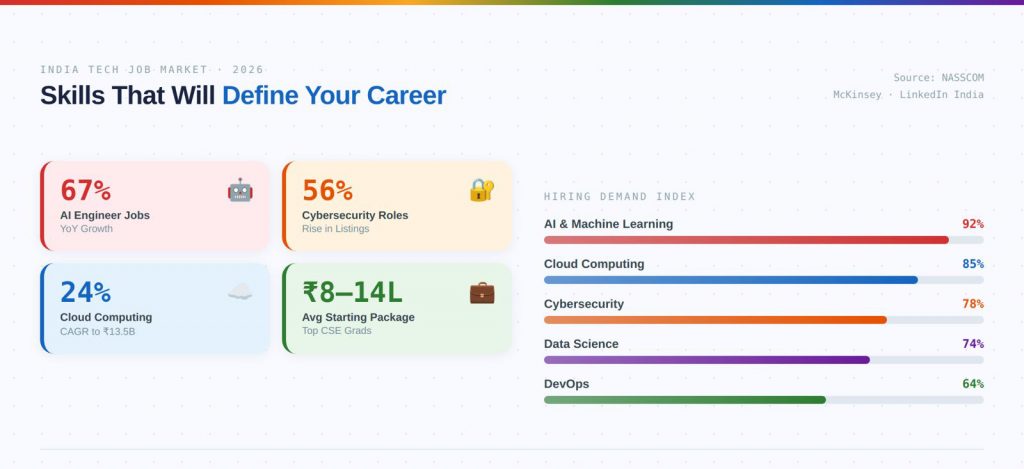
Before choosing a university, understand the landscape you’re graduating into:
67% — Year-on-year growth in AI engineer job postings in India 56% — Rise in cybersecurity job listings in 2026 24% CAGR — Growth rate of India’s cloud computing market, projected to hit $13.5B by 2026 ₹8–14 LPA — Average starting package for CSE/AI graduates from top private universities in 2026
The message is clear: students who graduate with hands-on expertise in AI, cloud, cybersecurity, and data science are entering a seller’s market. The question is — which university actually delivers those skills, not just on paper, but in practice.
Market Insight: Over 85% of emerging tech roles require specific digital skills, according to NASSCOM and McKinsey. A broad CSE degree without specialisation is becoming less competitive.
What Separates a Good BTech CSE University from a Great One?
With over 8,000 engineering colleges in India, the differentiation comes down to five key factors:
- Specialisations that mirror market demand (AI, Cloud, Cybersecurity, DevOps)
- Industry partnerships that go beyond MoUs — actual certifications, live projects, and placements
- Faculty with real research and industry credentials, not just academic titles
- Access to advanced labs and emerging tech infrastructure
- Placement outcomes in product-based and tech-forward companies
Shoolini University checks all five. Here’s how.
Shoolini University’s BTech CSE: Built for the Tech Economy
Housed in the Yogananda School of AI, Computer and Data Sciences, Shoolini’s BTech CSE is not a generic engineering degree. It is a 4-year program designed from the ground up to reflect where the tech industry is heading — not where it was five years ago.
The curriculum spans programming fundamentals, data structures, and algorithms all the way to artificial intelligence, machine learning, cybersecurity, and cloud computing. But the real differentiator is what students do with that knowledge — through labs, live projects, and industry-embedded experiences.
Nine Specialisations — One of the Widest Choices in India
The 2026 job market is not looking for generalists. Employers want engineers who can own a domain. Shoolini’s nine specialisations reflect exactly the areas where hiring is hottest:
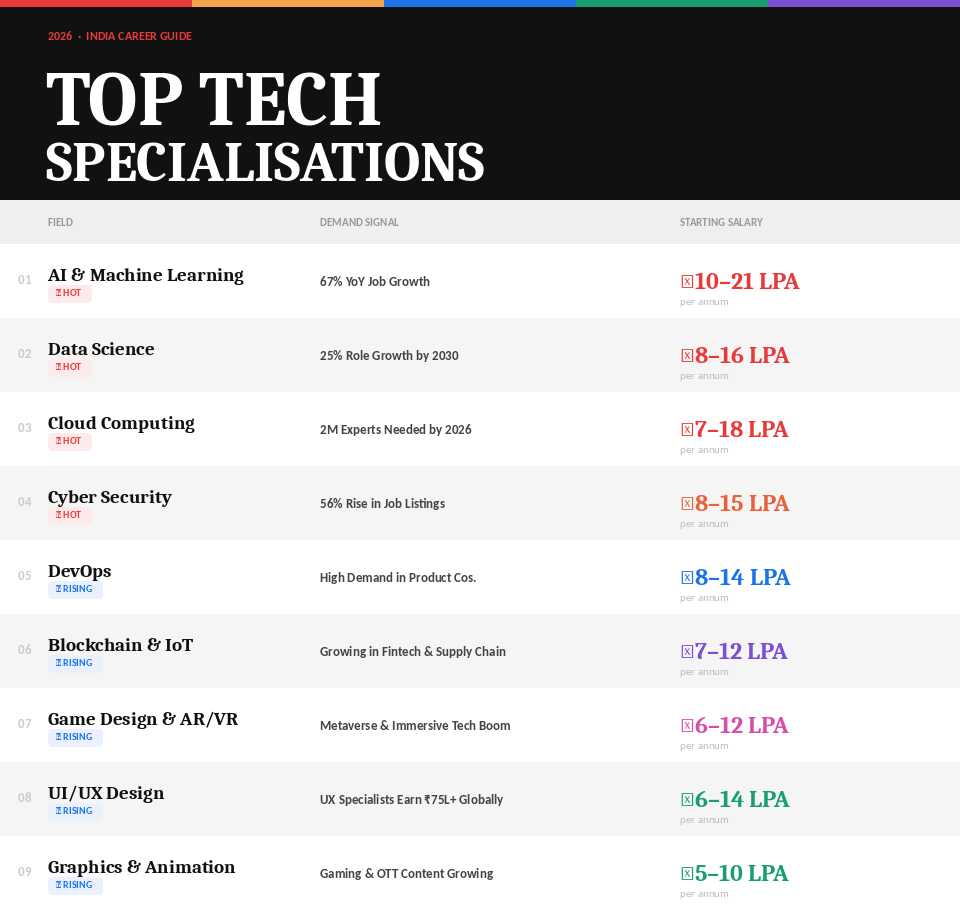
Key Takeaway: Every specialisation Shoolini offers corresponds to a high-demand, high-salary segment of the 2026 tech job market. This isn’t coincidence — it’s curriculum design driven by industry intelligence.
Industry Partnerships That Actually Mean Something
Many universities list industry partnerships in their brochures. Shoolini turns them into tangible student outcomes.
AWS Academy Certification Cloud computing is one of the fastest-growing tech sectors in India, with a projected CAGR of 24% and demand for 2 million cloud professionals by 2026. Shoolini students can pursue AWS certifications — the gold standard in cloud credentials — directly through the university’s AWS Academy tie-up. This isn’t an optional extra; it’s built into the academic ecosystem.
IIT Kanpur Collaboration (Ikigai Lab) Shoolini’s collaboration with Ikigai Lab at IIT Kanpur gives CSE students access to data analytics projects typically reserved for India’s top government institutions. In a job market where IIT proximity often means employer preference, this bridge matters.
IBM, Algo8.AI, and AADDOO.AI These partnerships expose students to enterprise AI, industrial automation, and real product development environments — the exact kind of experience that separates candidates in campus placements.
Faculty Who’ve Worked Where You Want to Work
Shoolini’s faculty is drawn from IITs, NITs, and global institutions. Several hold postdoctoral credentials from universities like the University of Colorado. You’ll find IEEE members, GATE qualifiers, and professors with ML certifications from Stanford.
This blend of academic rigour and industry reality is rare — and it shapes how students are taught to think about problems, not just code solutions.
State-of-the-Art XR/AI Research Centre
In 2026, the difference between reading about AI and building with AI is everything. Shoolini’s XR/AI Research Centre gives students hands-on access to Extended Reality, Augmented Reality, and AI tools in a dedicated research environment.
The labs are supported by research and infrastructure grants from government bodies including DST and HIMCOSTE — a signal that Shoolini’s research ecosystem is recognised at a national level.
Career Outcomes: What the Market Data Says
BTech CSE graduates from Shoolini go on to roles across the full spectrum of the tech economy:
- Machine Learning Engineer — one of the top three hiring categories in India’s product companies in 2026
- Software Engineer — perennially the highest-volume CSE hiring role
- Data Scientist — driven by 25% projected growth in data roles by 2030
- DevOps Engineer — in high demand as companies shift to cloud-native infrastructure
- Business Intelligence Developer, Network Administrator, System Designer
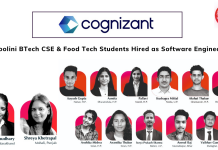
Shoolini’s Placement Cell actively connects students with leading companies including Jio, Havells, SBI Card, and a range of tech-forward organisations. The university runs placement drives, mock interviews, and skill workshops to ensure graduates are ready for the competitive job market.
Salary Context: In 2026, CSE graduates from tier-2 private universities with strong specialisations and certifications are earning ₹8–14 LPA at entry level — nearly double what core branch graduates earn. Shoolini’s AWS-certified and AI-specialised graduates are positioned at the upper end of this range.
Admission: How to Get In
Shoolini’s BTech CSE is open to students who have completed 10+2 with Mathematics as a compulsory subject and a minimum of 60% marks. Admission is accepted through CUET, JEE, NEET, SAT, or Shoolini’s own entrance test — giving students multiple routes to secure a seat.
Admissions are open for the 2026–27 batch.
When Indian students and parents search for the best BTech CSE universities, the usual answer is IITs and NITs. That’s not wrong — but it’s incomplete.
The question worth asking in 2026 is: which university is actually preparing students for the jobs that exist today and will dominate in 2030?
Shoolini University’s BTech CSE program — with nine market-aligned specialisations, partnerships with AWS, IIT Kanpur, IBM, and AI-first companies, a research-backed faculty, and a dedicated XR/AI lab — is one of the most comprehensively industry-ready CSE programs in India’s private university space.
If you’re serious about building a future in AI, cloud, cybersecurity, or any of the fastest-growing corners of tech, Shoolini University deserves serious consideration.