


After CUET UG 2026 exams, the next step is to download your scorecard, register for counselling on each university portal separately, and simultaneously apply to other universities — both central and private — that accept CUET scores.
Results are expected in the first week of July 2026 on cuet.nta.nic.in. The window between results and counselling deadlines is short. Students who act fast have more options than those who wait.
This blog covers exactly what to do — step by step — whether your score is strong, average, or lower than expected.
When Will CUET UG 2026 Results Be Declared?
Results are expected in the first week of July 2026 on the official NTA portal.
- Result portal: cuet.nta.nic.in
- Login required: Application number and date of birth
- Download and save your scorecard immediately — you will need it for every university counselling process
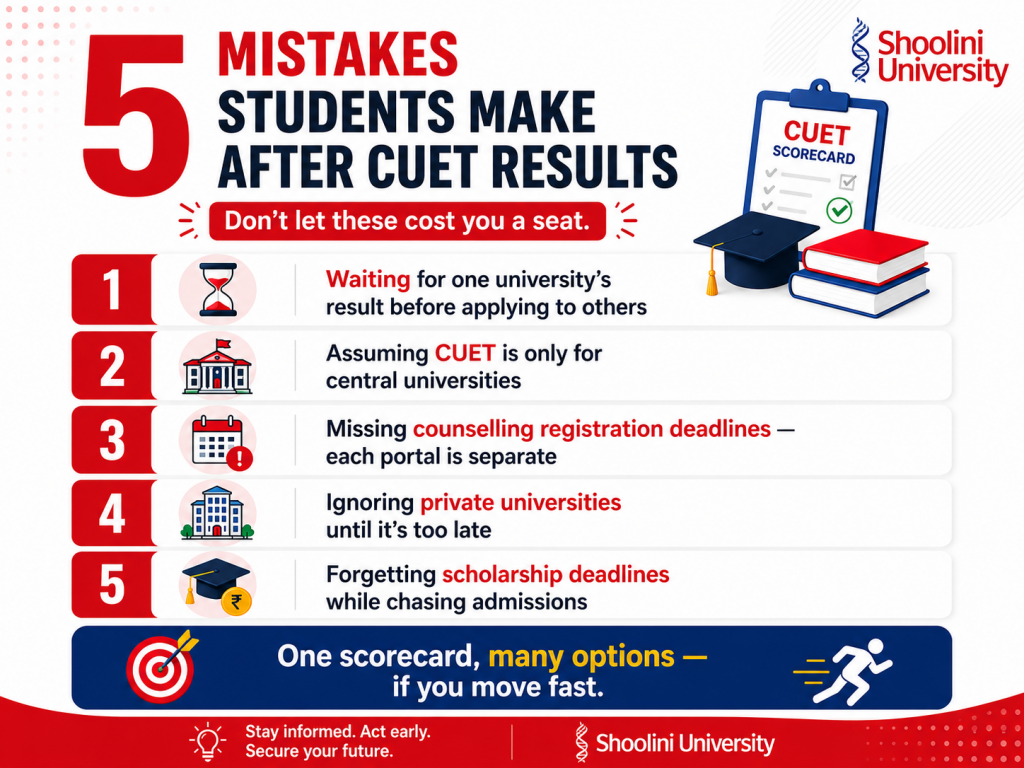
NTA only declares results. Every university conducts its own separate counselling. You must register individually on each university portal you are interested in.
What Should You Do Immediately After CUET Results?
Act within 48 hours — counselling windows open fast and close faster.
Step by step:
- Download and save your CUET UG 2026 scorecard from cuet.nta.nic.in
- Check the cutoff scores of the universities you applied to — each university releases its own cutoff scores
- Register for counselling on each university portal separately
- For DU — apply through the CSAS portal at admission.uod.ac.in
- For JNU — register on jnu.ac.in based on CUET score
- For all other universities — check their individual admission portals
- Keep all documents ready — Class 10 and 12 marksheets, ID proof, CUET scorecard, passport-size photos
- Simultaneously apply to private universities that accept CUET scores — do not wait for counselling results first
How Does CUET Counselling Actually Work?
There is no centralised CUET counselling — every university does it separately.
This is the part most students misunderstand. NTA’s role ends the moment results are declared. After that, every university manages its own process — its own registration form, its own merit list, its own seat allotment, and its own reporting deadline.
What this means in practice:
- You must actively track each university’s counselling schedule
- Missing a counselling registration deadline means losing that seat permanently
- Some universities conduct online counselling followed by offline document verification
- Some programs conduct interviews instead of counselling — NTA announces these separately
Based on previous-year trends, students targeting top central university courses like BCom, BSc, and BA should aim for a minimum CUET score of 700 for competitive options, per NTA historical data.
Do Private Universities Accept CUET Scores?
Yes — and many students do not realise this until after results.
CUET is not just for central universities. A growing number of private universities across India have started accepting CUET scores as part of their admission process. This means your CUET score has value beyond DU, JNU, and BHU — it can also get you into well-ranked private universities.
Before applying anywhere, check three things on the university’s official website. First — does the university accept CUET scores directly? Second — what is the minimum CUET score required for your preferred course? Third — does the university also have its own entrance test or a merit-based process as an alternative?
Whether your score is strong or average, always apply to both central universities and CUET-accepting private universities simultaneously. Waiting for one set of results before applying to the other costs you time — and seats.

What If Your CUET Score Is Lower Than Expected?
A lower score narrows some options — but it does not close all of them.
Central universities set competitive cutoffs that vary by course and campus. If your score falls below the cutoff for your first choice, here is what to do:
- Check cutoffs for other courses and campuses at the same university — sometimes a different program at the same institution is accessible
- Apply to state universities that accept CUET scores — many have lower cutoffs than central universities
- Apply to private universities that accept CUET scores — several well-ranked private institutions participate in CUET admissions
- Consider universities with their own merit-based or entrance test process as a parallel option
- Do not wait for counselling rounds to conclude before exploring these alternatives — act simultaneously
The smartest move is to explore alternatives while counselling is still on — not scramble for a backup when it’s too late.
What Career Options Are Available After CUET 2026?
CUET gives you options across science, commerce, and arts — the question is which course is the right fit for you. Your career is not determined by your CUET score. It is determined by the course you choose and the university you attend.
Top undergraduate courses to consider across streams:
Science students (PCB) B Tech Biotechnology with AI, B Tech Biomedical Engineering, BSc Biotechnology, BSc Microbiology, BSc Physics, B Pharmacy
Science students (PCM) B Tech CSE with specialisations in AI, Cybersecurity, Data Science, Cloud Computing, and Game Design and AR/VR
Commerce and arts students BBA with specialisations, BCom with ACCA, BA Economics and Finance, BA LLB, BBA LLB, BAJMC, BAMC
All streams BBA, BCom, BA (Hons), BSc Hospitality and Hotel Administration
The course and specialisation you pick matter more than which entrance exam you took to get there. Focus on what the degree leads to — not just how you got in.
How Do You Evaluate a University After CUET 2026?
Whether it is a central, state, or private university, check these four things before you apply.
Rankings and accreditation — Is the university ranked by QS or Times Higher Education World University Rankings? Does it hold NAAC accreditation? These are the most reliable quality indicators available to students.
Placement record — Who actually recruits from campus? What roles do they hire for, and what do they pay? Ask for specific company names and average packages, not just the highest package mentioned on the website.
Faculty quality — Do faculty members have real research publications, industry experience, and connections to the field you want to enter? This directly affects the quality of learning and mentorship you receive.
Infrastructure and global exposure — Labs, research facilities, and international tie-ups matter especially for science and engineering students. Exchange programs and global collaborations open doors that purely domestic education cannot.
Shoolini University — A Strong Option After CUET 2026
Shoolini University, located in Solan, Himachal Pradesh, accepts CUET scores for admission to all programs — which means your CUET scorecard has direct value here, not just at central universities.
Ranked No. 1 private university in India by QS World University Rankings and No. 2 by Times Higher Education World University Rankings, it offers 180+ programs across science, engineering, management, law, pharmacy, and media — open to students from all streams.
For students who scored well in Class 12 or CUET, Shoolini offers merit scholarships worth up to 50% tuition fee waiver for BBA, BCom, and BCA students based on Class 12 marks or CUET scorecard. Engineering students can avail up to 90% tuition fee waiver based on Class 12 marks or JEE Main scores. Need-based scholarships covering up to 100% tuition fee are also available for students from lower-income families. All scholarships must be applied for at the time of admissions — the deadline is 15th August 2026 (*terms and conditions apply).
What students actually get here is research exposure from year one through the Summit Research Program, paid internships with companies like Deloitte, KPMG, and ICICI Bank, and access to 104+ labs and 11 Centres of Excellence. The university also has 250+ global tie-ups — including a Dual Degree option with the University of Melbourne for BSc Biotechnology students.
If you are evaluating options after CUET 2026, Shoolini is worth a serious look — not just as a backup, but as a first choice for students who value research, global exposure, and strong placements.
Admissions 2026 are open. Seats Are Filling Fast – Apply Now!
The Most Important Thing to Remember After CUET 2026
Time is the real variable — not your score.
Students with strong scores lose seats. Students with average scores find excellent options — simply by acting fast. The post-CUET window is short — results in July, counselling in July and August, university admissions filling up simultaneously.
Download your scorecard. Register for counselling immediately. Apply to private universities that accept CUET scores in parallel. And remember that the degree you pursue and the university you attend will shape the next four years of your life far more than the entrance exam you used to get there.
Admissions 2026 at Shoolini University are open. Ranked No. 1 private university in India by QS World University Rankings 2026. Apply now.
Sources:
- NTA CUET UG 2026 Official Portal https://cuet.nta.nic.in
- DU CSAS Admission Portal https://admission.uod.ac.in
- JNU Admissions Portal https://www.jnu.ac.in/admission
- UGC Official Guidelines on University Admissions https://www.ugc.gov.in
- PIB — Union Budget 2025-26 Education Allocation https://www.pib.gov.in
FAQs
Q1. Can students apply before CUET results are announced?
Yes — many universities, including private institutions, accept applications before results are declared, so applying early secures your seat and keeps your options open.
Q2. What if my CUET score is low?
A low score narrows some options but does not close all of them — check cutoffs for other courses at the same university, apply to state universities with lower cutoffs, and simultaneously apply to private universities that accept CUET scores or admit through merit.
Q3. Are private universities better backup options?
Several well-ranked private universities offer strong research infrastructure, global tie-ups, and placement records that are genuinely competitive with central universities. Evaluate based on rankings, accreditation, and placements — not on the type of institution.
Q4. Should students wait for all counselling rounds before deciding?
No — waiting for all rounds to conclude before exploring other options costs you time and seats, since private university admissions and merit-based processes fill up simultaneously with CUET counselling.
Q5. Can I change my course preference later?
It depends on the university. Some allow course changes within the first semester, but most do not, so it is important to choose carefully before confirming admission, rather than treating it as reversible.
Q6. Which universities offer direct admissions?
Many private universities and some state universities offer direct admissions based on Class 12 merit, university-specific entrance tests, or rolling admissions without requiring a CUET score. Check each university's official admissions page for its specific process.
Q7. Is taking a drop year worth it for CUET?
It depends entirely on your goal — if you are targeting a specific program at a top central university and your score fell significantly short, a focused gap year can be worthwhile, but if strong alternatives exist that match your career goals, joining a good program now is often the better decision.


