
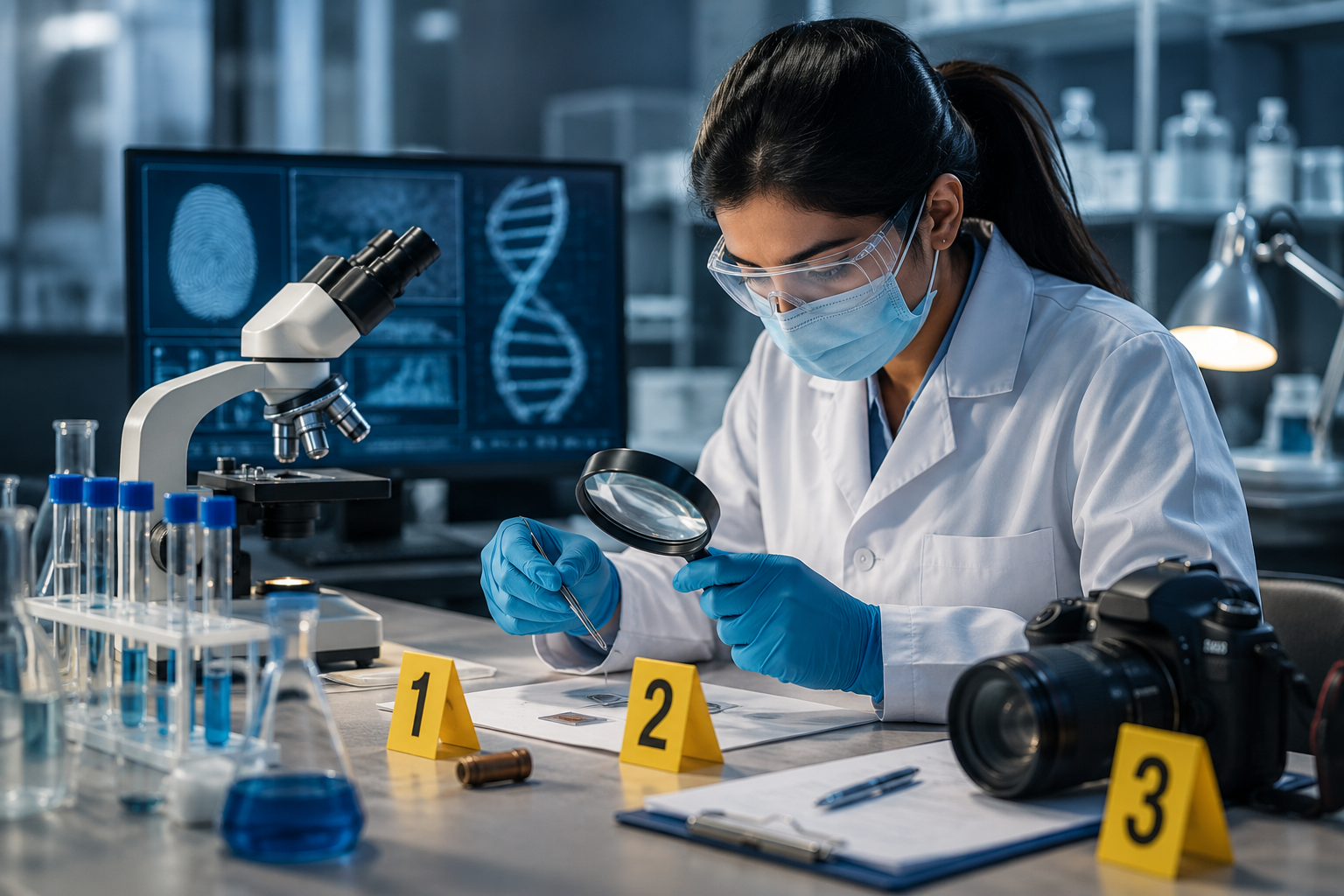
India needs more trained forensic professionals. The Ministry of Home Affairs has identified a shortage of forensic professionals and a backlog of cases in forensic science laboratories. India’s new criminal procedure law, the Bharatiya Nagarik Suraksha Sanhita (BNSS), is expected to increase the number of cases requiring forensic examination.
Section 176(3) of the BNSS introduces a new requirement for offences punishable with imprisonment of seven years or more. State governments have up to five years to implement it. Once implemented, the officer in charge of a police station must arrange for a forensic expert to visit the crime scene and collect evidence. The process must also be videographed.
The government is expanding forensic capacity through the National Forensic Infrastructure Enhancement Scheme. With an outlay of ₹2,254.43 crore for 2024-25 to 2028-29, the scheme provides for nine new National Forensic Sciences University campuses, seven new Central Forensic Science Laboratories and infrastructure upgrades at the existing NFSU campus in Delhi. It aims to address the shortage of trained professionals and reduce case pendency in forensic laboratories.
For students looking at forensic science courses after 12th, the new law and expansion of forensic laboratories are likely to increase demand for trained professionals. Actual government job opportunities will depend on vacancies announced by central and state agencies.
What Does a Forensic Scientist Do?
A forensic scientist examines evidence using scientific methods and reports findings that can assist an investigation or court proceeding.
The work depends on the specialisation. Forensic biologists examine blood, hair, tissue and other biological material. Forensic toxicologists test samples for drugs, poisons and chemicals. Fingerprint examiners study impressions, while questioned document examiners analyse handwriting, signatures and altered documents. Digital forensic professionals recover and examine evidence from computers, phones and other electronic devices.
Some professionals work at crime scenes, while others work mainly in laboratories. Accuracy is central to every role. Evidence must be collected and preserved correctly, its chain of custody documented and the findings reported without making claims that the evidence does not support.
So, what route should a student take to become a forensic scientist in India?
Five Steps to Become a Forensic Scientist
Step 1. Start with science in Classes 11 and 12
Forensic science draws heavily on biology, chemistry, physics and, increasingly, computing. A science background in Classes 11 and 12 is the usual starting point. The subjects that matter most later depend on the specialisation.
Biology supports DNA analysis and serology. Chemistry is central to toxicology and chemical examination. Physics matters for ballistics and impression evidence. Computer science is useful for cyber and digital forensics.
Eligibility differs between universities, so check each program’s requirements before applying.
Step 2. Study forensic science at undergraduate level
A BSc Forensic Science is one of the most direct undergraduate routes into the subject. Some specialised careers are also open to graduates of chemistry, biology, biotechnology or computer science after postgraduate study in forensic science.
When comparing forensic science courses in India, check the curriculum, laboratory work and practical training. A strong program should build a sound base in scientific subjects and apply that knowledge to evidence examination. Core areas commonly include forensic chemistry, biology, toxicology, fingerprints, questioned documents, crime scene investigation, DNA analysis, ballistics and digital forensics.
Step 3. Learn to work with evidence
A forensic science degree should involve substantial laboratory work. Consider a blood sample collected from a crime scene. Its value as evidence depends on handling several steps correctly, from collection and labelling to preservation, transport, laboratory examination, documentation, and interpretation. An early error can limit what can later be established scientifically.
Students should learn evidence collection and preservation, crime-scene documentation, chain-of-custody procedures, laboratory protocols, data interpretation and forensic report writing.
Instrumentation also matters. When comparing colleges, ask which instruments students can access, which ones they use under supervision and how much laboratory time the program provides.
Step 4. Find the branch that matches your strengths
Forensic science includes several distinct career paths. Students who enjoy biology may move towards forensic biology, serology or DNA profiling. Those who prefer chemistry may choose toxicology. Fingerprint analysis and questioned document examination require careful comparison and documentation.
Cyber forensics deals with evidence recovered from phones, computers and online accounts. Other areas include ballistics, environmental forensics and forensic psychology. Undergraduate study allows students to become familiar with these areas before choosing postgraduate study or specialised training.
Step 5. Gain experience before applying for specialist roles
A degree provides academic knowledge. Specialist roles may also require practical experience, postgraduate qualifications or employer-specific training.
During college, students can develop evidence-handling and analytical skills through laboratory projects, internships, research work and crime-scene simulations. Keeping clear records of projects, techniques and instruments can also help when applying for internships or entry-level positions.
Graduates seeking deeper technical roles can pursue an MSc in Forensic Science or a related specialisation. Government recruitment follows job-specific eligibility rules and selection procedures. Applicants should read each notification carefully before applying.
Where Can a Forensic Science Degree Take You?
The BSc forensic science scope covers laboratory work, crime-scene investigation, research, digital forensics and investigative support.
Possible entry-level roles include crime scene investigator, forensic laboratory assistant, fingerprint analyst, questioned document examiner trainee, forensic toxicology assistant, digital or cyber forensics assistant and research assistant. Qualifications and recruitment requirements differ by role and employer.
Government positions may be advertised by state forensic science laboratories, Central Forensic Science Laboratories, police departments and investigative agencies. The CBI, NIA and state Crime Investigation Departments follow their own recruitment procedures. Private-sector opportunities may be available in testing laboratories, cybersecurity companies, investigation firms, consulting and research institutions.
What Determines a Forensic Science Salary?
Students searching for forensic science course salary information will find widely different figures because no single salary applies to every graduate. Pay depends on the post, qualification, employer, location, specialisation and experience.
A laboratory assistant, digital forensic professional and senior forensic scientist perform different work and may need different qualifications. Government posts follow the pay scale stated in the recruitment notification. Private laboratories, cybersecurity companies, investigation firms and consulting organisations use employer-specific salary structures.
For a meaningful comparison, check the job title, required qualifications, experience level, employer and location. Current recruitment notifications are the most reliable reference for government salaries.
Studying Forensic Science at Shoolini University
Shoolini University offers a four-year BSc (Hons) Forensic Science program. Candidates need Physics and Chemistry, along with Biology or Mathematics, in Class 12 and a minimum aggregate of 60 per cent from a recognised board. Admission is through CUET, JEE, SAT or Shoolini University’s multiple-choice entrance test, followed by faculty interaction. BSc (Hons) Forensic Science
The program connects forensic science with biotechnology, law, chemistry, psychology and computer science. The curriculum covers crime-scene investigation, forensic biology and chemistry, toxicology, fingerprints, questioned documents, cyber forensics, serology, basic DNA science and ballistics.
Students have access to GC-MS, HPLC, microscopic imaging systems, DNA extraction and PCR facilities, biological safety cabinets and fingerprint and impression analysis tools. Practical learning includes mock crime-scene setups and case simulations.
Research opportunities listed for the program include DNA profiling, molecular forensics, toxicology, cyber forensics, forensic psychology, environmental forensics and questioned document examination. Nanotechnology in forensics and AI-powered evidence interpretation are listed as emerging areas.
The course page also states that students complete industrial training by the end of the sixth semester and month-long internships at industrial units, hospitals and other relevant organisations.
When comparing colleges, check the curriculum, supervised laboratory time, instruments available, internships, research opportunities and eligibility requirements.
Conclusion
Forensic science suits students who enjoy scientific analysis and can work carefully with evidence. India is expanding its forensic infrastructure while laboratories face shortages of trained professionals and pending cases.
Career options exist across government laboratories, law-enforcement support, private testing, digital forensics and research. Entry requirements vary by role. Students should compare the scientific content, laboratory training, internships and research opportunities offered by each program before applying.
Sources
- Ministry of Home Affairs, Government of India, Press Information Bureau, “Forensic Labs and Forensic Infrastructure”
- Ministry of Home Affairs, Government of India, Press Information Bureau, “Cabinet Approves Central Sector Scheme, National Forensic Infrastructure Enhancement Scheme”
- Bharatiya Nagarik Suraksha Sanhita, 2023, Section 176(3), Indian Kanoon
FAQs
Q1. Which course is best to become a forensic scientist?
BSc or BSc (Hons) Forensic Science is one of the most direct undergraduate options after Class 12. Students can later pursue an MSc or specialised training in areas such as toxicology, DNA analysis, cyber forensics or questioned documents.
Q2. Is BSc Forensic Science a good career in India?
It can be a good choice for students interested in laboratory science, evidence analysis and investigation. India is expanding forensic infrastructure, and the Ministry of Home Affairs has acknowledged a shortage of trained forensic personnel. Employment still depends on qualifications, specialisation, recruitment and available positions.
Q3. What is the salary of a forensic scientist in India?
There is no single salary that applies to all forensic scientists. Pay varies by employer, job profile, qualifications, specialisation and experience. Government applicants should check the pay level or remuneration stated in the relevant recruitment notification.
Q4. What are the career opportunities after BSc Forensic Science?
Graduates can explore crime scene investigation, forensic laboratory work, fingerprints, questioned documents, toxicology, digital forensics and research. Some specialist positions may call for an MSc or additional qualifications.
Q5. Which are the best colleges for forensic science in India?
Compare colleges on curriculum, laboratory equipment, faculty expertise, research exposure, crime scene training, internships, accreditation and admission requirements. Shoolini University's BSc (Hons) Forensic Science, for example, gives students hands-on training on GC-MS, HPLC and DNA extraction equipment alongside crime scene simulations, which is the kind of detail worth checking at any college you shortlist. The best choice depends on a student's preferred specialisation and academic plans.
Q6. What is the future scope of forensic science in India?
The government is expanding forensic capacity through a ₹2,254.43 crore scheme that adds nine NFSU campuses and seven CFSLs. The BNSS has also increased the role of forensic examination in investigations involving serious offences. Together, these developments should increase demand on India's forensic system.
Q7. Is forensic science better than criminology?
They lead to different kinds of study. Forensic science concentrates on the scientific examination of evidence. Criminology studies crime, criminal behaviour and related social factors. Students drawn to biology, chemistry and laboratory analysis may prefer forensic science, while those interested in crime as a behavioural and social subject may prefer criminology.
Q8. What qualifications are required to become a forensic scientist?
Requirements vary by role. A bachelor's degree in forensic science or an appropriate scientific discipline provides the foundation for entry-level work, while specialised scientific, research and senior positions may call for a master's degree or other qualifications set by the recruiting organisation.