


Finance seems like the obvious choice for an MBA after BCom. After all, commerce graduates already have a foundation in accounting, taxation and economics. But does that mean Finance is the best MBA specialisation for everyone?
Not necessarily. Marketing, Human Resources, Business Analytics and AI, and Pharma and Healthcare offer different career opportunities. The challenge is finding a specialisation that matches your interests, skills and long-term career goals.
That choice shapes next two years of study. It can also influence the internships students pursue, the skills they build and the jobs they apply for after graduation.
So, which MBA specialisation fits your plans? What jobs can graduates pursue, and how much can they expect to earn? This guide compares the options to help you decide.
Is an MBA a Good Choice After BCom?
An MBA after BCom is worth considering for graduates who want to apply their commerce background to business management. An MBA builds on that foundation by covering how organisations make decisions, manage teams, develop strategies and respond to market challenges.
For instance, a commerce graduate may know how to interpret a company’s balance sheet. During an MBA, they can use that knowledge to evaluate investments, plan budgets or assess business performance.
The India Skills Report 2026 recorded an employability score of 62.81% for commerce graduates, up from 55% the previous year. MBA graduates recorded a score of 72.76%. These figures reflect how graduates performed on the report’s employability assessment.
Commerce graduates are also well represented in IIM Rohtak’s MBA program. They made up 54.5% of its 2024–26 batch.
When choosing a course after BCom, start with the kind of work you want to do. CA and CMA suit graduates interested in specialised accounting careers, while M.Com focuses on advanced commerce education. An MBA suits graduates who want to manage business functions across industries.
How Does a Commerce Background Help During an MBA?
BCom graduates already know some of the concepts they’ll use in an MBA. Accounting provides a foundation for corporate finance, economics helps explain pricing and market demand, and business law introduces contracts and compliance. Statistics and business mathematics are also useful for subjects such as market research and business analytics.
In an MBA, students put these concepts to work through case studies, presentations, group discussions and practical assignments.
Consider a company with falling sales. An MBA case study may ask students to examine pricing, customer behaviour, competition and operational costs to work out what’s driving the decline. They then have to explain their findings and defend the solution they recommend.
Before starting an MBA, commerce graduates can strengthen their Excel skills, follow business news and practise presenting their ideas. Those interested in analytics can explore Power BI or SQL. This preparation can help in class and later during internships and recruitment interviews.
Which MBA Specialisation Should Commerce Graduates Choose?
The best MBA specialisation after BCom depends on the subjects a student enjoys and the kind of work they want to do. Finance is closely related to commerce, but Marketing, Human Resources, Business Analytics and AI, and Pharma and Healthcare offer distinct career paths.
MBA in Finance
An MBA in Finance builds on accounting, economics and financial management. Students study corporate finance, investment analysis, banking, risk management and financial markets.
Finance professionals help businesses decide where to invest, how to manage costs and which risks to take. For example, when a company plans to open a new manufacturing unit, its finance team estimates costs, forecasts returns and assesses whether the investment is worth making.
Graduates can explore roles such as Financial Analyst, Credit Analyst, Investment Analyst and Corporate Finance Executive. This specialisation suits students who enjoy numbers, follow financial markets and want to understand how companies manage money. Excel and financial modelling are useful skills for these roles.
MBA in Marketing
An MBA in Marketing focuses on understanding customers, developing products and helping businesses compete. Students study consumer behaviour, brand management, market research, sales and digital marketing.
Consider two companies selling similar products. One attracts customers through affordable pricing, while another focuses on product quality and brand reputation. Marketing professionals study what each group of customers values and use that insight to position their products.
Graduates can explore roles such as Marketing Executive, Brand Executive, Digital Marketing Specialist and Market Research Analyst. This specialisation suits graduates interested in communication, consumer behaviour and business strategy. The work calls for research to understand customers, creativity to reach them and analytical skills to measure what works.
MBA in Human Resources
An MBA in Human Resources focuses on recruitment, employee development, workplace management and organisational behaviour. Students learn about talent acquisition, compensation management, employee relations, training and labour laws.
When employees keep leaving a company, its HR team may examine compensation, workplace conditions and career development opportunities to find out why.
Graduates can pursue roles such as HR Executive, Talent Acquisition Specialist, Recruitment Consultant and Learning and Development Executive. This specialisation suits students interested in working with people, resolving workplace challenges and understanding how organisations manage their workforce.
MBA in Business Analytics and AI
An MBA in Business Analytics and AI combines management education with data analysis and technology. Students may study business statistics, data visualisation, predictive analytics and applications of AI.
Businesses collect information about customers, sales, expenses and operations. Analysts examine that data to identify patterns and help managers make decisions. For example, an online retailer may analyse previous sales to forecast festive-season demand and decide how much stock to order.
Career opportunities include Business Analyst, Data Analyst, Business Intelligence Analyst and Operations Analyst. Commerce graduates can pursue this specialisation without an engineering background, and confidence with numbers and familiarity with tools such as Excel, SQL and Power BI are valuable.
MBA in Pharma and Healthcare
An MBA in Pharma and Healthcare focuses on managing business functions within healthcare organisations. Hospitals, pharmaceutical companies and healthcare startups hire professionals to work in operations, marketing, supply chains and business development.
For example, hospital administrators may coordinate departments, improve appointment systems and manage resources to support patient services. Students may study healthcare management, pharmaceutical marketing, operations management and business strategy.
Career opportunities include Healthcare Operations Executive, Pharmaceutical Sales Executive and Healthcare Business Development Executive. This specialisation suits graduates interested in the business side of healthcare. Some specialised positions may require additional scientific or professional qualifications.
Comparing MBA Specialisations and Career Opportunities
Each specialisation develops different professional skills. Understanding the daily responsibilities associated with a career can make the decision easier.

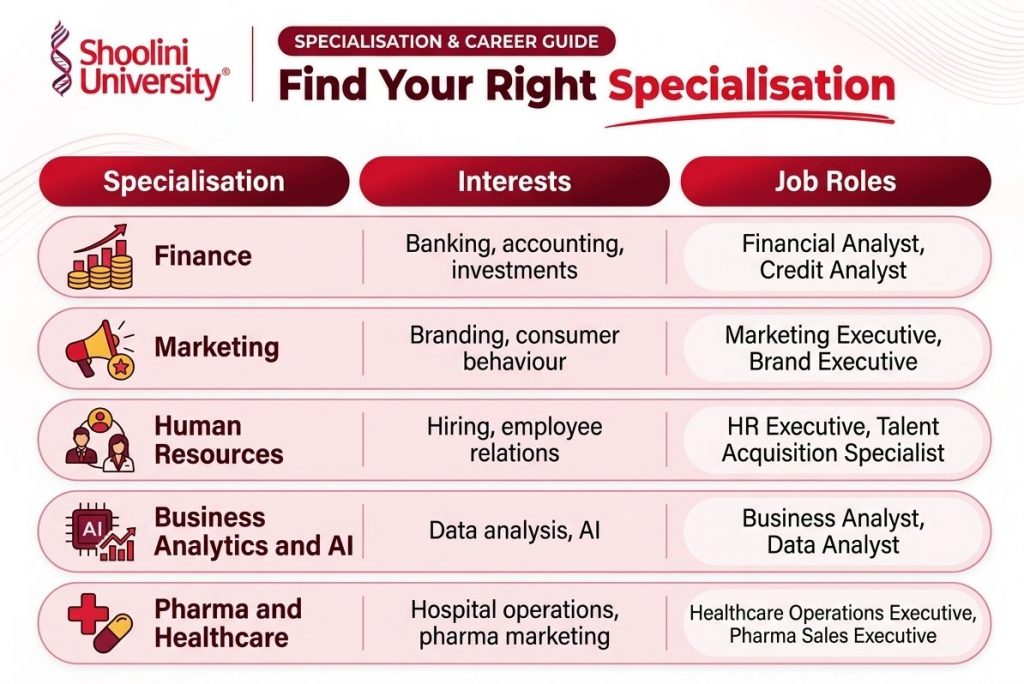
For example, Finance and Business Analytics both involve numbers, but their applications differ. Finance professionals examine financial performance, while business analysts may study sales, customer behaviour or operational efficiency.
Students should therefore compare job responsibilities rather than choosing a specialisation based only on popularity.
What Salary Can MBA Graduates Expect in India?
MBA salary after BCom in India depends on the specialisation, employer, location, experience and professional skills.
Take a look at the indicative annual salary benchmarks reported by Glassdoor and PayScale.
| Job Role | Indicative Annual Salary |
|---|---|
| Business Analyst | ₹9 LPA |
| Marketing Manager | ₹6.1 LPA |
| Financial Analyst | ₹5.7 LPA |
| Healthcare Product Manager | ₹5.5 LPA |
| HR Manager | ₹5.2 LPA |
These estimates cover different experience levels and are not directly comparable to fresher salaries or guaranteed placement packages.
A Finance graduate with financial modelling skills may qualify for different opportunities than someone with only classroom knowledge. Similarly, employers recruiting business analysts may look for SQL, Excel and data visualisation skills.
Internships, projects and certifications can help graduates demonstrate their abilities.
Rather than selecting a specialisation solely because of salary figures, students should consider the nature of the work and opportunities for professional growth.
How to Choose the Right MBA Specialisation and College
Choosing among the top MBA specialisations starts with identifying roles that suit your strengths and interests. Students who enjoy accounting and economics may prefer Finance. Those interested in customers and branding can explore Marketing, while graduates comfortable with statistics and technology may consider Business Analytics.
Reading job descriptions and speaking with people in those roles can show what the work involves day to day.
Once you’ve shortlisted a few specialisations, compare what each college offers. Start with the curriculum, faculty experience, internships, industry exposure and placement support. Look for practical projects and professional training that give students a chance to apply what they learn in class.
Recent placement reports can show which companies recruited, what roles they offered and the median salary package. Also check the college’s recognition and accreditation, along with fees and scholarship options.
Pursuing an MBA at Shoolini University
Shoolini University, Solan, offers a two-year NBA-accredited MBA through Shoolini Business School, with specialisations in Finance, Marketing, Human Resources, Business Analytics and AI, and Pharma and Healthcare. The Finance curriculum includes FinTech, venture capital, BFSI and financial derivatives, while Marketing covers digital marketing, brand management and retail.
The teaching team includes academics with experience at IIM, ISB and Oxford, alongside industry professionals who have worked at McKinsey, PwC and Citi.
Students participate in SPRINT, a Stanford-inspired skill-development bootcamp, and the 21-day Advanced Training Program (ATP), which helps them prepare for the workplace. The program also includes a two-month summer internship with a corporate mentor and V-Empower Coaching with ICF-certified coaches.
Shoolini Business School placed 85th overall in India and second in Himachal Pradesh in the Business Today–MDRA Best B-School Rankings 2026–27. Shoolini University is ranked 452nd globally and 10th in India in the QS World University Rankings 2027. It also holds NAAC A+ accreditation with a CGPA of 3.33 out of 4.
Applicants need a bachelor’s degree with at least 55% marks. They can submit scores from an accepted management entrance exam or take Shoolini’s entrance test. The admission process also includes an interaction with faculty.
Explore the MBA program at Shoolini University.
Conclusion
An MBA after BCom can open up careers across several areas of business. Finance builds on what commerce graduates already know. Marketing, Human Resources, Business Analytics and AI, and Pharma and Healthcare are also worth considering.
The best MBA specialisation after BCom depends on a student’s interests, skills and career goals. When comparing specialisations, start with what the jobs involve day-to-day, then factor in salary expectations.
Once you have a specialisation in mind, look at how each university teaches it. Check which subjects the program covers, what kinds of projects and internships students take on, and how the placement team helps them prepare for job applications and interviews. These experiences can help commerce graduates build on what they know and decide which roles to pursue after the MBA.
Sources
Frequently Asked Questions
Which MBA specialisation pays the highest after BCom?
Finance and Business Analytics can offer high-paying opportunities, particularly in investment banking, consulting and data-related roles. However, salaries depend on the employer, college, experience and professional skills.
Which MBA specialisations does Shoolini offer?
Shoolini Business School offers Finance, Marketing, Human Resources, Business Analytics and AI, and Pharma and Healthcare.
Is MBA better than CA or M.Com after BCom?
An MBA focuses on management careers, CA specialises in accounting, auditing and taxation, while M.Com provides advanced commerce education. The best option depends on career goals.
Is MBA Finance a good choice after BCom?
Yes. MBA Finance builds on accounting, economics and financial management, preparing graduates for opportunities in banking, investments and corporate finance.
What skills should BCom graduates develop before pursuing an MBA?
Communication, analytical thinking, problem-solving, Excel and presentation skills are useful. Students interested in analytics may also benefit from learning SQL or Power BI.


