


A career after BA LLB or BBA LLB can go in many directions. You can argue cases in court, join a law firm or work in a company’s legal team. Other options include judicial service, the UPSC Civil Services Examination, teaching and further study. Both degrees offer the same broad career options. The difference lies in the subjects taught alongside law. BA LLB includes subjects such as political science and sociology, while BBA LLB covers business and management.
More students are applying to study law, according to the latest entrance test figures. For the 2026 exam, 75,009 students registered for CLAT UG, the entrance test for five-year law courses at participating National Law Universities. That is up from 62,832 the year before. Courts need people too. As of July 2026, about 7,300 judicial officer posts in district and subordinate courts were vacant, the Law Ministry told Parliament.
This guide explains how to choose between BA LLB and BBA LLB, what each career involves and what you can earn.
Choosing Between BA LLB and BBA LLB?
BA LLB and BBA LLB graduates can apply for many of the same legal roles. Both let graduates practise law once they clear the bar exam.
BA LLB pairs law with Political Science, History, Sociology and Economics. These subjects explore how society and government work. That background can be useful in litigation, public policy or the civil services. BBA LLB pairs law with Management, Accounting, Finance and Marketing. Students learn how companies run and manage money. This helps in business deals, banking and company law.
BBA LLB pairs law with Management, Accounting, Finance and Marketing. The focus is on how companies run and manage money. This helps in business deals, banking and company law.
| Interests | Degree to Consider |
| Courts, politics and social issues | BA LLB |
| Business news, startups and company deals | BBA LLB |
| Numbers, accounts and finance | BBA LLB |
Graduates of either program can pursue a wide range of legal careers. A BA LLB graduate can join a corporate firm, and a BBA LLB graduate can become a judge. Internships and skills will count for more than the name of the degree. If you are still unsure, pick the subjects you would enjoy for five years.
How Do Litigation and Corporate Law Compare?
The litigation vs corporate law choice is the first big one most law students face.
When weighing litigation vs corporate law, it helps to look at the day-to-day work and how lawyers earn in their first few years.
Litigators meet clients, draft petitions and argue cases in court. Income is often low in the first few years while lawyers build their practice. The route into practice involves enrolling with a State Bar Council and passing the All India Bar Examination (AIBE).
Corporate lawyers work on contracts, deals and compliance for companies. At a law firm, they advise clients. In-house lawyers handle legal matters for their employer. Law firms and company legal teams hire through internships and recruitment drives. Entry-level roles typically come with a fixed salary.
Law graduates can also pursue careers in the judiciary, civil services, teaching and research. The table shows how graduates enter each field and how they’re typically paid when starting out.
| Career Path | Entry Route | Early Income |
| Litigation | State Bar Council enrolment and AIBE | Variable, often low at first |
| Corporate law at a law firm | Internships and firm recruitment | Fixed salary |
| In-house legal team | Internships or prior law firm experience | Fixed salary |
| Judiciary (Civil Judge, Junior Division) | State Judicial Service Examination, followed by training and a clerkship | Training pay, then the judicial pay scale on regular appointment |
| Civil services | UPSC Civil Services Examination or a state civil services exam | Government pay scale |
| Teaching and research | LLM and UGC-NET for many teaching posts. Research roles vary by institution. | Salary or fellowship stipend |
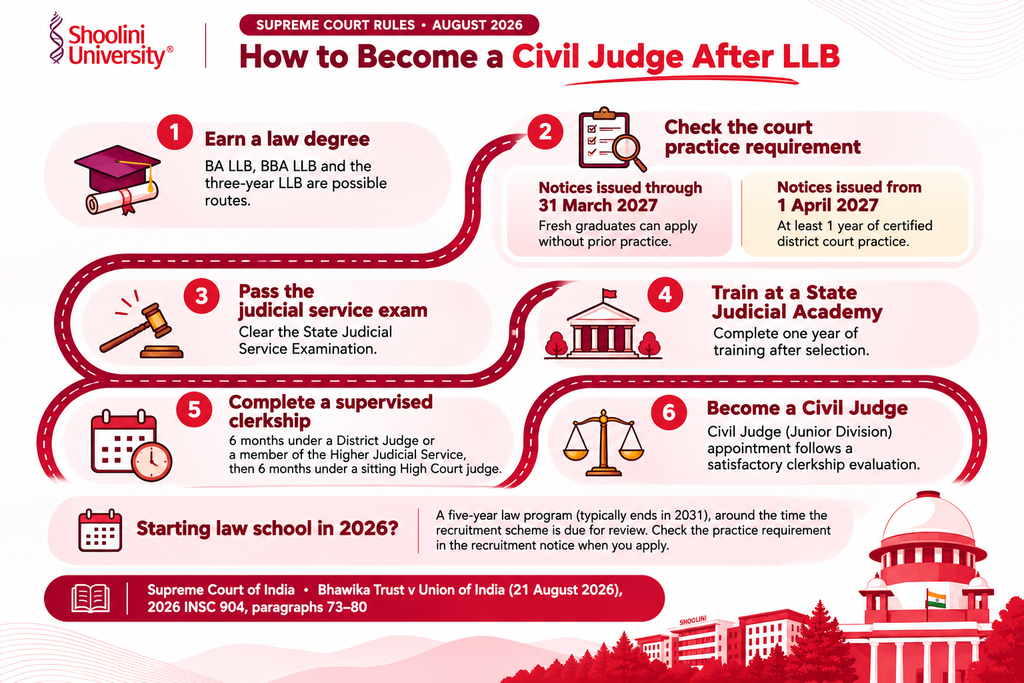
For Civil Judge (Junior Division) recruitment notices issued from 1 April 2027, candidates need at least one year of legal practice before they can sit the exam. A transitional rule allows fresh law graduates to apply under notices issued through 31 March 2027.
What Are the New Rules for Becoming a Judge?
For students weighing the judiciary and civil services after LLB, the rules for entry-level judicial recruitment changed in August 2026. The Supreme Court reduced the minimum period of practice required before taking the Civil Judge (Junior Division) recruitment exam from three years to one.
For recruitment notices issued up to 31 March 2027, fresh law graduates can apply without prior court practice. For notices issued from 1 April 2027, candidates must submit proof of at least one year of practice in district courts. After selection, candidates complete one year of training at a State Judicial Academy, followed by a year of supervised clerkship.
Students starting a five-year law program in 2026 are likely to graduate around the time the Supreme Court’s five-year recruitment scheme is due for review. The recruitment notice in force when they apply will set out the practice requirement.
Both BA LLB and BBA LLB graduates can also take the UPSC Civil Services Examination if they meet the age and other eligibility requirements. Law is one of the optional subjects in the Civil Services Main Examination.
Where Else Can a Law Degree Take You?
Many career options after BA LLB and BBA LLB sit outside courts and law firms.
Banks and finance companies hire law graduates for loan papers, recovery cases and banking rules. Tech companies and startups need people who know contracts, intellectual property and data privacy. India’s Digital Personal Data Protection Act, 2023 gives companies new rules to follow, and they need lawyers who understand them.
Legal Process Outsourcing (LPO) firms hire law graduates for legal research and document review for clients in India and abroad. NGOs and policy groups need lawyers for work on human rights, the environment and policy research. Government bodies and public sector companies also hire legal officers.
So your workplace does not have to be a courtroom. Corporate law careers in India now include roles in banking, technology, media and healthcare companies.
How Much Do Law Graduates Earn in India?
There is no single law graduate salary in India. Pay depends on the role, employer, city and area of law. PayScale India puts the average pay of an associate attorney at around ₹5.8 LPA, though the range is wide. A Civil Judge (Junior Division) starts on a basic pay of ₹77,840 a month, plus allowances, under the Second National Judicial Pay Commission scale. Treat these figures as rough guides.
Pay usually rises with experience and specialisation in areas such as tax or banking. Higher studies after BA LLB or BBA LLB can prepare graduates for specific roles. An LLM offers a chance to specialise and can lead to teaching roles. A Company Secretary (CS) course suits company law work. An MBA can help graduates move into business and management roles.
How to Use Your Five Years in Law School
You do not need to choose a career on day one. Use the next five years to find out what kind of work suits you. In your first two years, join moot courts, debates and legal aid camps. These give you a chance to try public speaking, research, writing and working with people.
In the third and fourth years, try internships in two different settings, such as an advocate’s office and a company legal team. Comparing them can help you decide which kind of work to pursue. Changing your mind after an internship is normal. Knowing which roles to rule out is as useful as knowing which ones to pursue.
By the fifth year, prepare for your chosen route. For litigation, learn the Bar Council enrolment and AIBE process. For corporate law, focus on placements and firm recruitment. For the judiciary or civil services, make a clear study plan.

What to Look for in a Law College
A law degree is both practical and academic, so look past the course name. Start by checking whether the Bar Council of India (BCI) approves the law program. That matters if you plan to practise law.
Then look at how students put what they learn into practice. Ask how often they take part in moot court competitions, work with legal aid clinics and visit courts. Find out, too, whether students get to meet practising lawyers and judges. Hearing about the cases they handle can give you a feel for how the profession works outside the classroom.
Alongside practical training, look at how the college helps students prepare for what comes after law school. Find out what support it offers for judicial service and other government exams. Then ask how the college helps with placements and where recent students have interned. Have they worked with law firms, corporate legal teams or senior advocates?
Studying Law at Shoolini University
Which law degrees can you study? Shoolini University offers BA LLB and BBA LLB after Class 12.
How is the university ranked and accredited? Shoolini is the No. 1 private university in India for the fourth consecutive year. It is ranked 452nd in the world and 10th in India in the QS World University Rankings 2027. It is NAAC A+ accredited, with a CGPA of 3.33 on a 4-point scale.
What does practical training look like? Law students take part in moot courts and legal aid activities. During the course, they meet practising professionals and receive career guidance. Model United Nations (MUN) events give students another chance to practise public speaking and negotiation.
Who can apply? You need to pass Class 12 in any stream with at least 55% marks. Shoolini accepts CLAT scores and also offers its own multiple-choice entrance test. BA LLB admission also includes an interaction with faculty.
Choosing Your Path
There is no fixed list of the best law career options in India. The right one depends on what kind of work suits you. When choosing between BA LLB and BBA LLB, start by comparing the subjects each degree pairs with law.
As the course progresses, try different kinds of legal work. A moot court may spark an interest in litigation. An internship with a company’s legal team can offer first-hand experience of corporate law, while working at a legal aid clinic can show what a career in public service might involve. By graduation, those experiences can help you decide where to start.
Explore BA LLB and BBA LLB at shooliniuniversity.com.
FAQs
Which is better for a career, BA LLB or BBA LLB?
Neither is better for everyone. BA LLB pairs law with subjects like Political Science and History, which suit litigation, the judiciary and the civil services. BBA LLB pairs law with management and finance, which suit corporate and business law. Pick the one that matches your interests.
Are BA LLB and BBA LLB graduates eligible for UPSC?
Yes. Both are graduate degrees and meet the education rule for the UPSC Civil Services Examination. You must also meet the age and other eligibility conditions. You can choose Law as your optional subject in UPSC Mains.
What is the starting salary after BA LLB or BBA LLB?
There is no fixed figure. Law firms and company legal teams pay a fixed salary. Pay in independent litigation depends on your clients and practice. PayScale India puts the average associate attorney salary at around ₹5.8 LPA.
Which industries hire law graduates apart from law firms?
Banks and finance companies, tech companies and startups, Legal Process Outsourcing firms, NGOs and policy groups, and government bodies and public sector companies all hire law graduates.
Does Shoolini University offer practical exposure in law programs?
Yes. At Shoolini University, law students take part in moot courts, legal aid activities and Model United Nations. They also meet practising professionals and get career preparation during the program.


