

According to NEET UG 2026 results, over 11 lakh of the nearly 20 lakh students who appeared qualified, and conversations around medical careers are everywhere. MBBS is no longer the only path for students who studied biology in Class 12. Biotechnology is a growing field, bringing together biology, healthcare, drug discovery, genetics, food science, agriculture, and technology.
So, how do you build a successful biotechnology career after Class 12? It starts with one decision: the course you pick after Class 12. Everything else follows from there.
What is Biotechnology?
Biotechnology is the use of living organisms, cells, and biological processes, combined with chemistry, engineering, and data science, to solve problems in medicine, agriculture, food production, and the environment.
At its core, biotechnology studies organisms like bacteria, enzymes, plant cells, and human tissue. This research gives us vaccines developed using genetically modified organisms, crops engineered to resist drought, and enzymes that break down industrial waste.
Key biotechnology areas:
- Medical biotechnology: Vaccines, diagnostics, gene therapy, drug development
- Agricultural biotechnology: Genetically modified crops, biofertilisers, pest-resistant seeds
- Industrial biotechnology: Enzymes and microbes used in manufacturing, biofuels, and waste treatment
- Environmental biotechnology: Bioremediation, waste management, sustainable resource use
For a Class 12 student, biotechnology opens up more paths than most expect: well beyond labs and research institutes, into pharmaceutical companies, food and agriculture firms, biotech startups, government research bodies, and academia.
Why Choose Biotechnology After Class 12?
Biotechnology is a good fit if you like biology, enjoy research, and want to work on problems that matter. You will find it almost everywhere:
- Healthcare and medicine
- Drug discovery
- Genetics and genomics
- Agriculture
- Food technology
- Environmental biotechnology
- Bioinformatics
- Industrial biotechnology
Most biotechnology jobs today mix biology with technology, data, and structured research — the more comfortable you are moving between lab and laptop, the more of these open up to you.
But liking the subject is only the first step; the bigger question is which course to choose.
Best Biotechnology Courses After Class 12
BSc (Hons) Biotechnology: A strong fit if you enjoy biological sciences and lab work. The course covers research-focused study and lab training, often with earlier access to research projects. It opens paths into research labs, healthcare, pharmaceuticals, quality control, and further studies.
BSc (Hons) Microbiology: A good choice if you find bacteria, viruses, and fungi interesting and want to understand how they work. The degree opens up diagnostics, food and pharmaceutical quality control, research labs, and environmental testing, and it pairs naturally with biotechnology if you want to keep your options open.
B Tech Biotechnology AI: With AI now central to most industries, this future-ready course combines biology and engineering with artificial intelligence: along with bioprocess engineering, industrial biotechnology, and manufacturing, you build AI and data-analysis skills used across drug discovery, diagnostics, and genomics. The mix works well if you enjoy both lab work and computing.
Also consider Bioinformatics, Biochemistry, Biomedical Sciences, and Food Technology, each a strong career track. Your choice usually comes down to what pulls you in the most: research, healthcare, technology, or industry.
Shoolini University, for instance, runs a four-year BSc (Hons) Biotechnology program. You will need 10+2 with at least one science subject and a minimum of 55 per cent marks; admission runs through CUET, NEET, JEE, or SAT scores, or Shoolini’s own multiple-choice entrance test followed by a faculty interaction. Shoolini also runs a BSc (Hons) dual degree with The University of Melbourne on a 2+2 model.
How to Build a Successful Biotechnology Career After Class 12
Here is a step-by-step way to approach it.
Step 1: Choose the right course. Do not go by rankings alone. Look at the curriculum, the labs, the research opportunities, the faculty, industry links, internships, and how well the course leads into higher studies. This is what separates the best biotechnology colleges in India from the rest.
Step 2: Build strong fundamentals. Most biotechnology careers rest on the same core subjects: molecular biology, genetics, microbiology, cell biology, biochemistry, and bioinformatics. Get these right early, and everything after gets easier.
Step 3: Learn hands-on lab skills. You need practice with DNA extraction, PCR, gel electrophoresis, gene cloning, cell culture, microbial work, fermentation, and bioprocessing.
Step 4: Learn bioinformatics and data analysis. Biotechnology today runs on data almost as much as on lab work. Get comfortable with bioinformatics tools, biological databases, sequence analysis, and basic computing; add data skills to your biology and your options widen.
Step 5: Get into research early. If research is your goal, start now. Help faculty with their projects, run your own small experiments, present your findings, and try to contribute to a publication or a patent while you are still studying. This is where Shoolini’s research culture stands out.
Step 6: Build the skills beyond the lab. A few other skills matter just as much once you are working: clear communication, technical report writing, teamwork, problem-solving, and a working grasp of industry rules, bioethics, intellectual property, and entrepreneurship. Employers value graduates who pair lab or data skills with these too.
Your Biotechnology Career Roadmap After Class 12

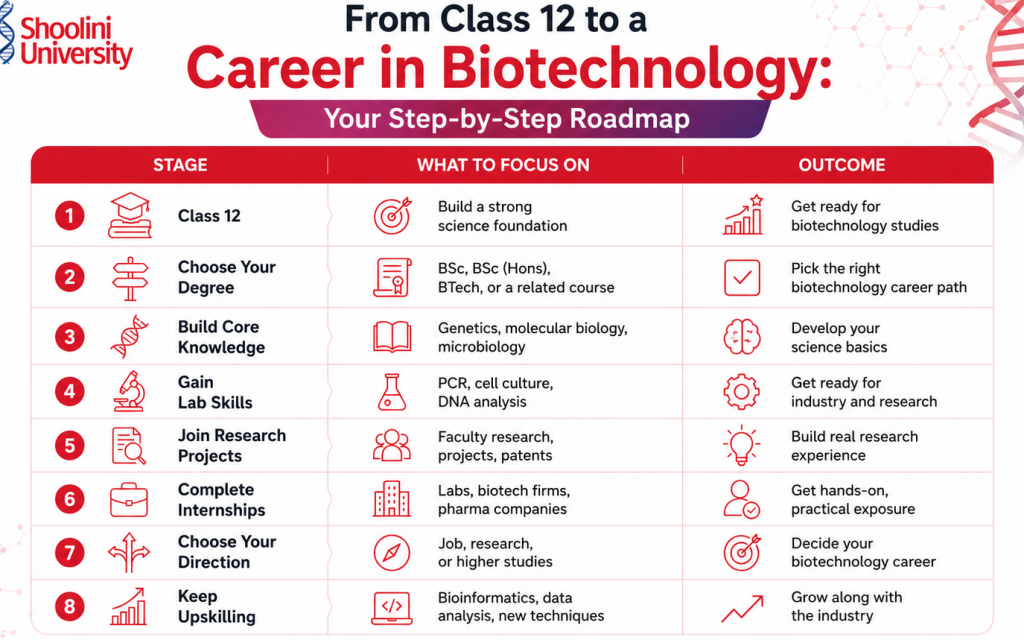
A strong biotechnology career comes from the right mix of education, practical skills, research exposure, and steady learning.
Career Options, Jobs, and Salary After a Biotechnology Degree
A biotechnology degree opens up roles such as:
- Research Intern
- Scientific Assistant
- Clinical Research Professional
- Quality Assurance Executive
- Quality Control Analyst
- Laboratory Technician
- Research Associate
- Forensic Science Professional
- Bioinformatics Professional
- Bioprocess Associate
You’ll find these roles across pharmaceutical companies, biotechnology firms, research labs, hospitals, food and agriculture businesses, and environmental organisations — your biotechnology career path comes down to which setting suits you best.
The field is also opening up in newer directions like bioinformatics, genomics, computational biology, and personalised medicine, and some graduates are starting their own ventures around diagnostics, biotech products, and food innovation.
Biotechnology salary in India depends on several things: your degree, your specialisation, your research experience, your technical skills, your employer, your city, and any qualifications you add after your first degree. Entry-level pay generally starts between ₹2.5 and ₹8 LPA, with specialised roles in bioinformatics, genetic engineering, and process management at the higher end. Actual pay varies by company and city, and students with research exposure, specialised skills, or a postgraduate degree tend to reach better roles over time.
Higher Studies After BSc Biotechnology
Many students build on their degree instead of jumping straight into a job. Common choices include:
- M Tech Biotechnology
- MSc Biotechnology
- MSc Biotechnology (1 Year)
- MSc Microbiology
- MSc Microbiology (1 Year)
- PhD Biology
- PhD Biotechnology
- PhD Genetics
- PhD Microbiology
Higher studies after BSc Biotechnology matter most if you are aiming for specialised research or advanced scientific roles; they’re also the best way into a biotechnology research career. An MSc or PhD built on early faculty work, scientific writing, and publishing while you study is what turns research from an interest into a path.
Why Study Biotechnology at Shoolini University?
Here is what that research culture looks like in practice.
Research-led learning: Shoolini’s Summit Research Program gives undergraduates research exposure early on: designing experiments, reading scientific papers, and analysing data. Its One Student, One Patent policy has every student work toward a patentable idea during their degree, part of a broader effort that has crossed 2,000+ intellectual property applications, backed by three campus incubators.
Biotechnology students also get access to a dedicated Centre of Excellence for Biotechnology, a Research Centre in OMICS and Biodiversity, and a Commercial Food Testing Lab sponsored by the Ministry of Food Processing Industries, Government of India, with hands-on access to government-grade testing equipment.
Experienced faculty: Faculty at the School of Applied Sciences and Biotechnology bring experience from Oxford, the National Institutes of Health (USA), the National Cancer Institute (USA), and IISc. Dean of Research and Development Pardeep Singh ranks among the top 2 per cent of scientists worldwide in the Stanford University list.
International exposure: The school has collaborations with 250+ leading international universities such as The University of Melbourne, Lanzhou University (China), Gachon University (Korea), the University of Naples (Italy), the University of Arkansas (USA), and the University of Maryland (USA).
Strong Life Sciences rankings:
- No. 1 private university in India for the fourth consecutive year (QS World University Rankings 2027)
- Ranked 452nd in the world and 10th in India (QS World University Rankings 2027)
- No. 3 in India for Life Sciences (THE World University Rankings by Subject 2026)
- No. 1 in Asia for Citations per Paper (QS Asia University Rankings 2026)
Choosing the Right Path
When you compare the best biotechnology colleges in India, look beyond the classroom: research opportunities, quality of labs, faculty expertise, undergraduate research programs, industry exposure, internships, a current curriculum, patents, international collaborations, and support for higher studies.
A strong biotechnology career after Class 12 begins well before graduation day, with the right degree, solid fundamentals, lab experience, research exposure, and a clear choice between a job and higher studies. If research is your goal, Shoolini University’s biotechnology programs, from BSc (Hons) and B Tech through to M Tech and PhD, are built for exactly that path.
Apply now to secure your seat in Biotechnology programs at Shoolini University.
Sources and References
- National Testing Agency (Official statement via ANI), NTA declares NEET (UG) 2026 results — https://aninews.in/news/national/general-news/nta-declares-neet-ug-2026-results-1121-lakh-candidates-qualify-counselling-schedule-on-track20260716225417/ (11.21 lakh qualified out of nearly 20 lakh candidates)
- FindMyCollege, Scope of Doing B.Sc Biotechnology in India (2026) — https://articles.findmycollege.com/jobs-after-doing-bsc-biotechnology/
- FindMyCollege, Biotechnology Salary in India 2026 — https://articles.findmycollege.com/biotechnology-salary-in-india/
- IILM, Jobs After B.Tech Biotechnology (2025) — https://iilm.edu/blog/7-highest-paying-jobs-after-doing-b-tech-in-biotechnology/
- Biotecnika, Career After BSc Biotechnology — https://www.biotecnika.org/2025/11/career-after-bsc-biotechnology-top-jobs-salaries-and-higher-education-paths/
- Shiksha.com, Biotechnology Career: Salary, Scope & Jobs Opportunities in India 2026 — https://www.shiksha.com/science/biotechnology-course-career-chp
FAQs
Q1. What are the best biotechnology courses after Class 12?
BSc (Hons) Biotechnology and B Tech Biotechnology AI are the main routes, along with related courses like Bioinformatics and Microbiology.
Q2. What are the career options after studying biotechnology?
Research, pharmaceuticals, clinical research, QA/QC, bioinformatics, healthcare, food biotechnology, and higher studies if you want to specialise further.
Q3. Is biotechnology a good career option in India?
Yes. It stays relevant across healthcare, pharmaceuticals, agriculture, food science, research, and newer biological technologies, so demand for trained graduates stays fairly steady.
Q4. What entrance exams are required for biotechnology courses?
Most universities look at CUET, NEET, JEE, or SAT scores, or run their own entrance test. At Shoolini, admission runs through any of these or the university's own multiple-choice test, followed by a faculty interaction.
Q5. Can biotechnology students get government jobs?
Yes, through government research bodies, laboratories, public healthcare institutions, and other scientific organisations, depending on what each one is recruiting for.
Q6. What skills are required for a successful biotechnology career?
Lab skills, molecular biology, bioinformatics, data analysis, designing experiments, clear communication, and critical thinking.


