
Research from the first year, faculty guidance on scientific projects, and support to develop patentable ideas make B Tech Bioinformatics at Shoolini a unique program. With a strong combination of biology, programming and data analysis, students build a solid foundation and learn how to apply these skills.
Applications range from research on blood tests that can help detect some cancers earlier to work that supported COVID-19 vaccine development. In each case, scientists use bioinformatics to make sense of biological data and apply it to healthcare.
This blog looks at how Shoolini prepares students for this field, covering its curriculum, research opportunities, admission requirements and career options.
What Is B Tech Bioinformatics and Who Is It For?
The four-year B Tech Bioinformatics course combines biology and computing, teaching students to analyse biological data and apply it to research. It suits students who enjoy biology, want to understand how living systems work and are keen to learn programming and data analysis. You don’t need prior coding experience or advanced biology knowledge to begin; the course builds these skills from the basics.
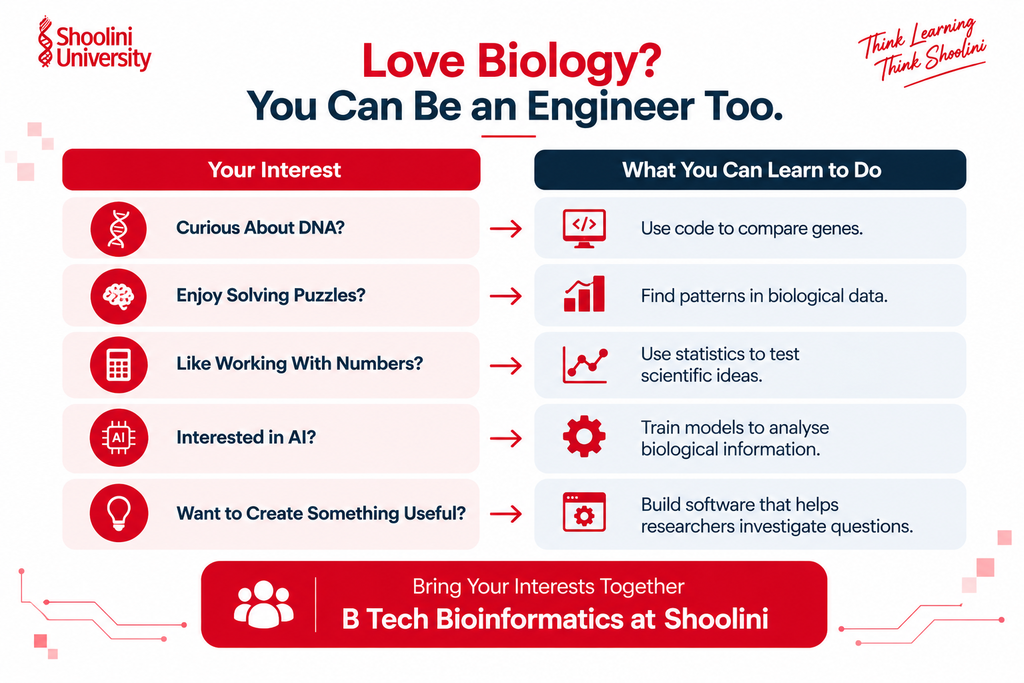
The course combines genomics, molecular biology, and cell biology with programming in Python and R, machine learning, data analysis, and bioinformatics tools. As students progress, they learn to analyse genomic data, work with sequencing information, and interpret results across medicine, agriculture, and scientific research.
This mix of biology, computing, and data skills also makes bioinformatics graduates valuable across research, healthcare, biotechnology, and related industries.

What Is Happening in Indian Bioinformatics Right Now?
Bioinformatics is helping researchers in India analyse genetic data and apply AI to biological research.
In February 2026, during the India AI Impact Summit, Union Minister Dr Jitendra Singh said that large-scale genome sequencing initiatives supported by the Department of Biotechnology were already AI-enabled. He also announced plans to establish Bio-AI Mulankur hubs in 2026, bringing AI-based predictions and laboratory testing together.
Research institutes are also combining different types of biological and health data. For example, CSIR-CCMB is participating in CSIR’s Phenome India project, which links genetic information from thousands of Indians with clinical data. Projects like this need people who can understand the biology and analyse the data.
Researchers in India can also access global resources such as the AlphaFold Database. In May 2026, EMBL announced that almost 80,000 high-confidence predictions of complexes formed by two different proteins had been added to the AlphaFold Database. The work involved EMBL-EBI, Google DeepMind, NVIDIA and Seoul National University. The database provides access to more than 200 million protein structure predictions.
For students, these projects show how Python programming, machine learning, and protein structure analysis apply to biological research.
What Does the B Tech Bioinformatics Program at Shoolini Cover?
The curriculum starts with the basics of biology and gradually moves towards the computational skills students need to work with biological data. Along the way, students become familiar with tools and methods used in research labs and the biotechnology industry.
Core Areas Covered Across Four Years
- Molecular Biology and Genomics: Understanding genes, DNA, cells and biological processes at the molecular level.
- Python and R Programming: Learning the programming languages commonly used to analyse and work with biological data.
- Bioinformatics Tools: Working with tools such as BLAST, GATK, Galaxy and Bioconductor that are widely used for biological data analysis.
- Next-Generation Sequencing: Learning how to work with and interpret data generated through modern DNA sequencing technologies.
- Machine Learning for Life Sciences: Understanding how machine learning can be applied to areas such as drug discovery, disease prediction and protein analysis.
- Structural Bioinformatics: Studying protein structures and learning about computational tools used to predict and analyse them.
- Biostatistics: Building the statistical skills needed to analyse and interpret biological data.
- Research Methodology: Learning how to plan research, analyse results and present scientific findings clearly.
The School of Bio-Engineering and Food Technology offers the program. Students also learn in a research-focused university environment, where they can gain exposure to ongoing work in areas such as biotechnology, genomics and computational biology.
What Makes Shoolini’s Bioinformatics Program Different?
Three things stand out: research access from year one, a patent culture built into the degree, and faculty who are active researchers.
Research from year one: Most undergraduate programs keep students in classrooms for the first two years before any real research exposure. At Shoolini, a first-year bioinformatics student can work on an actual research project in a DRDO-, DST-, or DAE-sponsored laboratory. That changes the quality of learning and the kind of graduates the program produces.
The IP portfolio: Shoolini has filed 2,000+ intellectual property applications—comprising 1,224 utility patents, 512 design applications, 247 copyrights, and 17 trademarks. This is backed by the One Student, One Patent policy, which guides every student to develop a patentable idea during their time at the university. For a bioinformatics student, that means learning not just to analyse biological data, but to contribute original ideas with real-world applications.
Faculty from active research backgrounds: 25 scientists at Shoolini appear on Stanford University’s list of the world’s top 2% scientists. The h-index of the university exceeds 150. These are the people supervising bioinformatics research, guiding final-year projects, and teaching the tools students will use in their careers. A lab where faculty actively publish is different from one where research stopped a decade ago.
What Are the Career Options After B Tech Bioinformatics from Shoolini?
A B Tech in Bioinformatics can lead to a range of careers across biotechnology, healthcare, pharmaceuticals, research and technology. The exact role depends on a student’s interests and whether they choose to move towards research, data analysis, AI or clinical applications.
Some of the career options include:
- Bioinformatics Analyst: Working with genomic and proteomic data for research, healthcare or biotechnology projects.
- Computational Biologist: Using computational methods to study biological systems and solve research problems.
- Genomic Data Scientist: Analysing large sequencing datasets generated by hospitals, research centres and genomics companies.
- AI and Drug Discovery Researcher: Using machine learning and biological data to support drug discovery and development.
- Clinical Data Analyst: Managing and analysing data generated through clinical research and trials.
- Research Scientist: Working with organisations such as CSIR, ICMR, ICAR, DBT and other research institutions on projects involving biology and computational analysis.
Salary depends on the role, organisation, skills and experience. As an indicative range, entry-level bioinformatics roles may offer around ₹4–8 LPA, while professionals with a few years of experience can move into higher-paying roles as they develop specialised skills in areas such as genomics, AI and computational biology.
What Are the Eligibility and Admission Requirements?
Straightforward — open to both PCB and PCM students.
- 10+2 with Physics, Chemistry, and Biology or Mathematics
- Minimum 50% aggregate (varies slightly by category)
- Admission through JEE Main, CUET, or Shoolini’s own entrance process
Students from both science streams are eligible. No prior coding experience is required for admission and programming is taught as part of the degree from year one.
Shoolini University — Rankings and Recognition
For a research-focused program like B Tech Bioinformatics, rankings matter in a specific way. They show whether the faculty are producing research, not just teaching about it.
Shoolini University is ranked 452nd in the world and 10th in India (QS World University Rankings 2027), and is the only Indian private university in the global Top 500. It is the No. 1 private university in India for the fourth consecutive year. In QS Asia University Rankings 2026, it ranks No. 1 in Asia for Citations per Paper. This metric directly reflects the quality of research output. In QS Subject Rankings 2026, Biological Sciences ranks in the 401–450 band globally and 10th in India.
In THE World University Rankings by Subject 2026, Life Sciences is ranked in the 301–400 band globally and No. 3 in India.
It holds NAAC A+ accreditation with a CGPA of 3.33 on a 4-point scale and ranks 69th among universities in India—the only university from Himachal Pradesh in the national top 100 (NIRF 2025).
These rankings directly reflect research quality in the sciences, which a bioinformatics student should consider when choosing where to study. B Tech Bioinformatics.
Sources:
FAQs
Q1. What is the eligibility for B Tech Bioinformatics after 12th?
Students who have completed Class 12 with Physics, Chemistry and Biology/Mathematics from a recognised board are eligible for B Tech Bioinformatics.
Q2. What is the scope of B Tech Bioinformatics in India?
B Tech Bioinformatics offers career opportunities in biotechnology, pharmaceuticals, healthcare, genomics, research, data science and computational biology.
Q3. How is bioinformatics connected to AI?
Bioinformatics uses AI and machine learning to analyse biological data, identify patterns and support research in areas such as genomics and drug discovery.
Q4. Does Shoolini University offer scholarships for B Tech students?
Yes, Shoolini University offers scholarships to eligible B Tech students based on academic performance and other criteria.
Q5. What is the admission process for B Tech Bioinformatics at Shoolini University?
Students can apply online, meet the eligibility criteria, submit the required documents and complete the admission process as guided by the university.