

If you want to study B Tech CSE, you have probably heard about AI, cybersecurity and data science. Quantum computing may be a name you haven’t heard yet. Words like qubit and superposition make it sound complicated, which is why many students ignore it.
But there are reasons to give it a closer look. India’s National Quantum Mission has ₹6,003.65 crore allocated for 2023–24 to 2030–31. In December 2024, Google’s Willow chip showed that using more qubits for error correction could reduce errors. IBM, TCS and the Andhra Pradesh government have also announced plans to install a quantum computer in Amaravati, where researchers and companies could test potential applications.
Now think about your own timeline. If you start B Tech CSE in 2027, you will finish around 2031. That is when the mission’s current funding period ends. A technology that looks new today could be further developed when you look for your first job. You don’t need to decide on a quantum research career now. Start by understanding what this field is and where a CSE student fits in.
How Do Quantum Computers Work?
Quantum computing is a way of processing information using quantum physics. Conventional computers use bits, which are either 0 or 1. Quantum computers use qubits. A qubit can exist in a combination of the states associated with 0 and 1, called superposition. When measured, it gives one of those two outcomes. Quantum algorithms use this and other quantum properties to tackle certain hard problems, such as studying how molecules behave.
A quantum computer won’t replace your laptop or phone. Researchers are studying how it could help in chemistry, drug discovery, planning and scheduling, and cryptography. Cryptography is the science of protecting information.
Right now, one of the biggest problems is errors. Qubits are sensitive to disturbances, which can disrupt calculations. In Google’s Willow experiments, using larger groups of qubits for error correction reduced errors. Each tested increase in group size roughly halved the error rate.
This is where CSE comes in. Someone has to write the software, design the algorithms, keep the systems safe and connect quantum machines with conventional computers. An algorithm is a step-by-step method for solving a problem. All of this draws on computer science skills.
Why Is India Investing in Quantum Technology?
India is investing in research, equipment and training to develop its own quantum technologies. The National Quantum Mission has four focus areas. These are quantum computing, quantum communication, quantum sensing and metrology (the science of measurement), and quantum materials and devices.
The mission’s four research hubs have been established at IISc Bengaluru, IIT Bombay, IIT Madras and IIT Delhi. The Department of Science and Technology has also worked with AICTE to create curricula for a B Tech minor and an M Tech in quantum technology.
The Amaravati project is part of this wider investment. In May 2025, IBM, TCS and the Andhra Pradesh government announced plans for an IBM Quantum System Two with a 156-qubit Heron processor at the city’s Quantum Valley Tech Park. So quantum computing in India now has government funding, dedicated curricula and a planned computing facility behind it.
How Are Quantum Computers Linked to AI?
AI and quantum computing meet in a field called quantum machine learning. Researchers are testing whether quantum computers can make some machine learning tasks faster. It is still early, and a practical speed advantage for everyday AI tasks has not yet been established.
The good news is that both fields use linear algebra and probability. If you are already learning these subjects and Python for AI, you have a good start for quantum too. You will have new concepts to learn, but some of the maths and programming will already be familiar.
What Does Quantum Mean for Cybersecurity?
Quantum computing and cybersecurity are already connected. Encryption is the lock that protects your logins, payments and messages. A sufficiently powerful quantum computer could break some of these locks in the future. So in August 2024, the US National Institute of Standards and Technology released its first three post-quantum cryptography standards, designed to withstand quantum attacks.
Companies will need engineers to update their systems to meet these new standards. If you like cybersecurity, post-quantum cryptography is an area you could work in.
Where Should a CSE Student Start?
You don’t need a physics book on day one. Quantum computing for CSE students starts with familiar subjects such as programming and maths. Here’s a starting point.
- Python. Learn to build small projects. Qiskit from IBM and Cirq from Google both use Python.
- Linear algebra and probability. These help you describe quantum states and calculate the probabilities of measurement results.
- Algorithms. Learn why some problems are hard for conventional computers.
- Quantum basics. Learn what a qubit is, and ideas like superposition, measurement and entanglement.
- Quantum programming. Try Qiskit or Cirq. IBM and AWS (through Amazon Braket) let you run small programs on real quantum machines online.
- Your direction. As you learn, see whether you prefer software, algorithms or security.
You don’t have to learn everything at once. The programming, maths and algorithm skills you build along the way are useful in AI and cybersecurity too, even if you pick a different path later.

Where Could These Skills Take You?
Let’s be realistic. Quantum is an emerging technology career. There aren’t thousands of jobs waiting for fresh graduates today. But there aren’t enough trained people either. McKinsey research, shared by the World Economic Forum in 2025, found about one qualified candidate for every three quantum jobs.
| Role | What You Might Do |
| Quantum Software Developer | Write and test quantum programs |
| Quantum Algorithm Engineer | Build step by step methods for hard problems |
| Post Quantum Security Engineer | Make security systems safe against quantum attacks |
| Quantum Research Scientist | Research how quantum machines and software work |
| Quantum Hardware Engineer | Work on qubits, chips and the parts that control them |
As a CSE graduate, software, algorithm and security roles suit you best. Hardware jobs need more physics or electronics. Research jobs may need a master’s degree. So think of one quantum course as the first step in a focus area.
What Should You Look for in a University?
You don’t need a degree with ‘quantum’ in its name. At the start, strong computer science basics matter more. When you compare the best engineering universities in India, ask these questions.
Does the university offer quantum training?
Shoolini’s Student Research Council and C-DAC Bangalore ran a seven-day National Quantum Training Program in 2026. It was online. 188 people joined from 68 organisations in India, the US, the UK, the UAE and Singapore. As many as 116 finished the training and 89 earned Certificates of Merit. Participants covered quantum machine learning, quantum cryptography and error correction. They also used Qniverse, a quantum platform built by C-DAC Bangalore. Next, Shoolini plans a National Quantum Informatics Program in December 2026 with C-DAC Bangalore, DigiTod and qBraid. It is also discussing a Centre of Excellence in Quantum Computing.
Can undergraduates do research?
Shoolini has a One Student, One Patent policy. Every student develops a patentable idea during their time at the university. The campus has three incubators. The university has also crossed 2,000+ total intellectual property applications. These include patents, designs, copyrights and trademarks.
Are AI and cybersecurity available?
Yes. B Tech CSE at the Yogananda School of AI, Computers and Data Science offers Artificial Intelligence, Cyber Security, Cloud Computing, Data Science, Blockchain and IoT, DevOps, Game Design and AR/VR, UI/UX, and Graphics and Animation. AI and Cyber Security connect most closely to quantum machine learning and post-quantum security.
Can you learn outside the syllabus?
Students get labs with high-performance GPU computing, Apple labs, and the AI and Robotics Centre built with Sirena Technologies. They can also work towards certifications from IBM, AWS, Google, Microsoft, Stanford, NYU, Vanderbilt, DeepLearning.AI and ISC².
What do the rankings say?
Shoolini is ranked 452nd in the world and 10th in India in the QS World University Rankings 2027. It is the only Indian private university in the global Top 500 and the No. 1 private university in India for the fourth consecutive year. It is No. 3 in India for Engineering in the THE World University Rankings by Subject 2026. It is also NAAC A+ accredited, with a CGPA of 3.33 on a 4-point scale.
Where do graduates work?
Shoolini’s engineering placement network covers 250+ companies. The highest B Tech CSE package on record is ₹42 LPA at Algo8.
Conclusion
You do not need to specialise in quantum computing from the start. Build a strong foundation in computer science first. Learn Python, understand how algorithms work, try AI and cybersecurity, and build projects. Then learn how a qubit works and write a small quantum program.
By 2031, quantum computing may be far ahead of where it is today. Your career may also take you in another direction. Either way, the coding, maths and security skills you build will remain useful.
B Tech CSE admissions at Shoolini University are open.
Sources
- Google Research, Making quantum error correction work
- Department of Science and Technology, National Quantum Mission
- IBM, IBM, TCS and Government of Andhra Pradesh plans for India’s largest quantum computer, 2 May 2025
- World Economic Forum, How we upskill quantum talent for a quantum-safe future, November 2025
- Shoolini University, Shoolini and C-DAC Organise National Quantum Training Program, 11 August 2026
FAQs
Q1. What's the job potential in quantum computing?
Demand is ahead of supply. McKinsey research shared by the World Economic Forum found about one qualified quantum candidate for every three quantum jobs. India's National Quantum Mission also funds research hubs and labs, which need engineers and researchers.
Q2. Why is quantum computing important for the future?
Google says quantum computers could help in chemistry, new medicines and cryptography. Cryptography is already affected, since NIST has released new encryption standards made to stay safe against quantum attacks.
Q3. How is quantum computing connected to artificial intelligence?
The link is quantum machine learning. Researchers are testing if quantum computers can make some machine learning tasks faster. It is still early, so build strong AI and maths skills first.
Q4. Which industries will need quantum computing professionals?
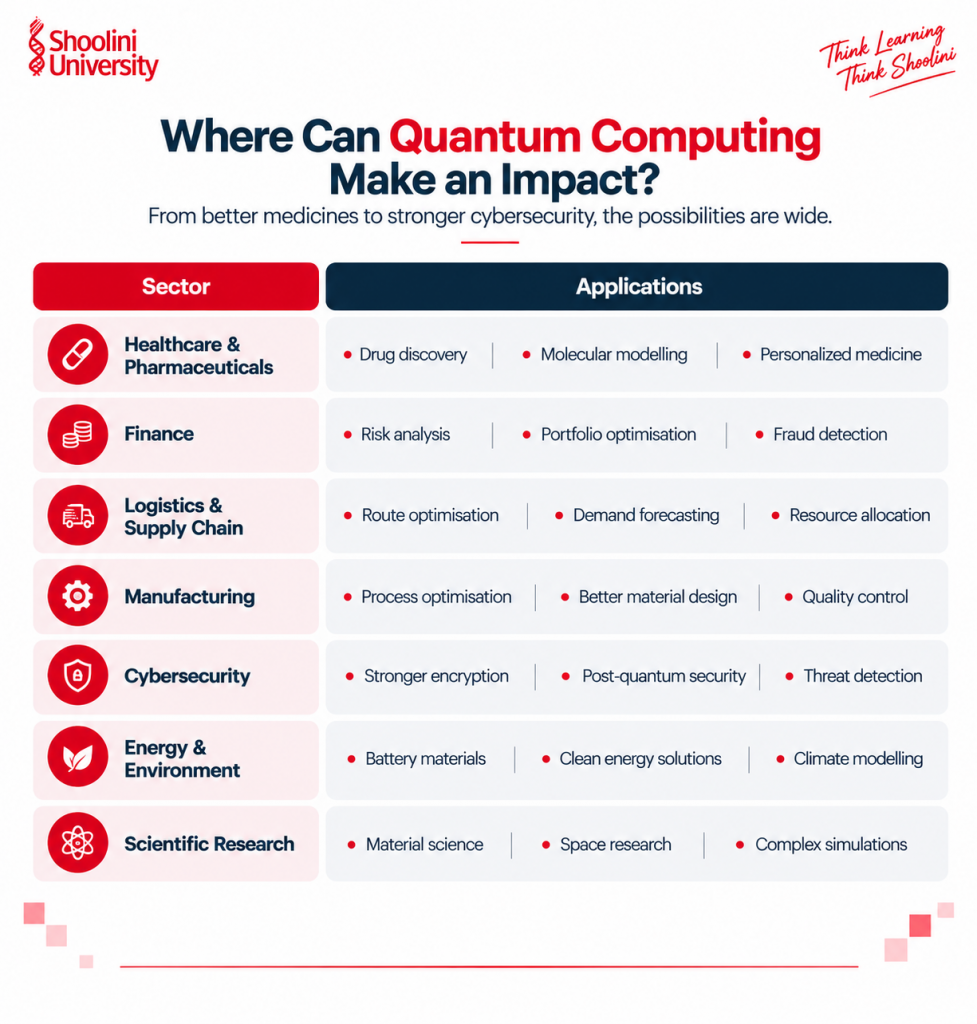
IBM chief executive Arvind Krishna named medicines, materials science, banking and finance, logistics, cybersecurity and AI. Some uses are closer to real life than others.
Q5. Can CSE students build careers in quantum computing?
Yes. CSE students already study programming, maths and algorithms, which are the base for quantum work. Software, algorithm and security roles suit them most, while hardware roles need more physics.
Q6. What career opportunities are available in quantum computing?
Roles include quantum software developer, quantum algorithm engineer, post quantum security engineer, quantum research scientist and quantum hardware engineer. Research and hardware roles may need a master's degree.
Q7. Do I need to be good at physics to learn quantum computing?
You need a few basic quantum ideas, but you can start quantum programming without advanced physics. Linear algebra, probability, algorithms and Python matter most.
Q8. Which programming language is used in quantum computing?
Python is the best place to start. Qiskit and Cirq both use it.
Q9. Will quantum computers replace normal computers?
No. Quantum computers are being built for specific problems and will work next to normal computers.


