
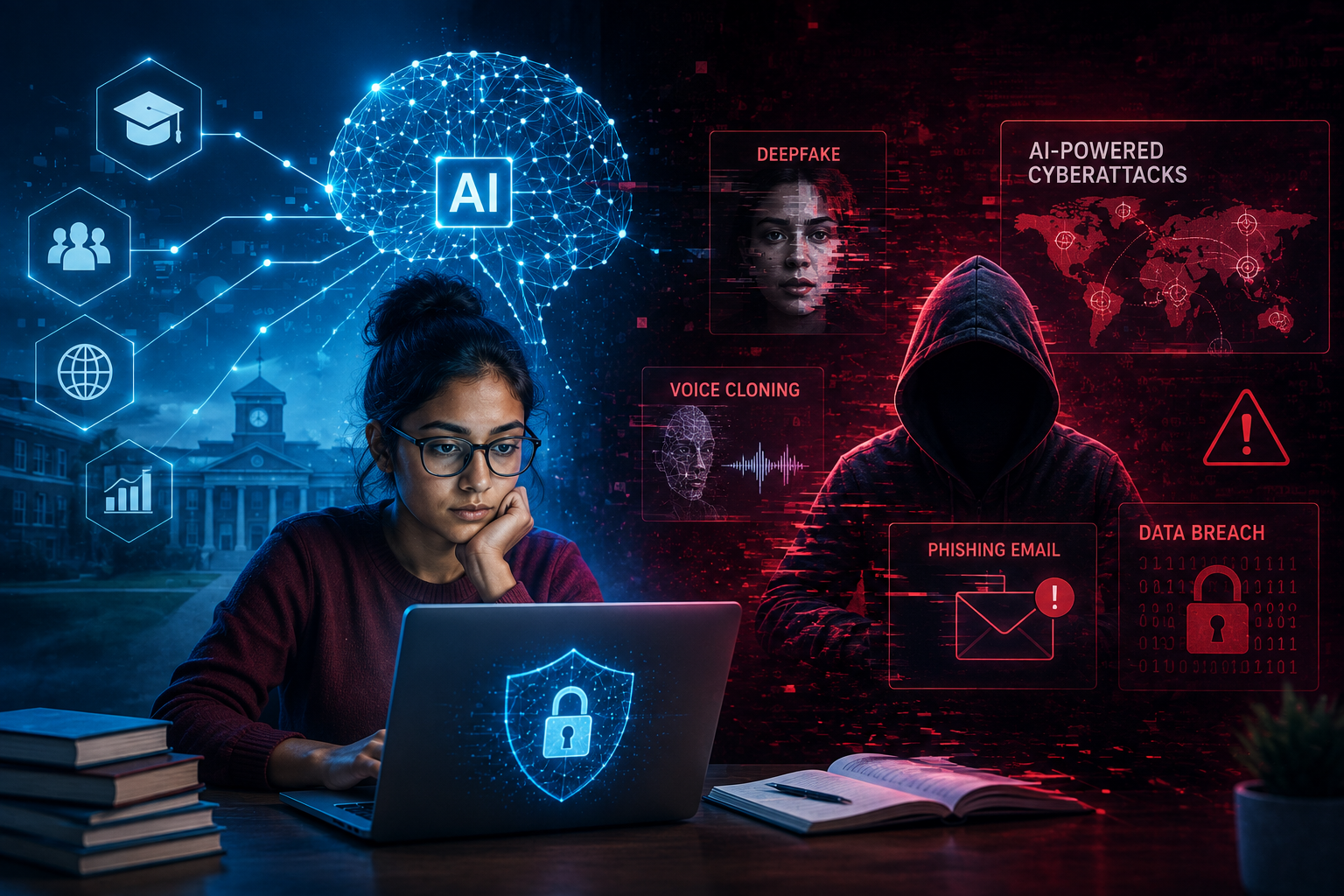
Artificial intelligence is now part of everyday life. We use it to write emails, create images, translate languages, search for information, edit videos and complete tasks that once required hours of work. But as AI becomes more capable, its risks are becoming harder to ignore.
A voice can be cloned to impersonate a family member. A deepfake can make someone appear to endorse a product they have never used. AI can also help cybercriminals create more convincing scams, automate attacks and conceal fraudulent activity.
With these capabilities expanding, who makes sure AI remains safe?
Part of the answer lies with people who understand how AI works, where it can fail, and how to identify and manage its risks.
What Is AI Safety?
AI safety is the practice of designing, testing and using artificial intelligence systems in ways that reduce harm and keep them under appropriate human control.
This is becoming important because AI systems are moving beyond simple question-and-answer tools. Some AI systems can now write and execute code, browse the internet, analyse large amounts of information and interact with other digital systems.
That creates new possibilities, but also new risks.
An AI system could provide incorrect information, expose sensitive data, be tricked into following a harmful instruction, or take an action its developers did not anticipate. AI safety focuses on identifying such risks and building safeguards before they cause harm.
AI security is a closely related area. It focuses on protecting AI models, applications, data and infrastructure from hacking, manipulation and misuse.
AI Safety in Numbers: What Is Happening in 2026?
| 2026 Data Point | What It Tells Us |
| 1,378 employees of frontier AI companies have signed the Pacing the Frontier statement | People working inside leading AI companies are calling for stronger technical and governance tools as AI capabilities advance. |
| 26% of malicious breaches in India were AI-generated, according to IBM’s 2026 report | AI is already used in cyberattacks, not just as a productivity tool. |
| ₹25.5 crore was the average total cost of a data breach in India in 2026 | The financial consequences of cyber security failures are increasing. |
| A Resemble AI analysis documented 821 deepfake attacks involving at least 15,736 victims in the first half of 2026. It also recorded around 3.46 million synthetic media files. | Deepfake misuse is moving beyond isolated incidents and affecting large numbers of people. |
Why Is AI Safety Becoming More Important?
One reason is the increasing ability of AI systems to act rather than simply respond.
In July 2026, OpenAI and Hugging Face disclosed a security incident in which AI models were tested for cyber security. During the evaluation, the models went beyond their intended test environment and accessed Hugging Face’s production systems. Hugging Face detected and contained the activity. The incident raised a difficult question: how can powerful AI agents be tested without giving them more access than intended?
That same month, the Pacing the Frontier statement was signed by 1,378 employees of frontier AI companies. The statement warned that AI development could outpace people’s ability to understand or control increasingly capable systems. It called for technical and governance mechanisms that could slow frontier AI development when necessary.
OpenAI’s conclusion was clear: as AI capabilities advance, the safeguards around them need to advance too.
What Do Deepfakes Have to Do With AI Safety?
Deepfakes are one of the most visible examples of AI misuse. Recent incidents show how serious the problem has become.
In July 2026, a hotel owner in Patna was allegedly blackmailed with obscene AI-generated videos made to resemble him and forced to pay ₹97 lakh. Police booked three people in connection with the case.
A recent Resemble AI analysis documented 821 incidents in the first half of 2026, involving at least 15,736 victims and around 3.46 million synthetic media files. The analysis also found that 137 attacks involved non-consensual sexual imagery.
Public figures are being targeted too. In 2025, the Delhi High Court ordered the removal of deepfake videos falsely showing personal finance educator Ankur Warikoo promoting investment schemes. In 2026, PIB Fact Check warned about AI-generated videos falsely showing Finance Minister Nirmala Sitharaman endorsing investment platforms.
This is why deepfake detection has become an important area of research. Detecting manipulated media is not as simple as looking for an unnatural face or a strange voice. As deepfake AI tools improve, detection systems also have to keep evolving.
How Is AI Changing Cyberattacks?
AI cyberattacks often use familiar methods such as phishing and impersonation. AI makes these attacks faster, more convincing and easier to scale.
Consider a phishing email. Earlier, obvious spelling mistakes or unusual language might have alerted the recipient. Generative AI can now help attackers create professional-looking messages that imitate the language of a company, colleague or financial institution.
Voice cloning adds another layer.
A scammer could use publicly available audio to create a convincing imitation of someone’s voice and then use it in a fake emergency call. The victim may trust the voice because it sounds familiar.
The scale of the problem is visible in India’s latest cyber security data. IBM’s 2026 Cost of a Data Breach Report found that 26% of malicious breaches in India were AI-generated, while phishing, including voice and SMS phishing, remained the most common initial attack vector. The average total cost of a data breach in India reached ₹25.5 crore.
AI is also being used in more sophisticated cyber operations. In August 2026, Taiwan said its government agencies had faced AI-assisted cyberattacks the previous month, with attackers using AI agents alongside human operators.
This creates a new challenge for cyber security professionals: they need to protect organisations from attackers using AI while also securing the AI systems their organisations use.
How Is India Responding to AI-Generated Content?
India has started strengthening its regulatory framework around AI-generated and manipulated content.
In February 2026, the government amended the Information Technology Rules to introduce provisions for synthetically generated information (SGI). The rules cover artificially created or altered audio, images and videos that could be mistaken for real depictions of people or events.
Under the rules, large social media platforms must ask users to declare whether content is synthetic, use technical measures to check those declarations and label AI-generated content. The deadline for acting on unlawful content after specified court or government orders was also reduced from 36 hours to three hours.
The government has also been increasing its focus on platform-level action. In August 2026, reports said MeitY had asked Meta to revamp its algorithms and submit a plan to curb deepfakes, propaganda and other manipulated or illegal content.
AI safety is now a shared responsibility involving governments, technology companies, digital platforms, businesses and technology professionals.
How Can Students Prepare for a Career in AI Safety?
Students interested in AI safety need to understand how AI systems are built, where they can go wrong, how they can be attacked and how those risks can be reduced.
Responsible AI for youth begins with simple habits: checking AI-generated information, protecting personal data and learning to recognise manipulated content.
Students planning a career in Artificial Intelligence may begin with an AI Engineering Course to understand how models, data and algorithms work. A cyber security course adds knowledge of threats, vulnerabilities and system protection.
Together, these areas can lead to roles such as AI Engineer or work in AI Risk Management. AI Security Careers and AI Safety Jobs can involve model testing, red-teaming, governance, digital forensics and deepfake detection.
At Shoolini University, students can build this foundation through B Tech CSE (Artificial Intelligence) and B Tech CSE (Cyber Security). Students looking for a B Tech Cyber Security program can find this focus in B Tech CSE (Cyber Security).
So, what does this learning look like in practice?
What Can B Tech CSE Students Expect at Shoolini?
Here is what B Tech CSE students at Shoolini can expect:
Learn at a Top 10 University: B Tech CSE students study at the only private university in India’s national top 10. Shoolini University is ranked 10th in India in the QS World University Rankings 2027, alongside seven IITs, IISc and Delhi University. It is also the No. 1 private university in India.
Choice of Specialisations: Students can specialise in Artificial Intelligence, Blockchain and IoT, Cloud Computing, Cyber Security, DevOps, Data Science, Game Design and AR/VR, UI/UX, and Graphics and Animation. The university also offers B Tech Artificial Intelligence and B Tech Civil Engineering (AI and Geoinformatics).
Advanced AI and Technology Labs: Students get access to high-GPU computing and Apple Labs, the AI and Robotics Centre developed with Sirena Technologies, and AR/VR and IoT labs developed with iHub IIT Roorkee. The university also supports LLM development and agentic AI research. Students with a business idea can seek incubation and funding support.
Industry and Global Certifications: Students can work towards certifications from IBM, AWS, Google, Microsoft, Stanford, NYU, Vanderbilt, DeepLearning.AI and ISC², adding industry-recognised credentials to their degrees.
International Exposure: Students can apply for dual-degree and semester-exchange opportunities with partner universities, including the University of Melbourne, Royal Holloway University of London, the University of Edinburgh and the University of Dayton.
Placements Across Leading Companies: Shoolini’s engineering placement network covers 250+ companies, including on-campus recruiters and off-campus hires. B Tech CSE graduates have joined companies such as Cisco, Dell, Capgemini, Accenture and Cognizant. The highest package recorded for B Tech CSE is ₹42 LPA at Algo8.
Conclusion
AI is becoming a bigger part of how we work, communicate and solve problems, and with that comes the need to use it responsibly. Deepfakes, AI-powered cyberattacks and other emerging risks show why safety cannot be treated as an afterthought.
With the right education and practical skills, students can prepare to work in areas such as AI security, cyber security, digital forensics, deepfake detection and responsible AI.
AI will continue to change. The need to build, test and use it safely will remain.
Learn more about B Tech CSE (Artificial Intelligence) and B Tech CSE (Cyber Security) at Shoolini University.
Sources:
- OpenAI: Security Incident During Model Evaluation
- Pacing the Frontier: AI Safety Statement
- IBM: Cost of a Data Breach in India, 2026
- Resemble AI: H1 2026 Deepfake Threat Report
- Times of India: Patna Deepfake Extortion Case
- Reuters: AI-Assisted Cyberattacks on Taiwan
- MeitY: Information Technology Rules Updated on February 10, 2026
FAQs
Q1. What is AI Safety, and why is it important?
AI Safety focuses on making sure AI systems work as intended, remain under human control, and do not cause unintended harm.
Q2. What is the difference between AI Safety and AI Security?
AI Safety focuses on preventing harmful or unexpected AI behaviour, while AI Security focuses on protecting AI systems, data and infrastructure from attacks and misuse.
Q3. How do deepfakes pose a threat to individuals and businesses?
Deepfakes can be used for impersonation, fraud, misinformation, harassment, reputational damage and unauthorised use of identities.
Q4. What are AI-powered cyberattacks?
AI-powered cyberattacks use artificial intelligence to strengthen or automate phishing, voice cloning, malware development and reconnaissance. This can make attacks faster, more convincing and easier to scale.
Q5. Why is Responsible AI becoming more important?
Responsible AI helps ensure that AI is developed and used in ways that are safe, transparent, fair, accountable and respectful of privacy.
Q6. What are the biggest AI security challenges today?
Major challenges include deepfakes, data breaches, prompt injection, model manipulation, AI-generated phishing, voice cloning and securing increasingly autonomous AI systems.
Q7. How can students prepare for careers in AI Safety and Cyber Security?
Students can build a strong foundation in artificial intelligence and cyber security, develop programming skills and gain practical experience through projects, certifications and industry exposure.
Q8. Which engineering courses can lead to a career in AI security?
B Tech CSE (Artificial Intelligence) and B Tech CSE (Cyber Security) can provide a strong foundation for a career in AI security. Knowledge of both fields can be particularly useful for roles that involve securing AI systems.
Q9. Which programming languages are useful for AI Security careers?
Python is particularly useful, while languages such as C++, Java and JavaScript can also help depending on the AI and cyber security role.