

Most people think cybersecurity is about building walls. The students who actually get hired know it is about thinking like the person trying to break them.
That is the mindset shift that separates a cyber security student who graduates job-ready from one who spent four years studying theory. In 2026, with cyberspace having turned into an active war zone during Operation Sindoor, India’s Digital Personal Data Protection (DPDP) Act creating urgent compliance demand, and AI-powered attacks becoming mainstream, the need for professionals who genuinely think like hackers to defend systems has never been more real.
What Does It Mean to Think Like a Hacker?
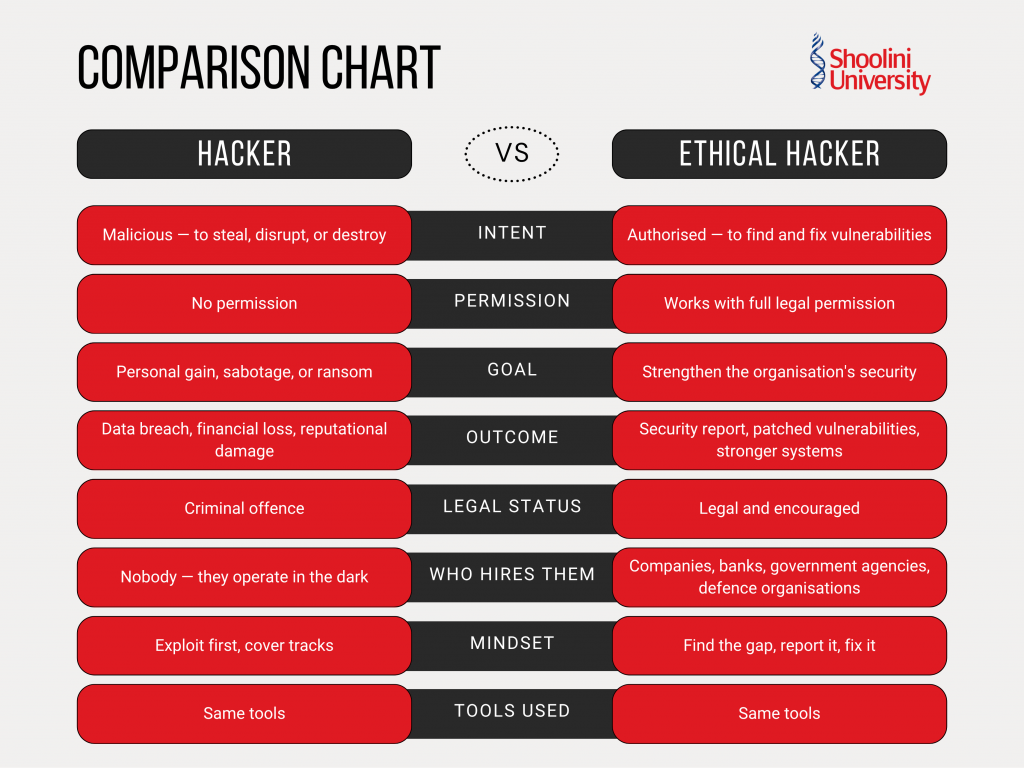
It means understanding attacks before you can defend against them.
Ethical hacking — also called penetration testing — is the practice of legally attempting to break into systems to find vulnerabilities before malicious actors do. This is not optional knowledge in 2026. It is the foundation of modern cybersecurity.
Cyber security students learn to:
- Identify weaknesses in networks, applications, and systems
- Simulate real-world attacks in controlled environments
- Understand how hackers think, plan, and execute breaches
- Build defences based on actual attack patterns — not assumptions
Why Is Cyber Security One of the Most Popular Career Fields in India Right Now?
Because the threats are no longer theoretical — they are happening in real time.
Three things happened in the last 12 months that changed the cybersecurity conversation in India permanently:
- Operation Sindoor, May 2025: When India launched military action, cyberspace became a simultaneous battlefield. According to reports, over 1.5 million cyberattacks were recorded in a matter of days — targeting Indian Railways, the Income Tax Department, HAL, and BSNL. As many as 150 attacks successfully breached Indian infrastructure.
- India’s DPDP Act — 2026 is the compliance year: India’s Digital Personal Data Protection Rules were notified in November 2025. The year 2026 is now the critical build year for companies to create compliance systems, appoint Data Protection Officers, and build breach response mechanisms. According to the CyberSec India Conference 2026 held in Mumbai on April 23–24, over 50% of Indian enterprises now rank cybersecurity as a top business risk — not just an IT concern.
- India’s IT Amendment Rules 2026 — the 3-hour deepfake mandate: New IT Rules 2026 require platforms to remove AI-generated deepfakes within 3 hours. India is now treating synthetic content as a national security threat. This has created entirely new specialisations that did not exist two years ago — deepfake detection, AI threat analysis, and synthetic media forensics.
For cyber security students entering this field, these are not background trends. They are the job descriptions being written right now.
What Do Cyber Security Students Actually Learn?
A strong B Tech CSE Cyber Security program covers both offence and defence.
Core areas of study:
| Subject Area | What It Covers |
| Ethical Hacking | Penetration testing, vulnerability assessment, attack simulation |
| Network Security | Firewalls, intrusion detection, packet analysis |
| Cryptography | Encryption, digital signatures, secure communications |
| Digital Forensics | Evidence recovery, incident investigation, malware analysis |
| Cloud Security | Securing AWS, Azure, and GCP environments |
| AI and Cyber Threats | Detecting AI-generated attacks, deepfakes, prompt injection |
| Compliance and Governance | DPDP Act, CERT-In guidelines, RBI and SEBI mandates |
In 2026, the IndiaAI Mission onboarded 38,000 GPUs to power indigenous AI models — including tools like Vastav AI for deepfake detection. Students who graduate with AI security knowledge enter a market with very few competitors.

What Is the Job Market Like for Cyber Security Students in India?
The gap between demand and supply is one of the widest in any profession.
According to a Hindustan Times editorial from April 2026, India has only around 380,000 cybersecurity professionals against a demand exceeding 1.2 million. That is a shortfall of over 800,000 professionals — right now.
Key hiring drivers in 2026:
- DPDP Act enforcement — Companies need Data Protection Officers, compliance analysts, and security architects immediately
- RBI and SEBI mandates — Financial services firms are building dedicated cyber risk teams
- Cloud migration — 37% of Indian businesses are on the cloud, expected to cross 60%, creating massive demand for cloud security specialists
- Defence and critical infrastructure — Over 1,000 defence-tech startups are active with 430 procurement contracts signed, all requiring cybersecurity professionals
- CERT-In guidelines — Enhanced incident reporting requirements mean organisations need 24/7 SOC capabilities
Sectors actively hiring:
| Sector | Why They Need Cyber Security Professionals |
| BFSI | Fraud detection, compliance, dedicated cyber risk teams |
| IT and Consulting | SOC operations, client security audits, threat intelligence |
| Government and Defence | Critical infrastructure protection, national security |
| Healthcare | Patient data protection, ransomware defence |
| E-commerce and Fintech | UPI fraud prevention, data breach response |
| Telecom | Network security, 5G infrastructure protection |
What Are the Career Options After a Cyber Security Course in India?
Graduates can enter multiple high-growth roles across sectors.
| Role | What You Will Do |
| Ethical Hacker / Penetration Tester | Legally hack systems to find vulnerabilities before attackers do |
| Security Analyst | Monitor networks, detect threats, respond to incidents |
| SOC Analyst | Work in Security Operations Centres managing real-time threat alerts |
| Digital Forensics Expert | Investigate cybercrimes and recover digital evidence |
| Cloud Security Engineer | Secure cloud infrastructure and data environments |
| AI Security Specialist | Defend against AI-powered attacks, detect deepfakes |
| Data Protection Officer | Ensure DPDP Act compliance across the organisation |
| Cybersecurity Consultant | Advise companies on risk, governance, and security strategy |
What Is the Salary After a Cyber Security Course in India?
| Experience Level | Role | Salary Range |
| Fresher (0–2 years) | Security Analyst, SOC Analyst | ₹6–8 LPA |
| Mid-level (3–5 years) | Penetration Tester, Cloud Security Engineer | ₹12–20 LPA |
| Senior (6+ years) | Security Architect, Threat Intelligence Lead | ₹25–60 LPA |
| Leadership | CISO, Head of Information Security | ₹60 LPA – ₹1 crore+ |
What Is Post-Quantum Cryptography and Why Should Students Know About It?
It is the next major frontier in cybersecurity — and India is already behind.
According to the CyberSec India Conference 2026 in Mumbai, only 10–15% of Indian companies have begun deploying quantum-resistant encryption, even though 50–55% are evaluating it. The National Quantum Mission is pushing post-quantum security up the national priority list.
Quantum computers will eventually break today’s encryption standards. The cyber security students graduating in the next two to three years will be the professionals building India’s quantum-resistant infrastructure.
Is a B Tech CSE Cyber Security Degree Worth It in 2026?
Yes — it is one of the most future-proof engineering degrees available.
- India’s cybersecurity market is valued at USD 6.56 billion in 2026 and projected to reach USD 15.06 billion by 2031
- The WEF Future of Jobs Report 2025 ranks Information Security Analysts among the top 15 fastest-growing professions globally through 2030
- Cybersecurity hiring in India is growing at 30–35% annually
- 93% of Indian companies are increasing their cybersecurity budgets in 2026
Unlike many tech roles, cybersecurity is recession-resistant. Cybercrime does not slow down during economic downturns — it increases.
Best University for Cyber Security in India – Shoolini University
Shoolini University is ranked No. 1 private university in India by QS World University Rankings, No. 2 private university by Times Higher Education World University Rankings, and No. 3 in Engineering by THE Subject Rankings.
That is not just a ranking. It reflects how seriously Shoolini has built its engineering and technology infrastructure to meet industry needs.
The campus is set in the hills of Solan, Himachal Pradesh — a focused, distraction-free environment where students can learn, build, and experiment without the noise of a city campus.

What students get access to:
- AI & Futures Centre — Dedicated AI learning space with modern labs and collaborative classrooms
- XR and AI Research Centre — Equipped with Meta Quest 2, Irusu Play VR Plus, and Google Cardboard headsets alongside high-performance systems for design, simulation, and research
- AI and Robotics Centre — Launched in collaboration with Sirena Technologies, making Shoolini one of the very few universities in India with on-campus AI-robotics integration — directly relevant as autonomous systems become new cybersecurity targets
- Yogananda School of AI, Computers and Data Science — Industry-aligned academic training focused on practical skills, connecting software intelligence with real computing systems
For cyber security students, this infrastructure means real lab environments to simulate attacks, test defences, and understand how intelligent systems can be compromised and protected.
The university’s Placement Cell starts working with students from early semesters — not just final year. Students are guided consistently through industry exposure, career readiness, and placement support in technology-driven roles.
If you are looking for a B Tech CSE Cyber Security program that combines academic depth, cutting-edge infrastructure, and strong placement support — Shoolini University delivers all three.
Cyber Security Admissions 2026 at Shoolini University are open. Apply now.
Sources:
- https://www.orfonline.org/expert-speak/operation-sindoor-and-india-s-cyber-threat-landscape
- https://themachinemaker.com/news/cybersec-india-conference-2026-to-spotlight-indias-shift-toward-accountability-driven-cybersecurity/
- https://indianprinterpublisher.com/blog/2026/04/dpdp-rules-2025/
- https://destcert.com/resources/cybersecurity-job-demand/
FAQs:
Q1. What do cybersecurity students study in their degree?
They study ethical hacking, network security, cryptography, digital forensics, cloud security, AI threat detection, and compliance frameworks like India's DPDP Act.
Q2. What is ethical hacking, and is it legal?
Ethical hacking is the authorised practice of attempting to breach systems to identify vulnerabilities. It is completely legal when done with permission.
Q3. Which companies hire cybersecurity graduates in India?
TCS, Infosys, Wipro, HCL, IBM, Deloitte, KPMG, Accenture, HDFC Bank, ICICI Bank, government agencies such as CERT-In, DRDO, and NIC, and defence-tech startups are among the top recruiters.
Q4. What certifications help cybersecurity students get hired faster?
CEH (Certified Ethical Hacker), CompTIA Security+, OSCP, CISSP, and CISM are the most recognised. Certifications can boost starting salaries by 15–25%.
Q5. Can cybersecurity students work in government jobs?
Yes. CERT-In, DRDO, NIC, NIA, state cybercrime cells, public sector banks, and India's intelligence agencies all actively recruit cybersecurity professionals. These roles offer strong job security and meaningful national-level work.
Q6. Which is the best university for B Tech CSE Cyber Security in India?
Shoolini University, Solan, is ranked No. 1 private university in India by the QS World University Rankings 2026, offering a B Tech CSE program with Cyber Security as a specialisation.


