

Think about how much of your life exists online. Your bank account, photographs, conversations, college records, shopping history and even your identity are connected to digital systems.
Most of the time, we do not think about how secure these systems are. That changes when a company reports a data breach, someone’s social media account is hacked or a phishing scam exposes sensitive information. Cyber security professionals work to prevent such incidents. As digital systems become more connected, their work is becoming more complex.
Businesses today depend on cloud platforms, mobile applications, APIs, artificial intelligence and connected devices. Every new technology expands what digital systems can do, but it can also create new ways for attackers to gain access.
For students considering B Tech CSE Cyber Security in 2026, the field extends far beyond antivirus software and firewalls.
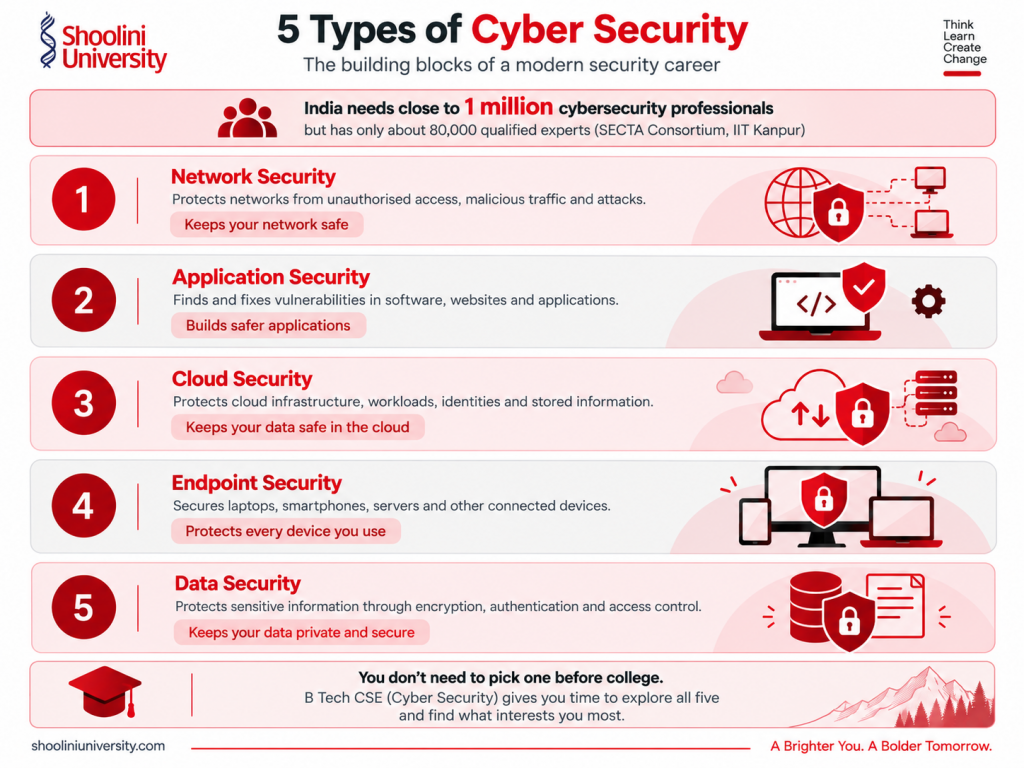
India also faces a shortage of trained professionals. The EICTA Consortium at IIT Kanpur estimates that India needs close to one million cyber security professionals but has only around 80,000 qualified experts. The Data Security Council of India’s Indian Cyber Security Skilling Landscape 2025–26 also found that 63% of enterprises reported limited hands-on skills among candidates.
So the real question is not whether cyber security has scope. It is whether you enjoy understanding how systems work, identifying where they can fail and learning how to protect them.
What Do You Study?
A four-year engineering program in cyber security begins with the core subjects that underpin computer science.
Students learn programming, computer networks, operating systems, databases, software development and computer architecture. They then move into areas such as cryptography, network security, vulnerability assessment, malware analysis and secure computing.
The distinction matters.
A short-term cyber security course may focus on a particular tool, technique or certification. An engineering degree provides a broader computer science foundation, helping students understand what they are protecting and why vulnerabilities exist in the first place.
Choosing cyber security also does not limit students to one career path. A strong foundation in computer science can lead to roles in software development, networking, cloud computing and other technology fields.
Why Is Cyber Security Becoming So Important?
The more connected technology becomes, the more important security becomes.
Companies are moving their infrastructure to the cloud. Banking and shopping take place through apps. Businesses use APIs to connect platforms, while AI systems process enormous volumes of information.
Each of these systems needs protection.
The World Economic Forum’s Future of Jobs Report 2025 lists Security Management Specialists among the fastest-growing roles expected in India through 2030, alongside AI and Machine Learning Specialists and Big Data Specialists.
Artificial intelligence is changing the field further. ISC2’s 2025 Cybersecurity Workforce Study, based on responses from more than 16,000 professionals worldwide, found that 41% considered AI knowledge a critical skill, while 48% were actively building AI-related capabilities. The study also found that 73% believed AI would create demand for more specialised cyber security roles.
For students thinking about AI and Cyber Security careers, this overlap could become increasingly important. Future professionals may use AI to detect threats while also learning how to protect AI-powered systems from attacks.
What Areas Can You Explore?
Cyber security is much broader than ethical hacking. The commonly discussed 5 types of cyber security cover different parts of a digital defence system.
Network security protects networks against unauthorised access and malicious traffic. Application security focuses on weaknesses in websites, software and apps. Cloud security protects cloud infrastructure, workloads and identities. Endpoint security deals with devices such as laptops, smartphones and servers. Data security protects sensitive information through encryption, authentication and access controls.
As students gain experience, they can explore specialised areas such as penetration testing, malware analysis, digital forensics, incident response, threat intelligence, cryptography and AI security.
You do not have to decide on a specialisation immediately after Class 12. College gives you time to learn about different areas and find out which part of cyber security interests you most.

How Can You Start After Class 12?
Students researching B Tech Cyber Security after 12th sometimes assume that they should already know ethical hacking or advanced programming.
That is not necessary. Mathematics, logical thinking, curiosity and a willingness to understand computers are better starting points.
A practical cyber security roadmap begins with programming, mathematics, Linux and computer fundamentals. Students can then move on to computer networks, databases, operating systems and web technologies.
Once these foundations are clear, concepts such as cryptography, vulnerability assessment, malware analysis, network defence and cloud security become easier to understand. By the later years of the degree, projects, industry certifications and cyber security internships become particularly valuable.
Security cannot be learned entirely from a textbook. Working with logs, network configurations, vulnerabilities and simulated attacks helps students understand how security teams respond when something goes wrong.
What Skills Will Employers Look For?
One of the biggest mistakes students can make is focusing on advanced security tools before understanding basic computer systems.
Start with the fundamentals. Programming and scripting, Linux, computer networks, operating systems, databases and web applications provide the base. From there, students can build knowledge of secure coding, cryptography, vulnerability assessment, cloud security, identity and access management, incident response and malware analysis.
The Cyber Security skills 2026 employers are likely to value include the ability to work across multiple systems rather than viewing security in isolation.
Communication matters too. Imagine finding a serious vulnerability in a company’s application. Identifying it is only part of the job. You also need to explain what could happen, how serious the risk is and what the organisation should do about it. Technical ability helps you identify the problem. Clear communication helps you explain it and work with others to resolve it.
What Happens to Cyber Security Careers as AI Grows?
AI will automate parts of cyber security, particularly repetitive monitoring and analysis.
But that does not mean cyber security professionals will disappear.
AI systems can process large amounts of security data and detect unusual behaviour faster than humans in some situations. At the same time, companies are feeding sensitive information into AI platforms, building AI-powered applications and automating business decisions.
These systems can also be attacked.
That creates new questions. How do you protect an AI model? What happens if its training data is manipulated? How do you prevent sensitive information from leaking through an AI application? Professionals entering cyber security will increasingly need to understand both sides: how AI can improve security and how AI itself needs to be protected.
What Kind of Careers Can You Build?
The B Tech Cyber Security scope is much wider than becoming an ethical hacker.
Graduates can explore cyber security jobs such as Security Analyst, SOC Analyst, Network Security Engineer, Security Engineer, Cloud Security Associate, Vulnerability Assessment Analyst, Incident Response Analyst and Application Security Engineer.
With experience, professionals can move into penetration testing, threat intelligence, digital forensics, security architecture, cryptography, cloud security and AI security.
Your first job does not have to decide your entire career. A student might begin in a Security Operations Centre, develop an interest in cloud systems and later move into cloud security architecture. Someone else may start with vulnerability assessment and specialise in application security.
Cyber security allows this movement because the underlying skills remain connected.
How Does It Compare With Regular CSE?
Both start with the same computer science fundamentals, but they part ways on timing. A standard B Tech CSE program keeps things broad — programming, software development, databases, AI and computing systems — and leaves specialisation for later.
Cyber security narrows that focus sooner, building in deeper exposure to networks, threats, vulnerabilities and digital defence from year one. Neither option is inherently better.
Still weighing software development, AI, data science, cloud computing and security against each other? A standard CSE program gives you room to explore before choosing. Already drawn to networks, system vulnerabilities, cyber attacks and digital defence? Getting an early start means more time to build real expertise.
Can Freshers Actually Find Opportunities?
Yes, but a degree alone may not be enough.
Employers increasingly want evidence that students can apply what they have learned. Projects, security labs, capture-the-flag competitions, certifications and internships can provide that evidence.
According to the EICTA Consortium at IIT Kanpur, freshers without an industry certification typically begin at around ₹4–5 LPA in India, while relevant certifications during the degree can strengthen their employment prospects.
Students looking for entry-level cyber security jobs should spend their college years building a portfolio rather than waiting until the final semester.
A fresher who understands Linux, Python, networking, cloud basics and security concepts can demonstrate these skills through projects and apply for roles such as SOC Analyst, Junior Security Analyst, Network Security Associate or Vulnerability Assessment Analyst.
Studying Cyber Security at Shoolini University
For students looking for an engineering program with a specialised security focus, Shoolini University offers B Tech CSE Cyber Security through the Yogananda School of AI, Computers and Data Science.
Shoolini University is ranked 452nd globally and 10th in India in the QS World University Rankings 2027. This makes it India’s No. 1 private university for the fourth consecutive year. It is also ranked No. 3 in India for Engineering in the THE World University Rankings by Subject 2026 and holds NAAC A+ accreditation with a CGPA of 3.33/4.
The four-year program covers phishing prevention, malware, network vulnerabilities and computer system protection.
Students can explore research areas including virtualisation, exploit development, malware analysis, core Android and iOS security, and SCADA. Lab infrastructure is supported by the Department of Science and Technology (DST) and HIMCOSTE.
Students can also take certification courses through AWS Academy, which can be useful for those interested in cloud computing and cloud security.
Applicants must have passed 10+2 with Mathematics as a compulsory subject, along with any two approved subjects, and secured at least 60% marks. Admission is through CUET, NEET, JEE, SAT or Shoolini University’s entrance test, followed by faculty interaction.
Shoolini has placement connections with more than 250 recruiting companies across its schools, helping students connect academic learning with industry expectations.
Is Cyber Security the Right Choice for You?
Cyber security can be a suitable engineering path for students who are interested in how digital systems work and how they can be protected.
If you enjoy understanding how computers communicate, figuring out why something stopped working, exploring how systems can be exploited or thinking about how technology can be made safer, cyber security may suit you.
The field is also becoming broader.
Cloud platforms need security. Mobile applications need security. Financial systems need security. Connected devices need security. AI systems need security too.
For students interested in this direction, B Tech CSE Cyber Security provides a combination of computer science fundamentals and specialised security knowledge. The value of the degree will also depend on what students do alongside it, including projects, internships, certifications, practical work and continued learning as technology and cyber threats change.
Sources
- Data Security Council of India (DSCI), Indian Cyber Security Skilling Landscape 2025–2026 — https://www.dsci.in/resource/content/indian-cyber-security-skilling-landscape-2025-2026
- EICTA Consortium, IIT Kanpur, Cybersecurity Jobs in India 2026 — https://www.eicta.iitk.ac.in/knowledge-hub/cyber-security/cybersecurity-jobs
- World Economic Forum, Future of Jobs Report 2025 — https://www.weforum.org/publications/the-future-of-jobs-report-2025/digest/
- ISC2, 2025 Cybersecurity Workforce Study — https://www.isc2.org/Insights/2025/12/2025-ISC2-Cybersecurity-Workforce-Study
FAQ
Q1. Does a Cyber Security specialisation limit career options after B.Tech?
No. Since the program includes core Computer Science Engineering subjects, graduates can explore cybersecurity as well as careers related to software, networking and cloud computing. Your projects, internships and additional skills also influence the roles available to you.
Q2. Will AI replace Cyber Security jobs?
AI will automate some repetitive security tasks, but it is also creating new security challenges. Organisations need professionals who can use AI-based security tools while protecting AI systems, applications and data from emerging threats.
Q3. Which Cyber Security career path is best for beginners?
SOC Analyst, Junior Security Analyst, Network Security Associate and Vulnerability Assessment Analyst are common starting roles. Beginners should first build strong knowledge of networking, Linux, operating systems, Python and basic security concepts.
Q4. Is B.Tech Cyber Security better than regular CSE?
It depends on your interests. Regular CSE provides broader exposure across computer science, while cybersecurity introduces specialised security learning earlier. Students already interested in networks, threats and digital defence may benefit from the specialised route.
Q5. Is B.Tech CSE Cyber Security a good career choice in 2026?
Yes, especially for students interested in technology, computer networks, programming and problem-solving. Increasing adoption of cloud computing, connected systems and AI is also creating new security requirements.
Q6. Can freshers get Cyber Security jobs after B.Tech?
Yes. Freshers can qualify for entry-level positions, particularly when they combine their degree with projects, certifications, practical labs and internships. Employers often look for demonstrable skills alongside academic performance.
Q7. Can Cyber Security graduates work in cloud security?
Yes. Cloud security is one of the natural career directions for cybersecurity graduates. Knowledge of networking, encryption, identity management and cloud platforms provides a useful foundation, while exposure to AWS or other cloud environments can strengthen employability.