
The journey from “farm to fork” has undergone a radical transformation in recent years. What was once a simple process of harvesting and selling has evolved into a sophisticated multibillion-dollar industry driven by cutting-edge science and digital innovation. As we navigate through 2026, the global food systems are facing unprecedented challenges — from climate-induced supply chain disruptions to an urgent need for sustainable nutrition. This is where food technology careers come into the spotlight.
With the Indian food processing sector projected to reach a valuation of USD 535 billion by the end of this fiscal year, the demand for skilled experts has never been higher. For a student today, choosing this path means entering a sector that blends biology, chemistry, and engineering with business strategy and artificial intelligence. This blog explores the dynamic landscape of the industry, the food technology careers available after graduation, and why this field is considered one of the most future-proof career paths in the modern world.
The Expanding Scope of Food Technology in 2026
The modern food industry has moved far beyond basic preservation. Today, the Scope of Food Technology encompasses everything from ‘personalised nutrition’ based on DNA data to ‘circular economy’ initiatives that turn agricultural waste into valuable ingredients. In India, the government’s push through schemes like the PM Kisan SAMPADA Yojana has led to the creation of mega food parks and world-class cold-chain infrastructure.
This expansion has moved the needle from simple food security to food leadership, positioning India as a global hub for value-added food products.
For those pursuing a B Tech Food Technology or a BSc (Hons) Food Technology, the curriculum now reflects these global shifts. Students are trained in advanced subjects like nanotechnology in packaging, high-pressure processing (HPP), and the integration of IoT in supply chain management. This multi-disciplinary approach ensures that graduates are ready to handle the complexities of a fast-paced, export-oriented manufacturing environment. As a result, it opens new pathways in food technology careers within the industry.
Diverse Careers in Food Technology
When people think of food tech, they often think of a lab technician testing milk samples. While quality control is essential, the reality of careers in food technology is much wider. The industry is currently witnessing a massive demand for professionals who can operate at the intersection of technology and management.
- Product Development & Innovation: These roles involve creating new food formulations. Think of the “main character” energy required to launch a new line of protein-rich, gluten-free snacks or dairy-free desserts that actually taste like the real thing.
- Food Safety & Regulatory Affairs: With FSSAI norms becoming stricter, companies need experts to ensure “clean label” transparency and legal compliance.
- Supply Chain & Logistics: Using AI-driven predictive analytics to minimise waste and ensure that perishable goods reach the consumer fresh and on time.
- Sustainability Managers: Designing “Waste-to-Value” systems where byproducts are repurposed, reducing the environmental footprint of large-scale manufacturing.
The diversity of these roles means that a variety of food technology careers are available for people with varied interests — whether you are a data nerd, a creative chef at heart, or a strategy-driven leader.
Navigating Jobs After Food Technology Degree
Landing the right role depends heavily on your specialisation. For instance, jobs after Food Technology Degree programs vary significantly between undergraduate and postgraduate levels. While a Bachelor’s degree can get you into production management or quality assurance, higher education often opens doors to more strategic or specialised domains.
An M Tech Food Technology or an MSc Food Technology often leads to roles in Research and Development (R&D) or Senior Quality Management. On the other hand, those pursuing a PhD in Food Technology are the ones driving the ‘deep tech’ side of the industry — developing technologies like cultivated meat and precision fermentation processes. In India, the public sector also offers prestigious positions, such as Food Safety Officers and Technical Officers, in organisations like FSSAI and BIS, which are highly sought after for their stability and impact on public health.
The Digital Transformation of Food Technology Careers
As we move deeper into 2026, the traditional Food Technology Career Paths are being redefined by automation and AI. We are seeing the rise of ‘FoodTech 4.0’, where factories use digital twins to simulate production changes, and robots handle the heavy lifting in packaging. This digital shift means that tomorrow’s food technologist needs to be as comfortable with a data dashboard as they are with a pH meter.
There is a growing trend toward ‘Agri-Food Tech’ startups, where young entrepreneurs are using technology to bridge the gap between farmers and urban consumers. These startups are creating a new wave of Food Technology Jobs in India, focusing on niche markets like organic baby food, fortified staples for rural health, and hyper-local delivery systems that preserve nutritional integrity.

Choosing the Right Foundation
For students looking to build strong and diverse food technology careers, Shoolini University offers the right mix of research, practical learning, and industry exposure. It is considered one of the top food technology universities in India, known for its focus on innovation and hands-on training.
The School of Bio-Engineering and Food Technology has highly qualified faculty, including postdoctoral researchers and alumni from leading global institutions such as the University of Oxford, the National Cancer Institute (USA), the NIH (USA), IISc, JNU, DU, and ZSI. Their experience helps students build strong fundamentals and understand modern developments in food science.
Students can choose from a wide range of programs, including BSc (Hons) Food Technology, B Tech Food Technology, MSc Food Technology, M Tech Food Technology, and PhD Food Technology. These courses are designed to match current industry needs and open up multiple careers in food technology.
A major highlight is the Summit Research Program (SRP) for undergraduate students. This program provides personal research mentorship from the first year and encourages students to publish research papers and file patents early. It helps students develop confidence and a strong research mindset from the beginning.
The university has more than 104 laboratories and 11 Centres of Excellence, supported by grants from the Ministry of Food Processing Industries, Government of India. Students work in specialised labs such as the Food Quality Control Lab, Biosensor Lab, Bakery & Confectionery Lab, Fruit & Vegetable Technology Lab, and Food Processing Lab. This gives them real exposure to food safety, processing, and product innovation.
Another key facility is the NABL-accredited and APEDA-certified Commercial Food Testing Laboratory, established with MoFPI support. Equipped with advanced systems like UHPLC, ICPOES, and GCMSMS, this lab allows students to understand industry-level food testing and quality standards while working on real projects.
Learning is not limited to classrooms. Through the Experiential Learning Program, students take part in production-based and project-based work. They also gain business exposure by working with the on-campus food processing unit, which helps them understand how food enterprises operate. This makes them better prepared for modern food technology careers.
Shoolini also offers strong global exposure through over 250 international collaborations with universities such as the University of Arkansas, University of Naples, Taipei Medical University, Lanzhou University, Gachon University, and South Dakota Mines University. These partnerships provide opportunities for exchange programmes and collaborative research.
The university promotes innovation through its One-Student-One-Patent Policy, encouraging students to work on new ideas and turn them into real outcomes. Many students also qualify for prestigious JRF opportunities, showing the strength of the academic environment.
Placements are another strong point. Shoolini students placed in leading organisations such as Abbott, Nestlé, Cipla, Biocon, SRL Diagnostics, and Serum Institute of India. Graduates move into roles across food safety, quality control, research and development, processing industries, and regulatory sectors.
Located in the scenic Kasauli Hills of Himachal Pradesh, Shoolini University is recognised as India’s No. 1 Private University by QS World University Rankings 2026 and No. 2 Private University by Times Higher Education World University Rankings 2026. With its strong focus on research, industry exposure, and practical learning, it continues to prepare students for a wide range of opportunities in food technology beyond just laboratory roles.
Hear directly from our student, Asavari Kapoor, about her Food Technology journey at Shoolini University.

Conclusion: The Future is Flavourful and Tech-Forward
As the global population heads toward the 8-billion mark, the responsibility to feed the world safely and sustainably falls on food scientists.
Whether you are just starting with a bachelor’s degree or aiming for the highest levels of research, the industry is ready for innovators who are not afraid to challenge the status quo. The future of food isn’t just about what’s on the plate—it’s about the brilliant minds behind the scenes making it possible.
So what are you waiting for? Join Shoolini University Now!
FAQS:
Q1. What are some non-laboratory career options for food technology graduates?
Food technology graduates can work in product development, food safety, supply chain, marketing, and sustainability roles beyond labs. These roles focus more on innovation, management, and real-world food systems.
Q2. Do food technology graduates get opportunities in multinational food companies?
Yes, many graduates work with leading multinational companies in food processing, quality control, and R&D. The growing food industry creates strong demand for skilled professionals.
Q3. What skills are important to build a successful career in the food industry?
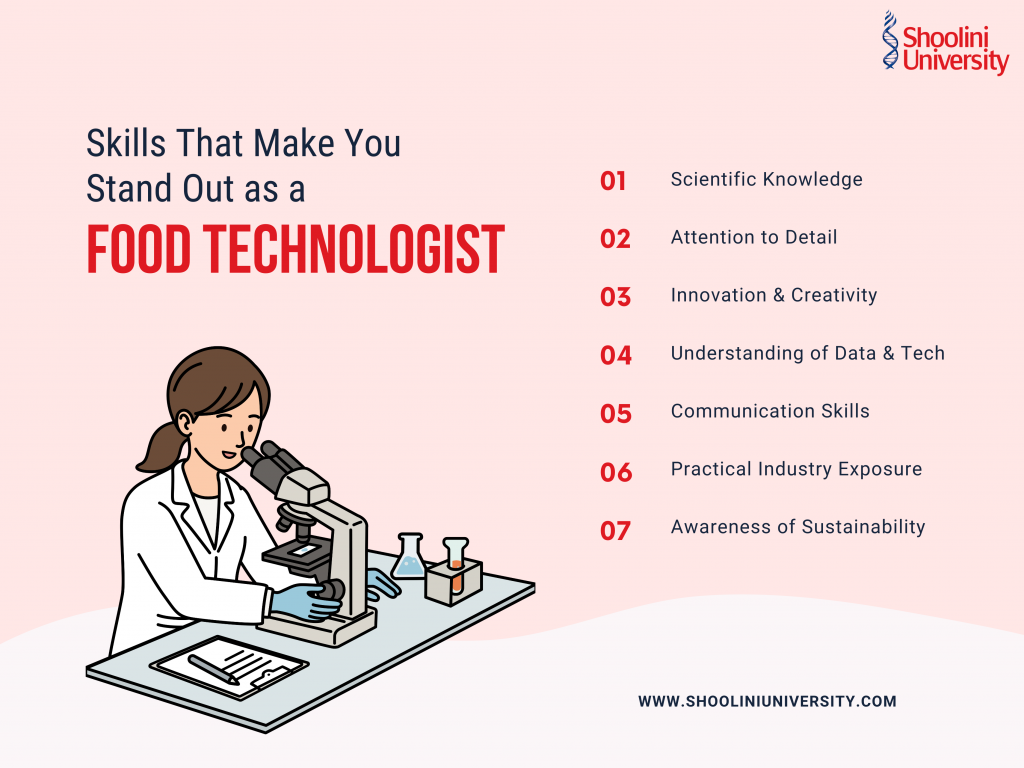
A strong understanding of food science, problem-solving ability, and adaptability to new technologies are essential. Communication and practical skills also play a big role in career growth.
Q4. Is Food Technology a good career option in India for the future?
Yes, it is a growing field due to rising demand for processed, safe, and sustainable food. The industry offers diverse opportunities and long-term career stability.
Q5. Can food technology graduates work in roles like product management, marketing, or consulting?
Yes, graduates can move into roles like product management, marketing, and consulting as the industry needs both technical and business knowledge. This makes the field highly flexible.
Q6. What facilities and industry exposure does Shoolini University provide for students pursuing Food Technology?
Students get access to advanced labs, a commercial food testing facility, and hands-on learning through real projects and production units. This ensures strong industry exposure during the course.
Q7. What are the advantages of studying Food Technology at Shoolini University?
The university offers research mentorship, global exposure, strong placements, and practical learning opportunities. This helps students become industry-ready and explore diverse career paths.