

Shoolini’s Bioinformatics Program is defined by its strong research focus from the very beginning. Students don’t just study concepts; they actively participate in real research projects, work with faculty, and build hands-on experience that prepares them for careers in bioinformatics.
When students choose a Bioinformatics program, they are making a bet on the future — a future shaped by genomics, precision medicine, computational biology, and data-driven drug discovery. In a field this dynamic, what separates a good education from a transformative one is not just the curriculum. It is the quality, depth, and authenticity of research experience embedded into every year of study.
At Shoolini University, research is not an optional add-on or a final-year project tucked into the last semester. It is the foundation of the entire academic structure.
Is Shoolini University a Research-Focused Institution?
Yes, and this is backed by strong global rankings and measurable research output.
The phrase “research university” is used loosely by many institutions. At Shoolini, it carries a lot of weight. According to QS Asia University Rankings 2026, Shoolini secured the joint number one position in Asia for Citations per Paper — a metric that directly reflects the global influence and quality of its published research.
The university also climbed to 159th in Asia overall and ranked 14th in India across more than 1,500 institutions.
For Bioinformatics students, this is not just a ranking. It indicates that the research produced here is being read, referenced, and built upon globally.
What Do the Research Metrics Actually Show?
Shoolini’s research strength can be understood through key indicators:
| Metric | Value | Why It Matters |
| Citations per Paper | No. 1 in Asia | Global research influence |
| h-index | >150 | Consistent research impact |
| IPs | 1,900+ | Innovation culture |
| Labs | 104+ | Hands-on exposure |
| Research Centres | 11 | Interdisciplinary learning |
These numbers reflect not just output, but the depth and consistency of research at the university.
How Strong Is Shoolini’s Research Depth (H-Index)?
Shoolini has an h-index of more than 150, which is higher than several IITs, including IIT Indore, IIT Hyderabad, IIT Bhubaneswar, IIT Gandhinagar, and IIT Ropar.
The h-index is a rigorous academic measure that reflects how consistently research is cited. A high h-index means the institution is producing impactful work across multiple publications.
For students, this means learning from faculty who are actively contributing to global research — not just teaching from textbooks.
What Kind of Research Infrastructure Do Students Get?
Shoolini’s infrastructure is supported by the ₹9 crore PURSE grant from the Government of India, awarded to select high-performing universities.
This funding enables:
- Advanced scientific equipment
- High-end laboratory facilities
- Research collaborations
- Innovation and incubation support
In practical terms, students get access to:
- Molecular biology labs
- Genomic sequencing tools
- Bioinformatics software environments
- Analytical research equipment
This ensures that learning is not limited to theory—it is applied and hands-on.
Do Students Get Research Opportunities Early?
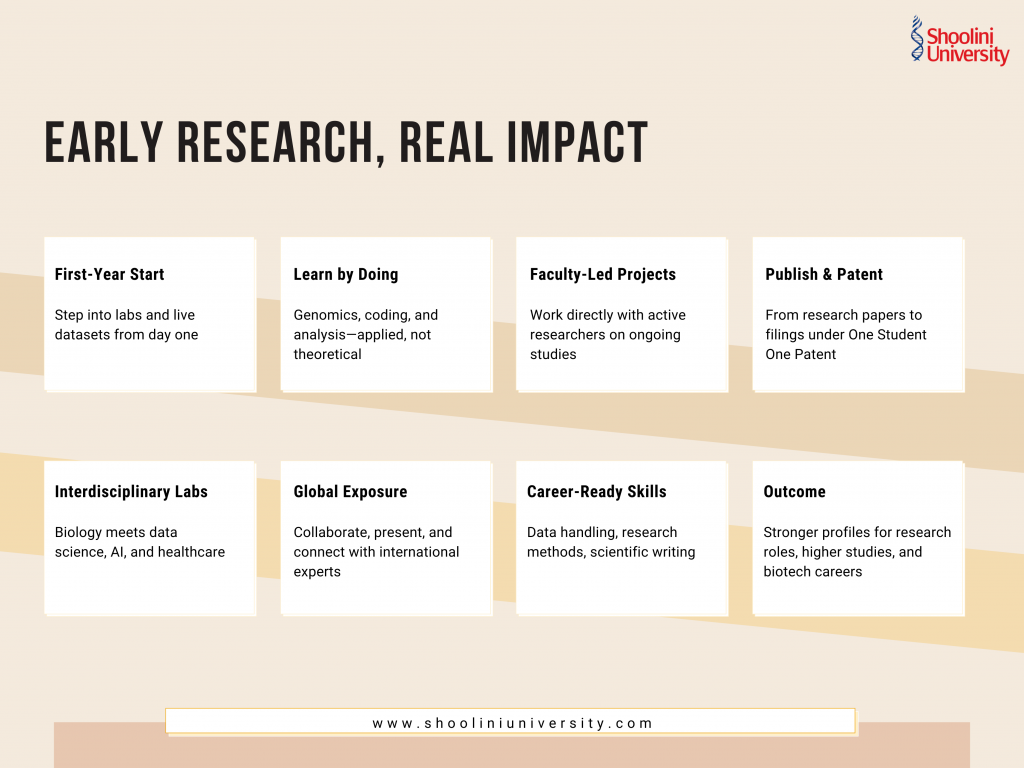
Students in the Bioinformatics program at Shoolini University gain early exposure to research from the first year. The curriculum integrates lab work, data analysis, and guided projects, allowing students to apply concepts as they learn. They work with faculty on ongoing studies in areas such as genomics, drug discovery, and computational biology.
Access to dedicated research centres and interdisciplinary labs strengthens this experience. Through initiatives like the One Student One Patent policy, students also explore innovation and intellectual property. This early engagement builds confidence, sharpens analytical thinking, and prepares them for higher studies or research-driven careers.
Students:
- Work alongside faculty researchers
- Learn to write and publish research papers
- Participate in patent filing
- Interact with global research experts
The impact of this approach is visible through the 1,900+ IP’s filed under the One Student One Patent initiative.

What Kind of Research Ecosystem Does Shoolini Offer?
Shoolini provides a strong research ecosystem that supports learning beyond classrooms.
Students benefit from:
- 11 dedicated research centres
- 104+ laboratories
- Access to 3 million+ books
- 9,000+ e-journals (EBSCO, DELNET)
The university also collaborates with over 250 global institutions, including:
- University of Melbourne
- University of Arkansas
- Gachon University
- Western Sydney University
This enables:
- International exposure
- Joint research opportunities
- Academic exchange programs
How Does Research Experience Impact Career Opportunities?
Research experience plays a critical role in shaping career outcomes in bioinformatics.
Employers in bioinformatics jobs in India look for candidates who:
- Understand both biology and data science
- Have worked with real datasets
- Are familiar with research tools and methods
Students with research exposure:
- Can demonstrate real project experience
- Have publications or patents
- Are better prepared for industry and academia
This creates opportunities in:
- Biotech companies
- Pharmaceutical firms
- Genomics labs
- Research institutions
Who Teaches in Shoolini’s Bioinformatics Program?
Shoolini’s Bioinformatics program is supported by faculty with strong academic and research backgrounds from global institutions.
Faculty members have experience from:
- University of Southampton
- NIH (USA)
- IISc
- IITs
- Ben Gurion University
They are actively involved in research, ensuring students learn in an environment where knowledge is continuously being created.
Why Is Bioinformatics a Good Career Choice?
Bioinformatics is a fast-growing field driven by advancements in genomics, healthcare, and data science.
Key Reasons
- Increasing demand in biotech and healthcare
- Growth in precision medicine
- Expansion of data-driven biology
- Opportunities in India and globally
This makes it a strong and future-ready career option.
Final Thoughts
In Bioinformatics, research experience defines the quality of learning.
Students who spend their academic years actively working on research develop stronger skills, better understanding, and greater confidence compared to those who rely only on theoretical learning.
At Shoolini University, research is not something students wait for — it is something they begin from the first year itself.
For students planning to pursue bioinformatics in 2026, choosing a university that offers real research exposure, strong mentorship, and global opportunities can make a significant difference.
Shoolini provides an environment where students can move beyond learning and actively contribute to the field.