


Every packet of instant noodles, every ready-to-eat meal, every bottle of packaged juice on a supermarket shelf has gone through the hands of a food technologist before it ever reached you. Someone decided how it should be processed, how long it should stay fresh, and how to make sure it is safe to eat.
That work sits at the centre of a fast-growing industry in India, and a BSc (Hons) Food Technology is one of the more direct routes into it. This blog looks at what the course actually involves, what the job market looks like right now, and why the university you choose for it matters.
What Does a BSc (Hons) Food Technology Course Cover?
It combines food science, chemistry, microbiology, and engineering principles to understand how food is processed, preserved, and made safe for consumption.
Students study subjects like food chemistry, food microbiology, food engineering, packaging technology, and quality assurance. The degree is applied by design, so a large part of the coursework involves lab work and practical training rather than only classroom theory. This is one of the reasons Food Technology course after 12th options have grown in popularity among PCB and PCM students alike, since it draws on both biology and applied science.
What Is the Scope of Food Technology in India Right Now?
Very strong, and backed by real government investment rather than just projected growth.
India’s food processing industry is projected to reach USD 535 billion by 2025-26, driven by rising domestic consumption, export demand, and the government’s push under Make in India for the World. The Production Linked Incentive Scheme for Food Processing, running from 2021-22 to 2026-27 with an outlay of ₹10,900 crore, has already generated around 3.39 lakh direct and indirect jobs, well past its original target. Exports of PLI-supported food products have grown at a compound annual growth rate of over 13% since the scheme began.
Multinational companies including Nestle, Kellogg’s, Mars, Kraft, and Del Monte all operate significant food processing and R&D operations in India, alongside a large and growing base of Indian food brands and MSMEs. This is the scope of Food Technology in India that students are actually stepping into, not a theoretical projection.

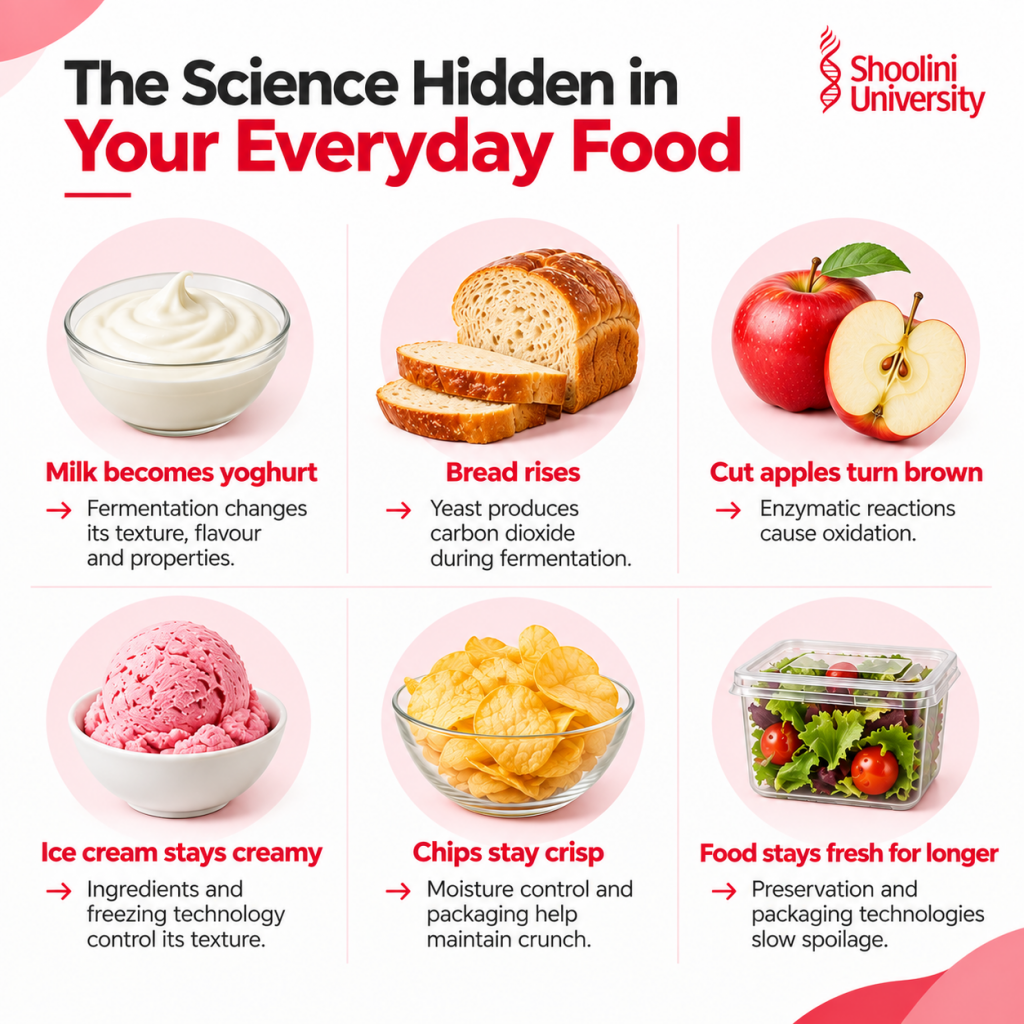
What Kind of Jobs Can You Get After BSc (Hons) Food Technology?
A wider range than most people expect, spanning private industry, research, and government service.
| Career Path | What It Involves |
| Food Quality Analyst | Testing raw materials and finished products for safety and quality standards |
| Product Development Executive | Working on new food products, from concept to shelf |
| Food Safety Officer | Regulatory role inspecting and certifying food establishments |
| Research and Development Associate | Working on food innovation, shelf-life extension, and process improvement |
| Packaging Technologist | Designing packaging that preserves freshness and meets safety norms |
| Regulatory Affairs Executive | Ensuring products meet FSSAI and export compliance standards |
Food Technology jobs are not limited to factory floors either. Many graduates move into research labs, food innovation teams at large FMCG companies, or regulatory roles that involve working closely with government food safety standards.
Are There Government Jobs in Food Technology?
Yes, and this is one of the more stable, well-defined career paths in the field.
FSSAI, the Food Safety and Standards Authority of India, regularly recruits for posts like Central Food Safety Officer and Technical Officer, with eligibility open to graduates in Food Technology, Biotechnology, Microbiology, and related life sciences. The Food Corporation of India and the Indian Council of Agricultural Research are also major recruiters in this space. Entry-level government positions typically start in the ₹25,000 to ₹40,000 per month range under central pay scale norms, with clear progression as experience builds.
Food technology government jobs tend to appeal to students who want the stability of a regulatory or public sector role rather than the faster pace of private industry, and both paths remain genuinely open throughout a career.
What Does Food Innovation Actually Look Like as a Career?
It means being part of the team that decides what food products actually reach the market, and how.
Food innovation careers involve work like extending a product’s shelf life without artificial preservatives, developing healthier versions of popular snacks, or adapting recipes for new markets. India’s PLI scheme has specifically encouraged innovation in categories like millet-based products, where sales grew from around ₹345 crore in 2022-23 to over ₹1,845 crore in 2024-25. This kind of growth doesn’t happen without food technologists working behind the scenes on formulation, processing, and packaging.
Is Research a Good Career Option After a Degree in Food Technology?
Yes, particularly for students who want to go beyond industry roles and into food science research.
Students interested in research often publish or read work in respected outlets like the Journal of Food Science and Technology, which covers ongoing research in food chemistry, processing methods, and safety standards. A strong BSc (Hons) Food Technology programme, followed by an MSc or PhD, opens the door to research roles in food science institutes, universities, and corporate R&D labs, where the work is less about production and more about developing the next generation of food processing techniques.
What Should You Look for in BSc Hons Food Colleges?
A few things matter more than rankings alone when comparing BSc Hons food colleges.
- Access to well-equipped food processing and analysis labs, not just theoretical classrooms
- Faculty with genuine research backgrounds in food science, not only teaching experience
- Industry tie-ups or internship pipelines with food companies and government food safety bodies
- Exposure to real research work, ideally with the chance to publish or contribute to ongoing studies
- A track record of graduates moving into both private sector roles and government food technology positions
Why BSc (Hons) Food Technology at Shoolini Stands Out
Shoolini University offers BSc (Hons) Food Technology through its School of Bioengineering and Food Technology. The program combines classroom learning with research and practical training. Students work in dedicated food processing and food analysis laboratories and also have access to the university’s wider biotechnology infrastructure. This places food technology within a larger life sciences ecosystem rather than an isolated department.
Research and publication are encouraged at the undergraduate level. Through Shoolini’s One Student, One Patent policy, students can work on original, patentable ideas instead of limiting their laboratory experience to syllabus-based exercises. This is particularly relevant for those interested in food innovation or postgraduate research.
In the QS World University Rankings 2027, Shoolini is ranked 452nd globally and 10th in India. It is the only private university in the country’s top 10, alongside seven IITs, IISc and Delhi University, and has been ranked the No. 1 private university in India for the fourth consecutive year. Admission to BSc (Hons) Food Technology is open to students from both PCB and PCM backgrounds, based on Class 12 marks or the university’s entrance process. NEET and JEE are not required.
The degree is suited to students who are curious about how food is made safe, tasty and shelf-stable at scale. With the industry growing and receiving government investment, graduates can work in private industry, food innovation, regulatory roles and research. They can also continue with postgraduate studies, making this a field with varied career options and long-term relevance.
Sources:
- https://www.india-briefing.com/news/india-food-processing-industry-2026-outlook-pli-fdi-44007.html
- https://www.ibef.org/industry/food-processing
- https://www.biotecnika.org/2026/06/govt-life-science-jobs-at-fssai/
- https://www.deccanchronicle.com/nation/indias-food-processing-sector-set-to-hit-usd-535-bn-by-2026-1902107
FAQ
Q1. What do students learn in BSc(Hons) Food Technology?
Students learn food chemistry, microbiology, processing methods, packaging technology, and quality assurance, combining science with hands-on lab work.
Q2. Can Food Technology graduates work in food quality and safety?
Yes, roles like Food Quality Analyst and Food Safety Officer are among the most common career paths for graduates in this field.
Q3. What skills are required for a career in Food Technology?
Strong fundamentals in chemistry and microbiology, attention to detail, and comfort with lab-based testing and analysis are essential.
Q4. Why should students study BSc(Hons) Food Technology at Shoolini?
Shoolini offers dedicated food processing labs, research opportunities through its One Student, One Patent policy, and a top 10 QS ranking in India.
Q5. What industries can Food Technology graduates work in?
Graduates can work in FMCG companies, food processing plants, government food safety bodies, packaging firms, and research institutions.
Q6. What makes Shoolini's BSc(Hons) Food Technology different from other programs?
The BSc(Hons) Food Technology program at Shoolini gives students access to broader biotechnology infrastructure alongside dedicated food technology training.
Q7. Can students pursue careers in food research and product development?
Yes, an MSc or PhD after this degree opens doors to research roles in food science institutes, universities, and corporate R&D labs.



%20Food%20Technology,%20its%20career%20scope,%20jobs,%20research%20opportunities%20and%20industry%20prospects%20in%20India.)