


If you are a Class 12 student who enjoys mathematics or computer science as much as biology, choosing a career path can be difficult. Should you pursue engineering or biology? With B Tech CSE Bioinformatics, you don’t have to choose. The program brings computer science and biology together, preparing students for careers where technology is transforming healthcare and medical research.
Quick Answer: B Tech CSE Bioinformatics is a four-year engineering degree that combines Computer Science Engineering with biology, genomics, and healthcare data. It prepares students for careers at the intersection of computer science, biology, and artificial intelligence in healthcare, including roles such as bioinformatics engineer, genomics analyst, and healthcare data scientist.
In this blog, you’ll learn:
• What Is B Tech CSE Bioinformatics?
• Bioinformatics vs Biotechnology
• Skills Required for Bioinformatics
• Artificial Intelligence in Healthcare
• Scope and Future of Bioinformatics
• What You Study in the Program
• Bioinformatics Career Opportunities
• Why Study B Tech CSE Bioinformatics at Shoolini University?
• FAQs
What Is B Tech CSE Bioinformatics?
B Tech CSE Bioinformatics is a four-year engineering degree that combines Computer Science Engineering with biology, genomics, and healthcare data. It is designed for students who want careers that combine computing with life sciences.
For students considering Bioinformatics after 12th, the program offers a strong foundation in engineering, biology, and healthcare data science, preparing them for emerging roles across healthcare, biotechnology, and artificial intelligence.
At Shoolini University, the program is offered through the Yogananda School of AI, Computers and Data Science. Students must have passed 10+2 with Mathematics and at least one of Physics, Chemistry, Computer Science, Electronics, Biology, Biotechnology, or a related subject, with a minimum of 60% marks. Admission is through CUET, JEE, NEET, SAT, or the university’s entrance test, followed by a faculty interaction.
Bioinformatics vs Biotechnology: What Is the Difference?
Biotechnology careers involve working directly with living organisms through laboratory research, cultures, enzymes, and experiments. Bioinformatics works with the information those experiments generate.
A biotechnologist may sequence a genome. A bioinformatics engineer develops the software that interprets that sequence, identifies mutations, and helps explain what they mean for diagnosis, treatment, or research.
In simple terms, biotechnology generates biological data, while bioinformatics uses computing to turn that data into meaningful insights.
Skills Required for Bioinformatics
Bioinformatics engineering combines computing with biology. Students develop skills in programming, data structures, algorithms, database management, machine learning, genomics, molecular biology, and biological data analysis.
Strong problem-solving skills are equally important. Real-world projects rarely have a single correct answer. Success often depends on applying computational methods to complex biological questions.
Artificial Intelligence in Healthcare: Where Bioinformatics Fits In
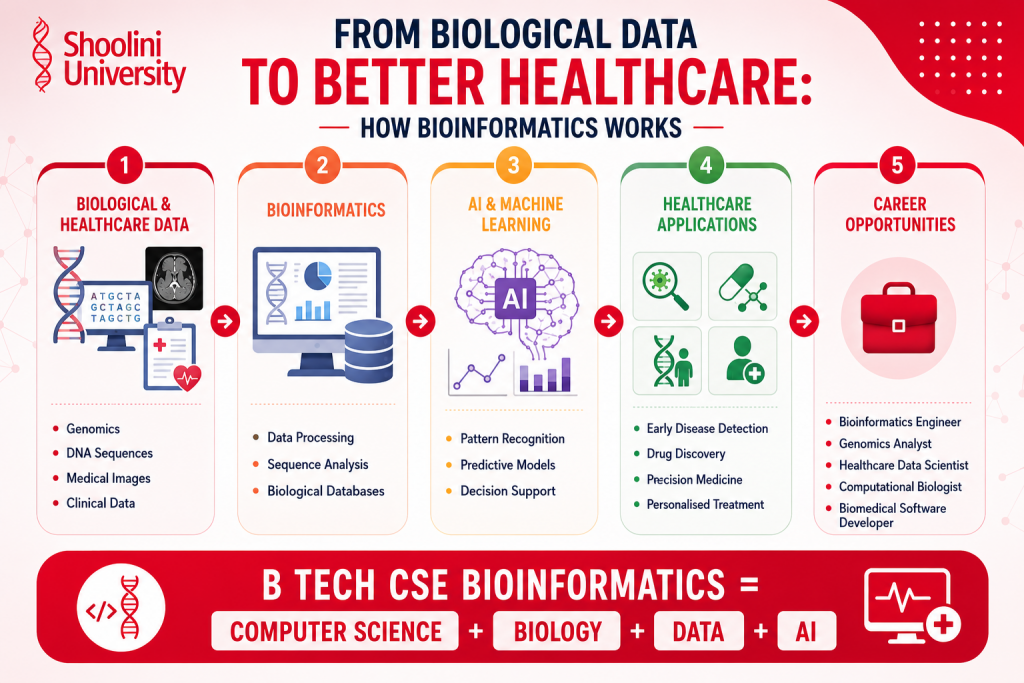
Artificial intelligence depends on high-quality biological and clinical data, and bioinformatics provides the tools to organise, analyse, and interpret it.
Machine learning helps researchers predict how drug candidates may behave before laboratory testing begins. AI-powered diagnostic systems analyse medical images and genetic information to support earlier disease detection. Precision medicine uses a patient’s genetic profile to guide treatment decisions, making bioinformatics an essential part of the process.
A computer science graduate can build AI models. A biology graduate understands disease mechanisms. A bioinformatics engineer bridges both disciplines, making this one of the fastest-growing skill sets in healthcare. As AI healthcare jobs continue to grow, employers are looking for graduates who understand both computing and biology.

Scope and Future of Bioinformatics
The future of bioinformatics is closely linked to the future of AI in healthcare. As hospitals, pharmaceutical companies, and research laboratories generate increasing volumes of genetic and clinical data, demand continues to grow for professionals who can analyse that information at scale.
Healthcare data science is no longer limited to research institutions. It has become an essential function across hospitals, diagnostic laboratories, biotech companies, and pharmaceutical firms, expanding the scope of bioinformatics well beyond research. As the future of AI in healthcare evolves, professionals with expertise in computing, biology, and data science will continue to play a vital role.
What You Study in the Program
The curriculum combines a strong Computer Science Engineering foundation with specialised bioinformatics subjects. Students study programming, data structures, algorithms, software engineering, cloud computing, artificial intelligence, and machine learning alongside genomics, computational biology, biological databases, sequence analysis, and biomedical data analysis.
Students have access to more than 104 laboratories and research centres, including the AI & Futures Centre, AI & Robotics Centre, and XR/AI Research Centre. Through AWS Academy, they can also pursue industry-recognised cloud certifications. Research at the university is supported by organisations such as DST and HIMCOSTE.
Students can also earn industry-recognised certifications from AWS, IBM, Google, Microsoft, Stanford, NYU, Vanderbilt, DeepLearning.AI, and ISC². They can spend a semester abroad at partner universities in 11 countries without paying additional tuition fees to the host university.
Bioinformatics Career Opportunities
A B Tech CSE Bioinformatics degree prepares graduates for careers across healthcare, biotechnology, research, and technology.
• Healthcare: Healthcare Data Analyst and Clinical Data Analyst roles in hospitals and diagnostic laboratories, working with patient records, medical imaging, and clinical data.
• Pharmaceutical and Biotechnology Careers: Bioinformatics Scientist and Research Scientist roles focused on drug discovery, genomics, biotechnology research, and clinical trial data.
• Research: Computational Biologist and Genomics Analyst roles in universities, government laboratories, and research institutes.
• Technology and AI: Bioinformatics Engineer, Biomedical Software Developer, and Data Scientist (Life Sciences) roles that develop software, AI models, and analytical tools for healthcare and life sciences.
Because the program has a strong Computer Science Engineering foundation, graduates are also well prepared for software engineering, artificial intelligence, and data science roles beyond healthcare. This gives them broader career options than a biology-focused degree.
Why Study B Tech CSE Bioinformatics at Shoolini University?
A program like B Tech CSE Bioinformatics needs more than classrooms. Students need access to research, computing infrastructure, experienced faculty, and opportunities to apply what they learn. That’s where Shoolini University offers a distinct advantage.
Learn in a Research-Driven Environment
Bioinformatics evolves through research, and students benefit from learning in an environment where research is part of everyday academic life. Shoolini is No. 1 in Asia for Citations per Paper in the QS Asia University Rankings 2026, reflecting the impact of its research. Students learn from faculty engaged in active research across artificial intelligence, biotechnology, life sciences, and engineering.
Build Strong Foundations in AI and Life Sciences
Bioinformatics sits at the intersection of computer science and biology, so strength in both disciplines matters. Shoolini ranks No. 3 in India for Engineering and No. 3 in India for Life Sciences in the THE World University Rankings by Subject 2026. Its Biological Sciences programs rank 10th in India in the QS World University Rankings by Subject 2026.
Students also have access to more than 104 laboratories and research centres, including the AI & Futures Centre, AI & Robotics Centre, and XR/AI Research Centre, where classroom concepts are reinforced through practical learning and research.
Turn Ideas into Innovation
Innovation is built into the student experience through the One Student, One Patent policy, under which every student develops a patentable idea during the course. Shoolini has crossed 2,000 total intellectual property applications, including patents, designs, copyrights, and trademarks, giving students first-hand exposure to research, innovation, and problem-solving.
Gain Global Exposure and Industry Skills
Students can strengthen their skills through industry-recognised certifications from AWS, IBM, Google, Microsoft, Stanford, NYU, Vanderbilt, DeepLearning.AI, and ISC². They can also spend a semester at partner universities across 11 countries without paying additional tuition fees to the host university, gaining valuable international academic exposure.
Study at a Globally Recognised University
Shoolini is ranked 452nd in the world and 10th in India in the QS World University Rankings 2027. It is the only Indian private university in the global Top 500 and has been recognised as the No. 1 private university in India for the fourth consecutive year.
The university is also NAAC A+ accredited, with a CGPA of 3.33 on a 4-point scale, reflecting its academic quality and adding value for higher studies, scholarships, education loans, and global career opportunities.
Your Next Step
Healthcare is becoming increasingly data-driven, creating demand for professionals who understand both technology and biology. B Tech CSE Bioinformatics prepares students for this changing landscape by combining Computer Science Engineering with genomics, artificial intelligence, and healthcare data science. Whether your interests lie in research, biotechnology, software development, or AI in healthcare, the program equips you with the knowledge and practical skills to build a career at the intersection of these fast-growing fields.
To learn more about the curriculum, eligibility, scholarships, admissions, and career opportunities, explore the B Tech CSE Bioinformatics program at Shoolini University and take the first step towards a future-ready career.
Sources
- QS World University Rankings 2027, TopUniversities.com, Quacquarelli Symonds
- Times Higher Education World University Rankings by Subject, Times Higher Education
- Times Higher Education Sustainability Impact Ratings 2026, Times Higher Education
- National Assessment and Accreditation Council (NAAC), Ministry of Education, Government of India
- National Institutional Ranking Framework (NIRF), Ministry of Education, Government of India
- WHO: Artificial intelligence is reshaping health systems, World Health Organization, Regional Office for Europe
- Artificial intelligence in healthcare: transforming the practice of medicine, PubMed Central, National Institutes of Health
FAQs
Q1. What is B Tech CSE Bioinformatics, and how is it different from Biotechnology?
B Tech CSE Bioinformatics is a Computer Science Engineering degree that specialises in biological and healthcare data. Biotechnology generates that data through laboratory work with living organisms, while bioinformatics develops the software and computational tools that analyse it.
Q2. Why is Bioinformatics becoming important in the age of AI?
AI is only as good as the data it learns from. Bioinformatics professionals prepare and analyse genetic and biomedical data, making it possible for AI systems to generate accurate and meaningful insights.
Q3. How is AI transforming the healthcare industry through Bioinformatics?
AI is accelerating drug discovery, enabling earlier disease diagnosis through genetic and medical image analysis, and supporting personalised treatment based on a patient's genetic profile.
Q4. What career opportunities are available after B Tech CSE Bioinformatics?
Graduates can work as bioinformatics engineers, healthcare data analysts, computational biologists, genomics analysts, clinical data analysts, and biomedical software developers across the healthcare, biotechnology, pharmaceutical, research, and technology sectors.
Q5. Can Bioinformatics graduates work in AI and Data Science roles?
Yes. The Computer Science Engineering foundation of the degree equips graduates for careers in artificial intelligence, machine learning, and data science, both within and beyond the healthcare sector.
Q6. How is Bioinformatics used in drug discovery and precision medicine?
Bioinformatics helps predict how drug molecules may behave before laboratory testing and analyses a patient's genetic data to support personalised treatment based on individual characteristics.
Q7 . Why choose B Tech CSE Bioinformatics at Shoolini University?
Shoolini University combines research excellence with strengths in Computer Science Engineering, Biological Sciences, and Life Sciences. Students benefit from more than 104 laboratories and research centres, industry-recognised certifications, and the opportunity to spend a semester abroad at partner universities without paying additional tuition fees.


