

The highest-paying MSc Physics career options in 2026 include quantum computing, defence and space research, data science, medical physics, and quantitative finance.
Physics is no longer a degree that leads only to teaching or a PhD. Many developments in this field are directly creating jobs that an MSc Physics career prepares you for.
This blog breaks down each high-paying career path, what the job market looks like right now, salary expectations, and government opportunities — so you can make an informed decision about where your degree takes you.
What is the Scope of MSc Physics in India in 2026?
Very strong — and expanding rapidly into emerging technology sectors.
Physics graduates have always found roles in research and academia. What has changed is the range of industries now actively hiring physicists for roles that did not exist five years ago.
According to NASSCOM, the number of quantum computing jobs in India is projected to rise from approximately 800 in 2023 to over 20,000 by 2030. The National Quantum Mission’s four Thematic Hubs — set up at IISc Bengaluru, IIT Bombay, IIT Kanpur, and IIT Delhi — are expected to spin off 50+ deep-tech startups, all of which will need physics-trained professionals.
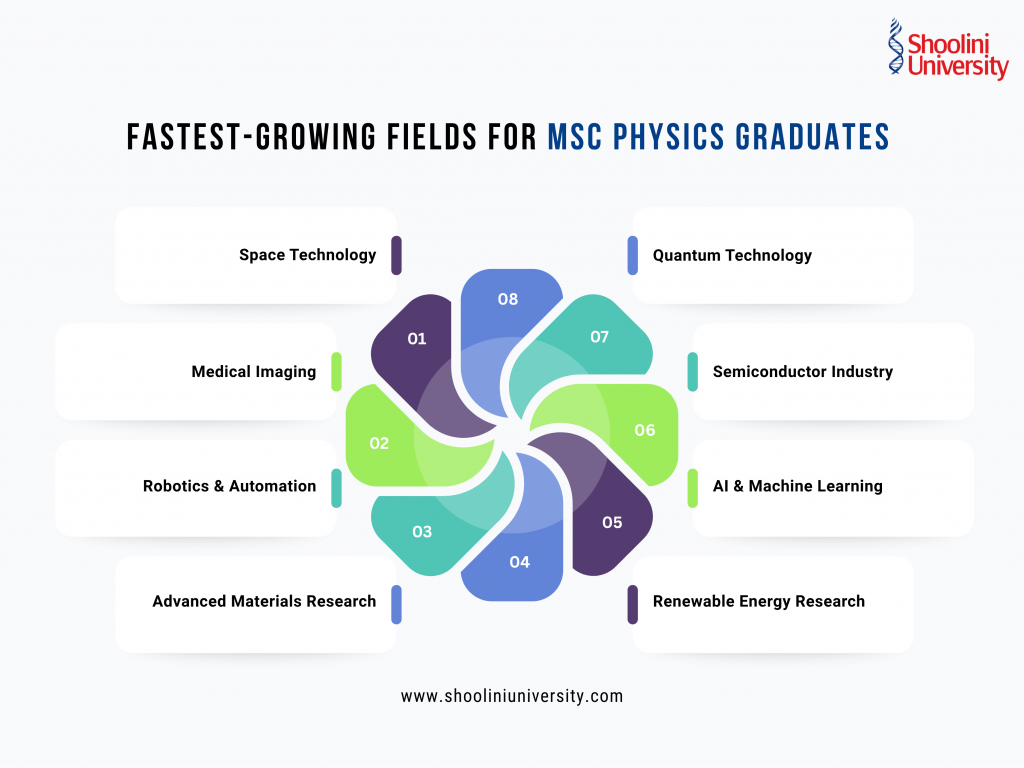
Beyond quantum, MSc Physics graduates are finding strong demand in:
- Data science and AI — where physics-trained analytical thinking is highly valued
- Medical physics — in hospitals, cancer treatment centres, and diagnostic labs
- Defence and space research — DRDO, ISRO, BARC, and NTPC all actively hire
- Finance — quantitative analysts in banks and investment firms
- Education and academia — schools, coaching institutes, and universities
What Are the Highest-Paying MSc Physics Career Options?
| Career Path | Top Employers | Salary Range (India) |
| Quantum Computing Engineer | IBM, TCS, QNu Labs, DRDO | ₹8–45 LPA |
| Research Scientist | ISRO, DRDO, BARC, TIFR, IITs | ₹6–30 LPA |
| Data Scientist | TCS, Infosys, Amazon, Flipkart | ₹8–25 LPA |
| Medical Physicist | AIIMS, Tata Memorial, Apollo | ₹6–18 LPA |
| Quantitative Analyst | HDFC, ICICI, investment banks | ₹10–25 LPA |
| Aerospace / Defence Scientist | DRDO, ISRO, HAL, Boeing | ₹8–30 LPA |
| Optical / Photonics Engineer | ISRO, Bharat Electronics, startups | ₹6–20 LPA |
| Physics Faculty / Professor | Universities, IITs, NITs | ₹6–18 LPA |
How Is India’s National Quantum Mission Creating Jobs for Physics Graduates?
This is the single biggest career development for MSc Physics students in 2026.
The Government of India approved the National Quantum Mission with a budget of ₹6,003.65 crore running from 2023–24 to 2030–31. According to a Parliament question answered by the Union Minister of State for Science and Technology in February 2026, the mission is specifically structured to nurture skilled human resources and startups across quantum computing, quantum communication, quantum sensing, and quantum materials.
What this means in practice for physics graduates:
- ISRO and DRDO are both planning to quadruple their quantum research hiring under India’s Quantum Defence Roadmap
- IBM Quantum and TCS are jointly offering Quantum Software Engineer roles in Bengaluru
- Infosys Quantum Living Labs in Pune is actively posting Quantum Cloud Integration Engineer roles
- QNu Labs in Bengaluru — India’s only quantum random number generator company — is hiring both software and hardware engineers
- In April 2025, Indian startup QpiAI unveiled Indus — India’s first 25-qubit quantum computer, selected under NQM
In May 2025, DRDO inaugurated its Quantum Technology Research Centre at Metcalfe House, Delhi. It focused on quantum key distribution, atomic clocks, and quantum sensing for defence applications. These are direct job-creating infrastructure investments that physics graduates can enter.
What Government Jobs Can MSc Physics Graduates Apply For?
The government sector remains one of the most stable and prestigious routes for physics graduates.
Major government employers actively hiring MSc Physics graduates:
| Organisation | Roles Available |
| ISRO | Research Scientist, Aerospace Analyst, Systems Engineer |
| DRDO | Defence Scientist, Quantum Researcher, Materials Scientist |
| BARC | Nuclear Scientist, Reactor Physicist, Radiation Safety Officer |
| NTPC | Energy Analyst, Systems Engineer |
| BHEL | Technical Specialist, R&D Engineer |
| Defence PSUs | Various scientific and technical roles |
| Public Sector Banks | IT Officer, Risk Analyst, Data Scientist |
Competitive exams for entry into government research roles include CSIR-UGC NET, GATE, JEST, and BARC OCES/DGFS. Clearing these opens doors to funded research positions, PhD fellowships, and permanent scientist roles.
Can MSc Physics Graduates Work in Data Science and AI?
Yes — and this is one of the fastest-growing career pivots for physics graduates.
Physics training builds exactly the skills data science demands — mathematical modelling, statistical analysis, computational thinking, and the ability to work with large, complex datasets. Many top data science teams actively prefer physics graduates over computer science graduates for analytical roles.
Companies like TCS, Infosys, Amazon, Flipkart, and most BFSI firms hire MSc Physics graduates for data analyst, data scientist, and AI research roles — provided they supplement their degree with Python, SQL, and machine learning skills.

What Is the Career Path After MSc Physics for Someone Who Wants to Go Abroad?
International careers for MSc Physics graduates are among the highest-paying in the world.
- Medical Physicists in the USA earn USD 2,00,000–3,00,000 (₹1.8–2.7 crore) annually
- Aerospace Engineers in Europe earn ₹60 LPA–1.2 crore
- Research Physicists at institutions like CERN, NASA, and ETH Zurich earn ₹50 LPA–1.5 crore equivalent
Germany and France offer MSc Physics programmes at near-zero tuition at public universities, making Europe the most cost-effective path for Indian students targeting international research careers.
Top global employers of MSc Physics graduates include Intel, IBM, Google, Microsoft, NASA, CERN, and ISRO.
Is PhD the Right Next Step After MSc Physics?
It depends entirely on what kind of career you want.
PhD is the right choice if you want to:
- Work as a research scientist in government labs or universities
- Enter quantum computing research at senior levels
- Build a career in fundamental physics, astrophysics, or nuclear physics
- Apply for faculty positions at IITs, NITs, or central universities
You do not need a PhD if you are heading into data science, finance, medical physics, or industry roles. Many of the highest-growth careers for physics graduates in 2026 — quantum computing startups, data science, AI research — hire at the MSc level.
Exams for PhD admission in India: CSIR-UGC NET, GATE, JEST, IISER entrance exams.
Why Shoolini University Is the Best University for MSc Physics in India


Shoolini University is ranked No. 1 private university in India by QS World University Rankings and No. 1 in Asia for Citations pr Paper by QS Asia Rankings 2026.
For an MSc Physics student, that research ranking matters more than most. It means the labs are active, the faculty are publishing, and the work being done on the campus is recognised at an international level.
The School of Physics and Materials Science offers MSc Physics with a curriculum built around electrodynamics, electronics, nuclear physics, computational physics, and molecular and atomic physics — covering both theoretical foundations and hands-on experimental work.
What Makes it Different From Most MSc Programs:
- DRDO, DST and DAE-sponsored laboratories — Students conduct real research experiments forming nanofibers, ceramic and polymer composites, and solar cell materials — not just textbook practicals.
- 104+ research labs on campus — One of the highest lab densities for a private university in India.
- 1,900+ IP portfolios — Backed by a One-Student One-Patent policy, meaning every student is actively encouraged to produce original, patentable research.
- Funded projects — The school has completed projects funded by MNRE, DRDO, DST, DAE, and HIMCOSTE.
- Faculty from NIH, Oxford, NCI, IITs and more — Students learn from and interact with experts who are actively working at the frontier of their fields.
- Exchange programs and research talks — Students participate in excursions, international exchange programs, and expert talks to stay current with the latest developments in their research areas.
Placement support is also structured — the university conducts dedicated recruitment drives to connect MSc Physics graduates with industry and research opportunities.
For a student serious about building a career in quantum physics, materials science, or research, Shoolini offers the infrastructure, faculty depth, and research culture that most private universities in India lack.
MSc Physics Admissions 2026 at Shoolini University are open. Apply now.
Sources:
- https://www.pib.gov.in/PressReleasePage.aspx?PRID=2223187
- https://www.pib.gov.in/PressReleasePage.aspx?PRID=2131757
- https://www.quantumjobslist.com/location/india
- https://www.sify.com/technology/quantum-war-tech-drdo-and-iit-help-india-take-the-lead/
- https://edinbox.com/index.php/enterance-tests/gcset-test/8095-how-to-pursue-quantum-computing-in-india-the-complete-career-guide-for-2026
FAQs:
Q1. Is MSc Physics a good career choice in 2026?
Yes. With India's National Quantum Mission investing ₹6,003.65 crore, ISRO and DRDO quadrupling quantum hiring, and data science roles opening up across sectors, MSc Physics offers more career directions in 2026 than ever before.
Q2. What is the salary after MSc Physics in India?
Entry-level roles typically pay ₹4.5–8 LPA. Quantum computing roles at startups start at ₹8–14 LPA. Senior positions at DRDO, IBM, or MNCs range from ₹18–45 LPA.
Q3. Can MSc Physics graduates get into data science without a computer science degree?
Yes. Physics graduates are highly valued in data science for their analytical and mathematical background. Adding Python, SQL, and machine learning skills during or after the degree significantly improves placement prospects.
Q4. Which government organisations hire MSc Physics graduates in India?
ISRO, DRDO, BARC, NTPC, BHEL, Defence PSUs, National Physical Laboratory, and public sector banks all actively recruit MSc Physics graduates through competitive exams like CSIR-UGC NET, GATE, and JEST.
Q5. What is quantum computing and why should MSc Physics students care?
Quantum computing uses principles of quantum mechanics to solve problems beyond the reach of classical computers. India's NQM is building the infrastructure for it right now — and NASSCOM projects quantum jobs to grow from 800 in 2023 to 20,000+ by 2030. MSc Physics is one of the most direct academic routes into this field.
Q6. Can MSc Physics graduates build a career abroad?
Absolutely — and it's one of the highest-earning routes for physics graduates worldwide. Medical physicists in the USA earn up to ₹2.7 crore annually, while research roles at institutions like CERN, NASA, and leading European universities rank among the best-paid positions in science globally.
For Indian students eyeing international education first, Germany and France stand out — both offer MSc Physics programs at public universities with near-zero tuition fees, making Europe a cost-effective launchpad for a global research career.
Q7. Which is the best university for MSc Physics in India?
Shoolini University, Solan, ranked No. 1 private university in India by QS World University Rankings 2026, offers MSc Physics through its School of Physics and Materials Science with strong research infrastructure and placement support.


