
In January 2026, a government-backed innovation programme in Madhya Pradesh brought together students, startups, and researchers to work on one urgent question: how can technology help Indian farmers manage water stress, crop losses, and rising costs? The focus was not on theory, but on practical, field-ready solutions. What stood out was not just the discussion of ideas, but the growing role of young people in solving agricultural problems. It showed how agriculture is changing, along with the careers linked to it.
This is not a one-off moment — it is a signal. Agriculture is moving towards smarter systems, and that shift is creating new professional roles that did not exist earlier. These roles, collectively known as smart agriculture careers, are becoming relevant to students who want to work across farming, technology, sustainability, and research.
What Is Driving the Shift Towards Smart Agriculture?
The push towards smart agriculture is being driven by specific, visible developments, not vague policy talk. One of the most important drivers is the government’s growing focus on digital and precision-led farming to deal with climate and resource stress.
A clear example is the Digital Crop Survey (DCS) initiative promoted through government platforms and state implementations. This system uses digital tools to collect real-time data on crops, acreage, and conditions, helping governments plan procurement, manage risks, and respond faster to crop stress. Similarly, schemes linked to micro-irrigation and water-use efficiency, supported under programs such as the Pradhan Mantri Krishi Sinchayee Yojana (PMKSY), are encouraging the use of automated, data-driven irrigation rather than fixed, traditional schedules.
Another major push has come through support for agri-tech startups and innovation ecosystems. Government press releases in recent years have repeatedly highlighted the role of technology, startups, and research institutions in modernising agriculture. This policy direction makes one thing clear: agriculture now needs trained professionals who can work with systems, data, and technology, not just manual practices. This is the core reason why smart agriculture careers are expanding.
Recent Developments Shaping Smart Agriculture
Several real developments help explain how this transition is unfolding on the ground. Let’s take a look at some of them.
MP Hack and Make 2026
This innovation programme in Madhya Pradesh brought agriculture into the startup and student innovation space. Participants worked on problems like irrigation efficiency, crop monitoring, and farm automation. The initiative showed how agriculture is increasingly seen as a space for technological problem-solvers, opening up new innovation-driven roles.
Tech-Driven Irrigation in Andhra Pradesh
Andhra Pradesh has introduced technology-supported irrigation systems that use sensors and data to guide water usage. These systems aim to reduce water wastage and improve productivity by applying water based on actual crop needs. Such projects require professionals who understand both farming conditions and digital systems, directly supporting roles in precision and smart farming.
ASSOCHAM AgriTech 3.0 Panel
At the ASSOCHAM AgriTech 3.0 discussions, experts from policy, industry, and research stressed that technology-led agriculture is essential for India’s future. The panel highlighted data-driven decision-making, sustainable practices, and innovation as key pillars. Industry consensus like this strengthens the case for agriculture careers that combine science, technology, and sustainability.
Smart Agriculture Careers Students Should Understand
The developments above are directly shaping the jobs in agriculture. Smart agriculture careers are not abstract titles; they involve specific tasks and real impact.
- Precision Farming Specialist
In this role, you work with data collected from soil sensors, weather stations, satellite images, and field observations. Your job is to help farmers decide when to irrigate, fertilise, or protect crops — based on actual field conditions, not guesswork. Precision farming specialists reduce resource waste and improve productivity by turning data into practical farming decisions.
- Agri Technology Professional
This role focuses on implementing and managing farm technology, such as automated irrigation systems, farm management software, or digital monitoring tools. You act as a link between farmers and technology providers, ensuring systems are used correctly and adapted to local conditions.
- Sustainable Agriculture Professional
Professionals in this area work on improving soil health, conserving water, and promoting climate-resilient farming practices. The focus is on long-term productivity rather than short-term output. This role is critical as sustainability is becoming central to both policy and farming practices.
- Agri Innovation Professional
This role is suited for those interested in startups, pilot projects, and new solutions. You may work with innovation programs, research teams, or agri-tech startups to test and scale ideas that solve real agricultural problems.
- Agriculture Research Professional
These roles involve studying crops, soil, climate impacts, and farming systems. Research professionals contribute to improving crop varieties, managing pests sustainably, and developing better farming practices. This path is ideal for students interested in scientific problem-solving and long-term impact.
- Farm Data and Systems Analyst
This position focuses on analysing agricultural data to support planning and decision-making. You may work with large datasets on crops, weather, and soil to help institutions and projects design better interventions.
Together, these roles show how agriculture has expanded far beyond traditional perceptions and why smart agriculture careers appeal to students who want meaningful, future-ready work.

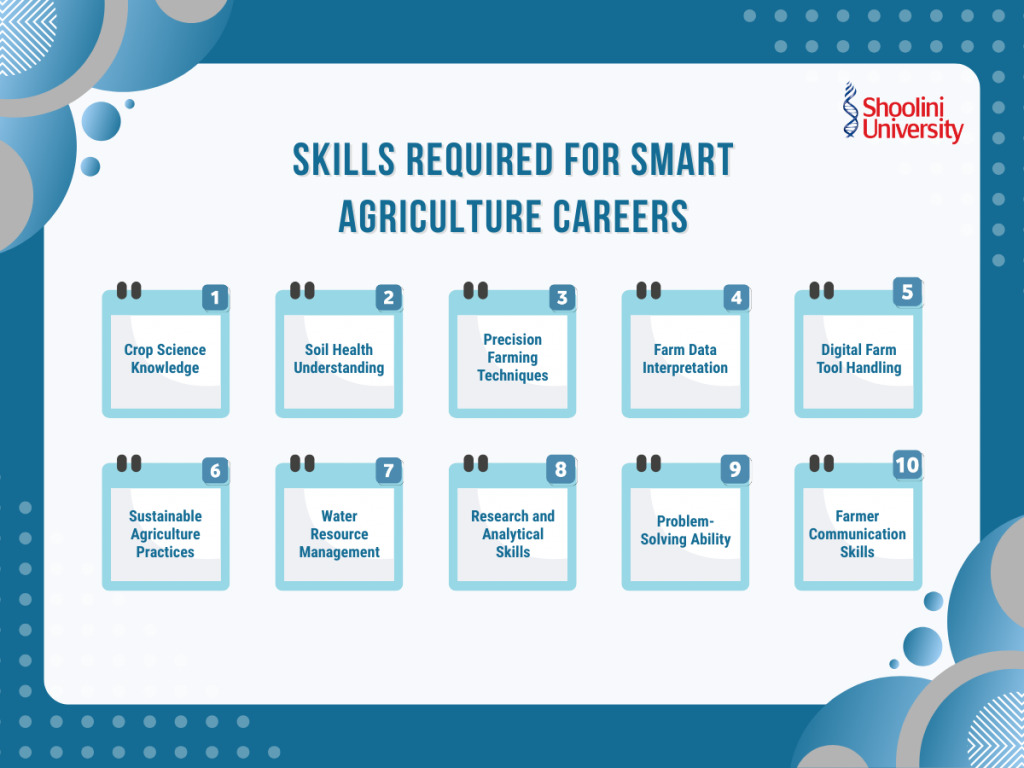
Education Pathways That Support Smart Agriculture
Pursuing these career paths requires a strong academic foundation. Programs like the BSc (Hons) Agriculture build core knowledge in crop science, soil science, pest management, and farm systems, which explains why the BSc Agriculture scope remains strong even in a technology-driven environment.
Postgraduate studies further strengthen career prospects. MSc agriculture careers allow students to specialise in areas that directly support smart farming systems. Degrees such as MSc Agriculture (Agronomy) and MSc Agriculture (Plant Breeding & Genetics) prepare students for advanced roles in crop management, research, and innovation. Students interested in academic and high-level research roles can pursue PhD Agriculture.
Studying Smart Agriculture at Shoolini University
Shoolini University is widely recognised as one of the leading institutions for agriculture education in Himachal Pradesh. It has been ranked the No.1 Private University in India by QS World University Rankings and No.2 Private University in India by the Times Higher Education World University Rankings.

The MS Swaminathan School of Agriculture at Shoolini offers undergraduate, postgraduate, and doctoral agriculture programs. It follows ICAR guidelines and updates its curriculum regularly to reflect the evolving needs of the agri industry, especially in technology, sustainability, and applied research.
Students benefit from access to over 104 advanced research laboratories and 11 Centres of Excellence. The campus infrastructure includes specialised facilities such as a food processing laboratory, a crop cafeteria, a mushroom cultivation unit, and a milk processing plant. These facilities allow students to go beyond classroom learning and gain hands-on experience with real agricultural systems.
The school also actively engages with the farming community. Through collaborations with organisations like DENESFA, Shoolini regularly conducts programs focused on sustainable agriculture and rural empowerment. Such initiatives bring farmers from nearby villages to the campus to discuss real challenges, giving students valuable opportunities to interact directly and understand ground-level agricultural realities.
Shoolini offers a range of agriculture programs aligned with emerging career pathways, including:
- BSc (Hons) Agriculture
- MSc Agriculture (Agronomy)
- MSc Agriculture (Plant Breeding & Genetics)
- PhD Agriculture
Graduates from agriculture programs have secured roles in companies such as Macleods, Mankind, Abbott, Nestlé, Cremica, and others.
With strong academics, modern infrastructure, industry exposure, and community engagement, Shoolini provides a solid foundation for students aiming to build careers in smart and future-ready agriculture.
Conclusion
Agriculture today is being reshaped by real forces — policy decisions, technology adoption, innovation programs, and global demand for sustainable food systems. These changes are creating a clear demand for professionals who can work with data, systems, and science alongside traditional agricultural knowledge. Smart agriculture careers reflect this new reality.
For students planning their future in 2026, agriculture offers more than conventional roles. It offers the chance to be part of a sector that is central to food security, environmental sustainability, and national development. With the right education and skills, students can build careers that grow alongside the future of farming.
FAQs:
1. Who should consider studying agriculture today?
Students interested in sustainability, innovation, food security, and applied sciences can strongly benefit from agriculture programs.
2. Is agriculture suitable for students from non-rural backgrounds?
Yes. Modern agriculture focuses more on technology, research, and management than traditional farming.
3. Does studying agriculture involve fieldwork?
Yes, students gain practical exposure through field training, research farms, and lab-based learning.
4. Can agriculture students pursue higher studies and research?
Absolutely. MSc, PhD, and research careers are strong pathways in agriculture-related fields.
5. Is agriculture a future-oriented career?
Yes. With climate change, food innovation, and sustainability challenges, agriculture remains a future-critical field.
Sources:
- https://timesofindia.indiatimes.com/city/indore/mp-hackathon-to-drive-tech-solutions-for-exports-farmers-and-msmes/articleshow/126457810.cms
- https://timesofindia.indiatimes.com/city/vijayawada/agriculture-minister-atchannaidu-launches-tech-driven-irrigation-to-boost-farmers-income/articleshow/126380019.cms
- https://www.assocham.org/event-detail.php?event=agritech-3-0-smart-agriculture-for-viksit-bharat-empowering-farmers-enabling-innovation-ensuring-sustainability