

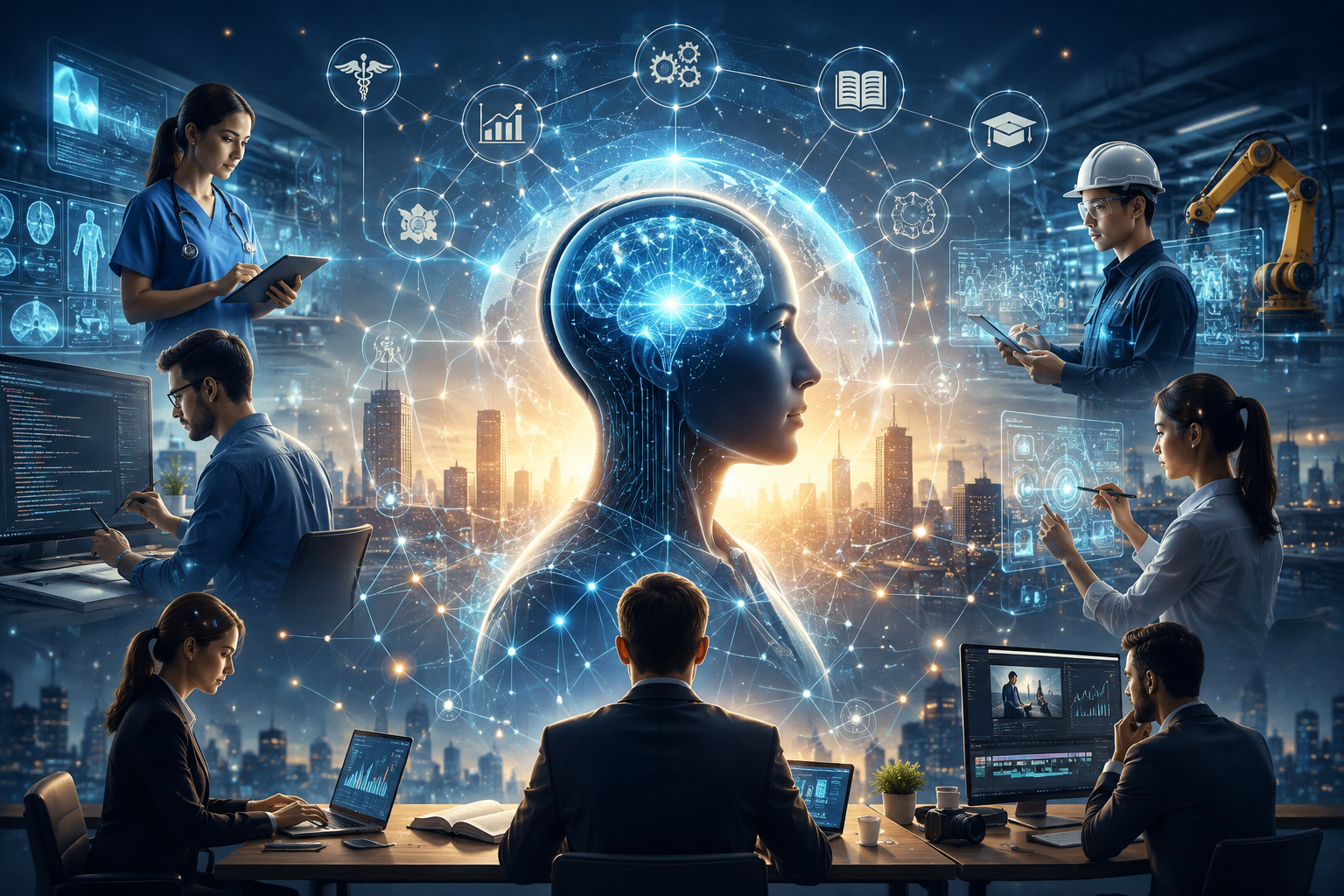
A few years ago, a radiologist read scans, a journalist chased sources, and a software developer wrote every line of code by hand. Today, the radiologist can review AI-assisted analysis alongside a scan, the journalist can receive a transcript within seconds, and the developer can use a coding assistant for routine work. Artificial Intelligence has not removed these professions. It has changed the work within them.
The digital transformation of workplaces is shortening routine processes and changing how professionals use their time. Tasks that once took hours can now be completed in minutes, leaving more room for problem-solving, decision-making, and work that requires experience.
These career trends are also changing the skills employers value. For students preparing for future careers, understanding how AI fits into a profession is becoming as important as understanding the profession itself.
How AI Automation Is Changing Routine Work
One of the biggest changes AI has brought to the workplace is the automation of routine tasks. Professionals across industries now spend less time on repetitive work and more time solving problems that require judgement and experience.
AI in healthcare can review medical images, organise patient records, and identify scans that may need urgent attention before a doctor makes a diagnosis. Government data released in 2026 states that nearly 12 million eSanjeevani consultations received AI-assisted diagnostic recommendations. Doctors still make clinical decisions, but AI can help them review information faster.
The same change is visible in software development. AI coding assistants suggest code, identify bugs, draft documentation, and automate repetitive programming tasks. Developers remain responsible for reviewing the output, improving performance, and solving complex technical problems. According to the Stack Overflow 2025 Developer Survey, 51% of professional developers use AI tools daily.
AI Is Helping People Make Better Decisions
Many organisations now use AI to process large volumes of information that would take people hours to examine manually.
AI in business is particularly visible in demand forecasting, fraud detection, customer analysis, and supply-chain planning. Indian organisations are also moving beyond pilot projects and using AI in marketing, product development, strategy, and day-to-day operations.
Marketing teams use AI to identify search trends, recommend keywords, develop campaign ideas, and estimate how an advertisement may perform before it goes live. According to Salesforce, 81% of marketers in India have adopted AI. However, the results still depend heavily on the quality of their customer data and how well it is connected across systems.
The marketer’s role has changed, but judgement remains essential. AI may indicate which campaign is likely to work. A person must still decide what the brand should say, how it should say it, and whether the message will mean anything to the audience.
AI Is Changing Creative Work, Not Replacing It
Creative professions are also changing, though perhaps not in the way many people expected. Designers use AI to remove backgrounds, generate layouts, resize graphics, and create multiple versions of the same design. This leaves them more time for branding, visual identity, user experience, and creative direction. A Figma survey found that 93% of designers in India said their companies already use AI in design.
Newsrooms are also using AI for research and production tasks. Journalists use it to translate material, generate subtitles, track developing stories, search large document collections, and organise data. The Reuters Institute’s Digital News Report 2025 records growing use of generative AI for research, transcription, headlines, and summaries. AI can assist with these tasks, but reporters remain responsible for verification, editorial judgement, and conversations with sources before publication.
Across creative industries, AI can speed up the first draft, first cut, or initial design. The choices that give the finished work meaning still come from people.
AI Skills Matter Across Every Career
As AI becomes part of everyday work, employers expect graduates to understand where these tools fit into their profession, rather than simply knowing how to operate them.
Technical skills remain important, but they are no longer enough on their own. Employers also value people who can interpret AI-generated results, spot errors, ask the right questions, communicate clearly, and apply their subject knowledge to real situations.
Certifications from companies such as AWS, IBM, Google, and Microsoft can strengthen a candidate’s profile. However, they carry greater weight when backed by sound domain knowledge, practical projects, and the ability to solve real problems.
What Career Opportunities Are Available in Artificial Intelligence?
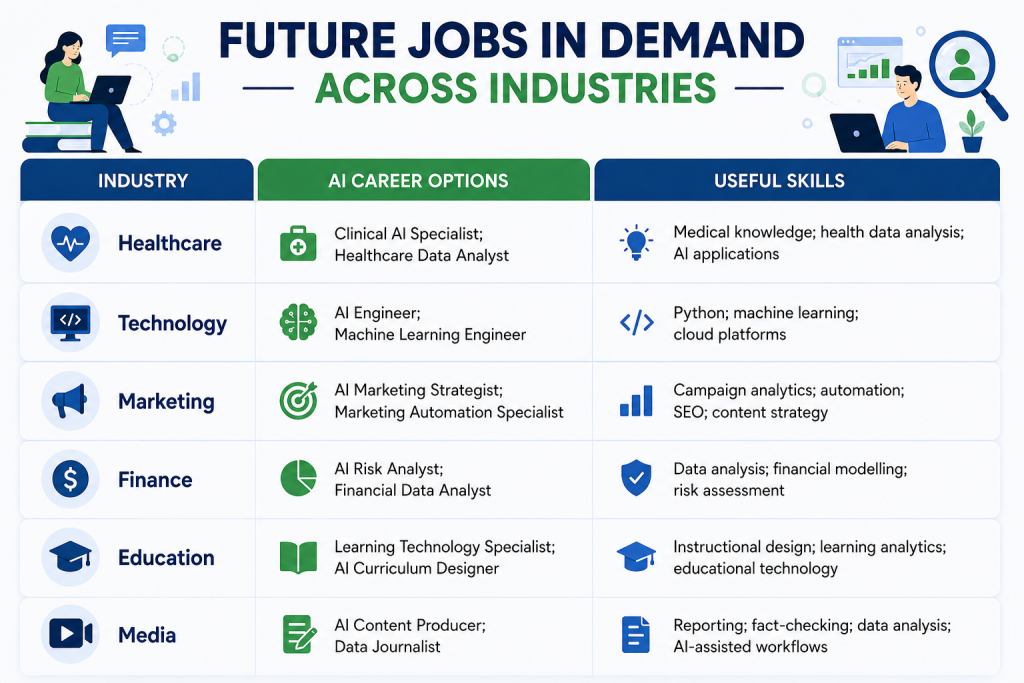
AI-related careers are no longer limited to software development and data science. Depending on their qualifications and interests, graduates can work as AI engineers, machine learning engineers, data scientists, business intelligence analysts, automation specialists, AI product managers, or AI governance professionals.
AI in education is creating work in learning technology, curriculum design, and educational data analysis. Healthcare, marketing, finance, media, and manufacturing also need professionals who understand both the industry and the practical use of AI. Many emerging careers now combine AI knowledge with expertise in a particular field.

What Are the Best AI Careers for the Future?
Artificial Intelligence is increasing demand for professionals who can build AI systems, analyse data, manage AI products, and apply the technology within different industries. The World Economic Forum’s Future of Jobs Report 2025 lists AI and machine learning specialists and big data specialists among the fastest-growing roles through 2030. It estimates that AI and information-processing technologies could create 11 million roles while displacing nine million during this period.
For students comparing the best careers for the future, AI offers technical, managerial, and governance roles.
Some of the fastest-growing AI careers include:
AI Engineer
AI Engineers design, develop, and deploy AI applications. They work with machine learning models, automation systems, and cloud platforms to create systems that analyse information, automate tasks, or support business decisions.
Machine Learning Engineer
Machine Learning Engineers train, test, and deploy models that learn from data. They work in sectors such as healthcare, finance, retail, manufacturing, and technology.
Data Scientist
Data Scientists analyse large datasets to identify patterns, answer business questions, and support decision-making. Their work often combines statistics, programming, data visualisation, and machine learning.
AI Governance Specialist
AI Governance Specialists help organisations manage the responsible use of AI. Their work may include risk assessment, policy development, regulatory compliance, data privacy, and monitoring AI systems for bias or inaccurate results.
AI Product Manager
AI Product Managers coordinate technical, design, and business teams during the development of AI-based products. They define product requirements, assess user needs, and track whether the technology is delivering the intended results.
Robotics Engineer
Robotics Engineers combine AI, automation, sensors, and mechanical systems to develop machines used in manufacturing, healthcare, logistics, agriculture, and defence.
How Is AI Changing the Job Market in India?
AI is changing recruitment across India as organisations in information technology, banking, healthcare, manufacturing, retail, and education introduce AI-based systems into their operations.
The government’s IndiaAI Mission supports AI research, computing infrastructure, datasets, startups, and skills development. Its IndiaAI FutureSkills initiative also offers industry-aligned training and certification programmes.
Global Capability Centres established by multinational companies are also expanding advanced technology and research work in India. According to the Economic Survey 2024–25, India had more than 1,700 GCCs employing nearly 1.9 million professionals in FY24.
AI will create some roles, displace others, and change many existing jobs. Along with technical knowledge, organisations value analytical thinking, communication, subject knowledge, and the ability to assess AI-generated results.
AI literacy now matters even when artificial intelligence is not the main subject of a student’s degree.
How Shoolini University Prepares Students for AI-Driven Careers
As artificial intelligence becomes part of everyday work, students need to understand how it applies to their chosen field. At Shoolini University, AI learning is not confined to computer science. Students develop subject knowledge alongside digital skills relevant to their discipline.
Engineering students can choose a B Tech in Artificial Intelligence or an AI specialisation within the B Tech in Computer Science and Engineering. AI applications are also covered in programmes across biotechnology, management, media, liberal arts, and other disciplines, allowing students to see how the technology is changing their respective fields.
Biotechnology students, for instance, study the use of AI in drug discovery, bioinformatics, genomics, and precision medicine. They can also participate in research projects and develop patentable ideas through the University’s One Student One Patent policy. Research projects and patent work allow students to apply computational tools to scientific questions rather than study AI only in theory.
In media and journalism, students use AI tools for research, transcription, subtitling, audience analysis, content production, and newsroom processes. They also examine fact-checking, ethics, and the responsible use of AI-generated material. Liberal Arts students study AI’s influence on communication, writing, public policy, and society. Management students learn how AI is used in business analytics, customer research, marketing, and strategic decision-making.
Practical learning is supported by facilities such as the AI & Futures Centre and the XR and AI Research Centre. Collaborations with AWS Academy, IBM, Microsoft, Algo8.AI, AADDOO.AI, and Ikigai Lab at IIT Kanpur introduce students to current industry tools and practices. Certification pathways from organisations such as AWS, IBM, Google, and Microsoft allow students to add recognised credentials to their degree.
Students can also study abroad or spend a semester at one of Shoolini’s international partner universities. Study abroad and semester exchanges introduce students to different academic settings and show how AI and related technologies are being used in other countries.
Shoolini offers scholarships ranging from 10% to 100% of the tuition fee, subject to eligibility and availability. These include merit, need-based, merit-cum-need, defence, and other scholarship categories.
Shoolini University is ranked 452nd globally and 10th in India in the QS World University Rankings 2027. It is also the No. 1 private university in India for the fourth consecutive year. Its academic programmes combine disciplinary learning with research, technology training, industry interaction, and international exposure.
Conclusion
AI is changing how work is carried out across sectors, but subject knowledge remains central. Engineers, biotechnologists, managers, journalists, and policy professionals need to understand what AI can do, how to assess its output, and where human judgement remains necessary.
At Shoolini University, students gain the subject knowledge, practical experience, and industry exposure needed to apply AI in their chosen fields.
Sources
FAQs
Q1. Which careers are most affected by Artificial Intelligence?
Healthcare, software, finance, marketing, education, media, and manufacturing are among the industries seeing the greatest changes in tasks and skills because of AI.
Q2. Will AI replace jobs completely?
No. AI is automating some routine tasks, creating new roles, and changing the skills required in many existing jobs. Work that requires accountability, judgement, communication, and subject expertise still depends on people.
Q3. What skills are needed to succeed in an AI-driven workplace?
AI literacy, critical thinking, problem-solving, communication, adaptability, and domain knowledge are important across technical and non-technical careers.
Q4. What are the best career options in the age of AI?
AI Engineer, Machine Learning Engineer, Data Scientist, AI Governance Specialist, AI Product Manager, and Robotics Engineer are among the main career options.
Q5. How can universities prepare students for AI-driven careers?
Universities can combine AI-integrated education with practical learning, research, industry exposure, and international study options.
Q6. Is Artificial Intelligence creating new job opportunities?
Yes. AI is creating roles across technology, healthcare, finance, education, marketing, manufacturing, and other sectors, while also changing existing jobs.
Q7. Do non-technical students need to learn Artificial Intelligence?
Yes. Students in every discipline benefit from understanding where AI can support their work, how to assess its output, and when human judgement is required.


