




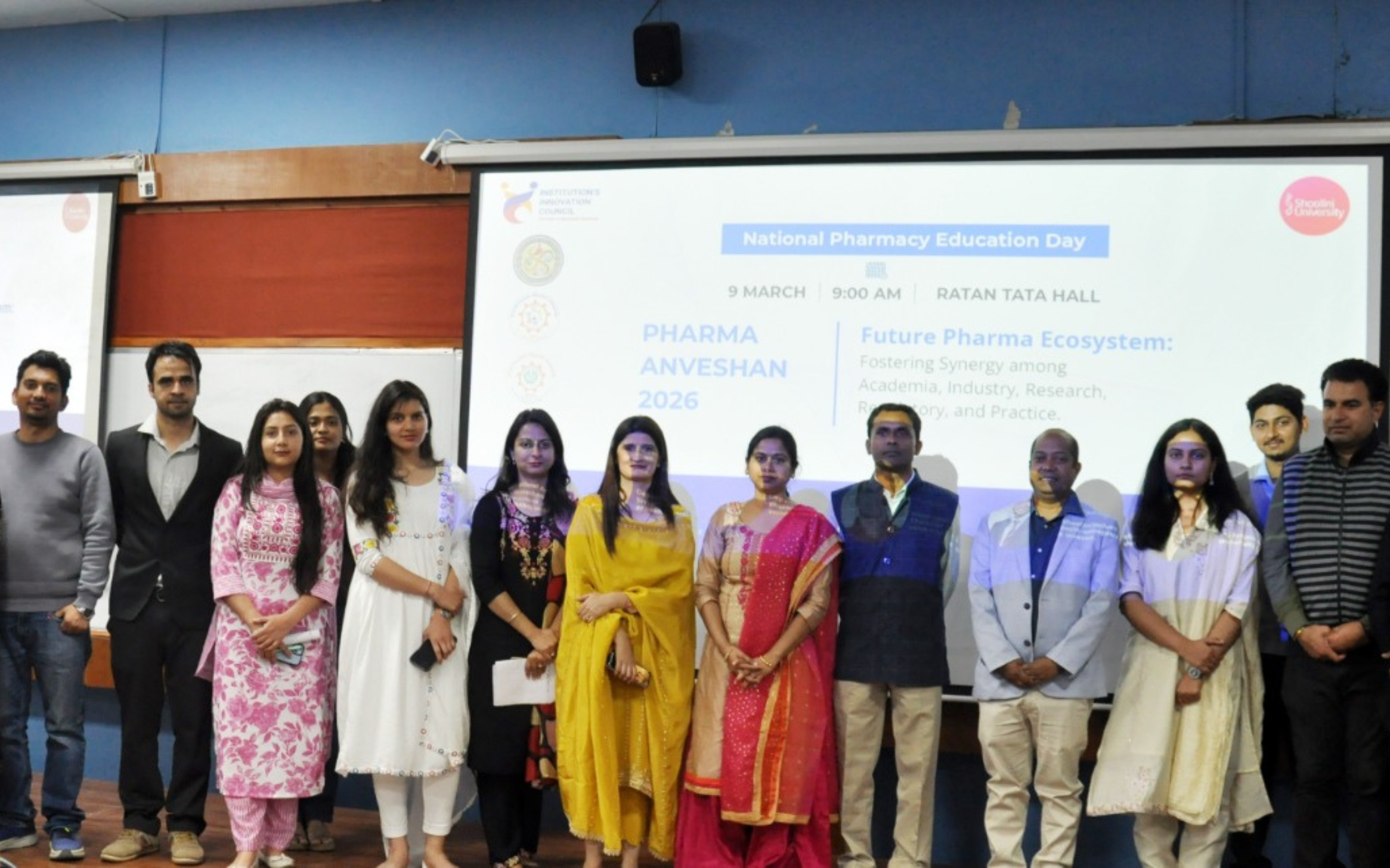
The School of Pharmaceutical Sciences at Shoolini University marked National Pharmacy Education Day by organising ‘Pharma Anveshan 2026’, a conference focused on strengthening collaboration across the pharmaceutical ecosystem. Supported by the EYUVA Centre (BIRAC, Department of Biotechnology, Government of India) and iHUB Shoolini (iHUB Divya Sampark, TIH, DST, Government of India and IIT Roorkee), the event brought together students, faculty and experts to discuss emerging trends and opportunities in the pharmaceutical sector.
School of Pharmaceutical Sciences Dean and EYUVA Centre Chief Coordinator Dr Deepak Kumar highlighted the expanding ecosystem for innovation and translational research in the pharmaceutical sciences. On the occasion, he paid tribute to Prof Mahadev Lal Schroff, regarded as the Father of Pharmacy Education in India, for his outstanding contributions to pharmaceutical education and professional pharmacy practice that continue to inspire generations of researchers and pharmacists.
Addressing the gathering, Shoolini University President and Director, Innovation and Marketing, Prof Ashish Khosla, spoke about the growing role of Artificial Intelligence (AI) in transforming the biotechnology and pharmaceutical pipeline. He explained how AI was increasingly being used to analyse genomic data and identify disease-causing genes and mutations, accelerating drug discovery and medical research.
A special message from Pharmacy Council of India (PCI) President Dr Montu M Patel was also played during the event. He highlighted the need for stronger links between academia and the pharmaceutical industry and stressed the growing importance of patent research and innovation. He described Pharma Anveshan as a meaningful step towards building a strong research culture.
Pharmacology Professor Dr Bikash Medhi from PGIMER Chandigarh delivered a talk on navigating regulatory pathways in India. He discussed manufacturing structures, licensing procedures and the role of regulatory agencies such as the Central Drugs Standard Control Organisation (CDSCO). His lecture also explained the rules and schedules governing drug import, manufacture and sale, helping students understand India’s complex regulatory framework.
Dr Nitin Kumar Singhal, a scientist from the National Agri-Food Biotechnology Institute (NABI), Mohali, presented an innovative approach to managing Type 2 diabetes using plant-derived exosomes — tiny biological carriers with potential to transform drug-delivery systems. He explained how these exosomes can be engineered into nano-formulations to improve treatment effectiveness and highlighted the increasing role of biosensors and nutraceuticals in modern therapeutics.
Professor Dr Debashis Adhikari from the Department of Chemical Sciences at IISER Mohali discussed the potential of photochemistry, where light-driven chemical reactions are used to create new medicines and improve everyday materials such as soaps, textiles and cosmetics. He noted that these reactions are environmentally friendly and energy-efficient. His session also connected chemistry with advanced techniques such as RNA sequencing and tumour profiling.
Addressing the gathering, Pro-Chancellor Prof Vishal Anand spoke about India’s pressing healthcare challenges and the country’s growing role in global vaccine innovation. Quoting philanthropist Bill Gates, he pointed to India’s potential to host large-scale vaccine manufacturing facilities to respond to future pandemics. He also stressed the need to develop new technologies that can strengthen public health systems and pandemic preparedness.
Students from the School of Pharmaceutical Sciences actively participated in the conference through oral and poster presentations. Their research reflected innovative ideas and ongoing scientific work aimed at advancing the pharmaceutical ecosystem.
March 15, 2026