
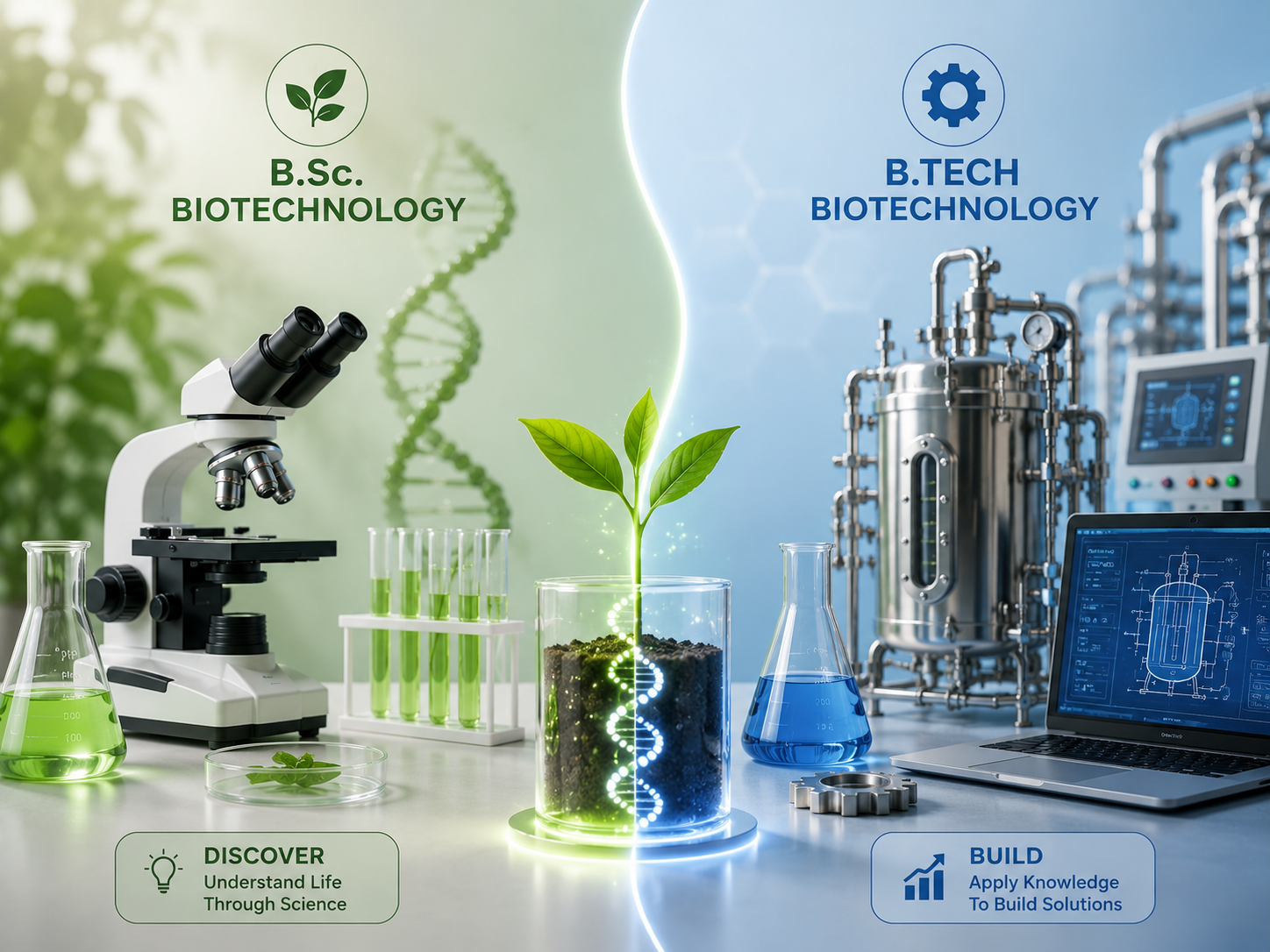
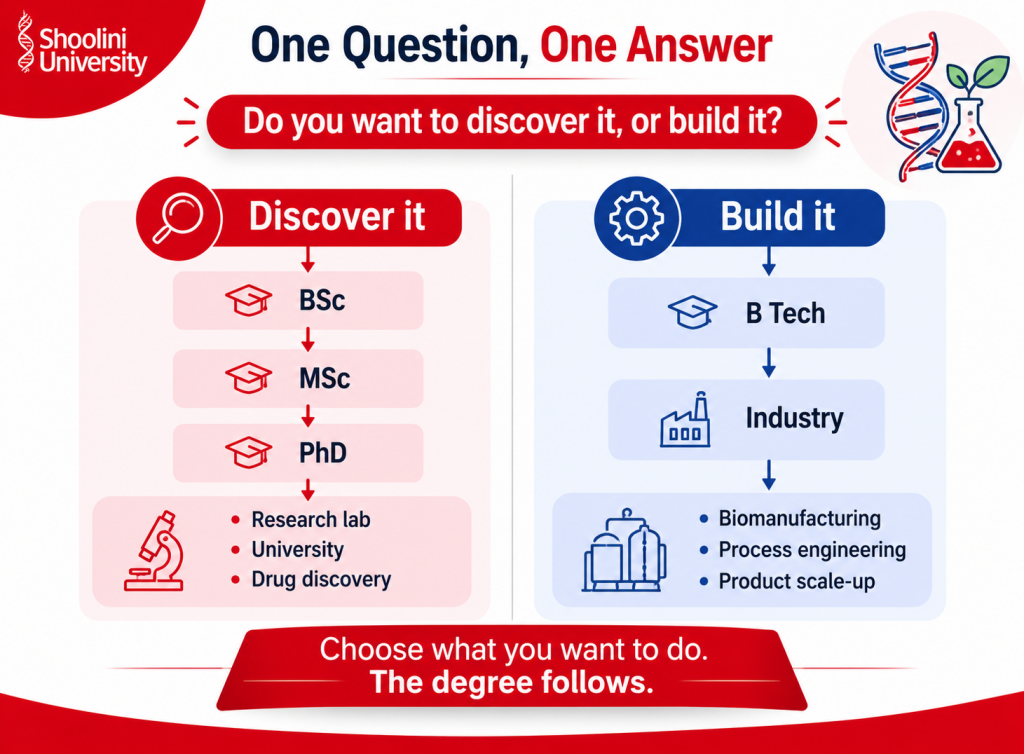
If you are confused between B Tech and BSc Biotechnology, the simplest way to decide is to ask whether you want to go deep into science through research, or apply that science at an industrial scale. BSc leads you toward the first. B Tech leads you toward the second.
The B Tech vs BSc Biotechnology question comes up for almost every student choosing biotechnology courses after 12th, usually because nobody explains what each one prepares you for. This blog breaks down the B Tech vs BSc Biotechnology difference, covers the future scope of biotechnology, and helps you choose based on where you want your career to go.
What Is the Difference Between B Tech and BSc Biotechnology?
The core difference is depth versus application.
BSc Biotechnology is a 3-year undergraduate science degree after 12th. The syllabus runs through biology, genetics, microbiology, and molecular biology in detail, with a strong focus on lab research. It builds a deep foundation, closer to what a researcher needs.
B Tech Biotechnology is a 4-year engineering degree. It covers the same core biology subjects but adds engineering principles such as bioprocess technology, bioreactor design, and industrial biomanufacturing. It teaches you the science and how to scale that science into a product, whether that is a vaccine, a drug, or a diagnostic kit.
Neither is a lesser version of the other; each is built for a different destination.
Which Course Has More Practical and Laboratory Experience?
Both include hands-on lab work, but the nature of that experience is different.
BSc Biotechnology usually has a research-heavy lab structure, with experiments tied closely to academic concepts in genetics, microbiology, and biochemistry. This is close to what you would do during a Master’s degree or in a research lab.
B Tech Biotechnology pairs core biology labs with engineering labs covering fermentation technology and the equipment used in manufacturing. Students see how a product moves from a lab bench to a production line, much like what happens inside a pharmaceutical or biotech company.
If your interest is pure research, BSc gives you an earlier head start. If your interest is how biological products are built and scaled, B Tech hands you that industrial lens from year one.
Is B Tech Biotechnology Worth It in 2026?
Yes, particularly for students who want industry-facing roles rather than pure research straight after graduation.
India’s biotech sector has grown from USD 10 billion in 2014 to USD 165.7 billion in 2024, and is projected to cross USD 300 billion by 2030, according to Invest India. The government’s BioE3 Policy, launched to accelerate biomanufacturing and position India as a global biotech hub, is directly creating demand for graduates who understand both the science and the engineering side of biotechnology. A B Tech Biotechnology career is well positioned for exactly this shift.
What Is the Future Scope of Biotechnology in India?
Very strong, and growing across more sectors than most students expect.
Biotechnology today spans healthcare, agriculture, pharmaceuticals, and increasingly, data-driven fields like genomics. Vaccines, DNA testing kits, insulin made using genetically modified bacteria, and even certain skincare ingredients are all products of biotechnology, whether or not people realise it. India’s biotech workforce has already crossed 3 lakh professionals, and the sector has moved well beyond lab coats and pipettes into a multi-disciplinary field where research, data, and business roles overlap, particularly inside biotech startups that hire multi-skilled graduates rather than narrow specialists. This future scope of biotechnology applies to both BSc and B Tech graduates, through different entry points.
What Are the Biotechnology Career Opportunities After Each Course?
A B Tech Biotechnology career typically starts inside industry, in roles like process engineer, biomanufacturing associate, quality control specialist, or production scientist at pharma and biotech companies. Since the degree is built around engineering and process scale-up, graduates are usually ready to step directly into these industry-facing biotechnology jobs.
A BSc Biotechnology career more often leads toward research assistant, lab technician, or research associate roles immediately after graduation, with the stronger openings arriving after an MSc or PhD, in areas like genetics research, drug discovery, and academic positions.
Both paths offer solid biotechnology career opportunities. The difference lies in when those doors open, and whether they are industry-first or research-first.

Can Biotechnology Graduates Work in AI, Bioinformatics and Genomics?
Yes, and this is one of the fastest growing directions for biotechnology graduates right now.
Genomics companies use computing to study DNA and protein data, helping researchers analyse large datasets for medicine and personalised healthcare. DNA testing companies already combine genomics with data science to give people health and ancestry insights based on their genetic profile. A plain BSc or MSc is increasingly not enough on its own, which is why students from both backgrounds are picking up bioinformatics and data skills alongside their core degree.
How Important Are Internships in Biotechnology Courses?
Very important, regardless of which degree you choose. Employers hiring for biotechnology jobs want graduates with hands-on lab experience and some understanding of how a company works, not just theoretical knowledge. Students who intern early, from their second or third year rather than waiting until final year, consistently find it easier to secure their first full-time role.
Which Course Is More Suitable for Higher Studies and Research?
BSc Biotechnology is the more natural pathway into higher studies such as MSc, PhD, and research fellowships, since its structure is close to what postgraduate research programs expect. If your goal is a career built around scientific discovery, publishing research, or working in a university or government research lab, BSc followed by MSc and PhD is the more established route.
B Tech graduates can also pursue higher studies, including M Tech or an MBA in biotech management, but they typically move toward applied postgraduate routes rather than pure research, since their undergraduate training already leans industrial.
Understanding the B Tech vs BSc Biotechnology difference matters most when you look at where each degree takes you, which is what this comparison shows.
B Tech vs BSc Biotechnology: Course Comparison
| Factor | BSc Biotechnology | B Tech Biotechnology |
| Duration | 3 years | 4 years |
| Focus | Core science, lab research | Science plus engineering and process |
| Best suited for | Research, MSc, PhD path | Industry, biomanufacturing, process roles |
| Lab experience | Research-focused | Engineering and production-focused |
| Higher studies | Very natural fit | Possible, more applied routes |
| Entry into industry | Slightly later, after MSc | Direct, right after graduation |
How Do You Choose Between the Two?
Ask where you see your career in ten years, not just what you want to study for the next few.
If you picture yourself in a research lab working on genetics or drug discovery at a fundamental level, BSc Biotechnology followed by MSc and PhD is the stronger route. If you picture yourself inside a company, working on how a vaccine or drug is manufactured and scaled, B Tech Biotechnology sets you up better from day one. Neither choice locks you out of the other path, but each gives you a head start in a different direction.
Why Study Biotechnology at Shoolini University
Shoolini University is India’s first Biotechnology University and offers both BSc and B Tech Biotechnology degrees after 12th, letting students choose the path that fits their goals rather than forcing one route. Whichever way you decide, the labs, the research culture, and the industry links are the same — you are choosing a direction, not a lesser or better degree.
What labs and research exposure do biotechnology students get?
Students work across dedicated biotechnology labs built for both research and applied biotech, giving BSc and B Tech students the exposure their specific track requires. The One Student, One Patent policy encourages students to work on patentable research from early in their degree, rather than only at the postgraduate level.
Where does Shoolini stand in national rankings?
In the QS World University Rankings 2027, Shoolini is ranked 452nd globally and 10th in India, the only private university in the country’s top 10 alongside seven IITs, IISc, and Delhi University. It has been the No. 1 private university in India for the fourth consecutive year, and holds a THE Subject Ranking of No. 3 in India for Life Sciences.
Are there global learning and study abroad options for biotechnology students?
Yes. Students can access dual degree and semester abroad pathways with international partner universities, giving them exposure to research and industry practices beyond India.
Biotechnology Admissions 2026 at Shoolini University are open. Apply now at shooliniuniversity.com or call 701 800 7000.
Sources:
Invest India – Investment Opportunities in Biotechnology, 2026 https://www.investindia.gov.in/sector/biotechnology
BioPatrika – Biotech Jobs in India 2026: Trends, Skills and Career Opportunities, March 28, 2026 https://biopatrika.com/career/jobs-internships/biotech-jobs-india-2026-trends-careers/
FAQs
Q1. Is B Tech Biotechnology worth it in 2026?
Yes, especially for students aiming at industry roles. India's biotech sector is projected to cross USD 300 billion by 2030, and B Tech graduates are well suited to the manufacturing and process engineering roles this growth is creating.
Q2. Which biotechnology course has more scope in the future?
BSc has stronger scope for research and academia through MSc and PhD routes. B Tech has stronger scope for industry roles in biomanufacturing, pharma, and process engineering.
Q3. Is biotechnology a good career after 12th?
Yes. Biotechnology now spans healthcare, agriculture, pharmaceuticals, and genomics, with India's biotech workforce already crossing 3 lakh professionals.
Q4. Can biotechnology graduates work in AI, bioinformatics and genomics?
Yes. Genomics and DNA testing companies already combine biology with data science, and biotechnology graduates who add computational skills to their core degree are in growing demand.
Q5. Which course provides more practical and laboratory experience?
BSc offers deeper research-focused lab experience. B Tech pairs lab work with engineering labs covering bioprocess and manufacturing equipment.
Q6. How important are internships in biotechnology courses?
Very important. Internships give students hands-on exposure that a classroom cannot, and students who intern early consistently find it easier to secure their first job.
Q7. Which biotechnology degree is more suitable for higher studies?
BSc Biotechnology is the more natural fit for research-focused higher studies like MSc and PhD. B Tech graduates typically move toward applied postgraduate routes like M Tech or an MBA in biotech management.
Q8. Which biotechnology course is better for research careers?
BSc Biotechnology, followed by MSc and PhD, is the more established path for a pure research career in academia or research institutions.