

More than 101 million people in India live with diabetes, and another 136 million are prediabetic. This comes from the ICMR-INDIAB study, India’s largest health survey of its kind. The same study found that 28.6% of Indian adults live with obesity. These numbers point to one thing. India needs more people who understand food, health, and how they’re connected.
This is the space BSc (Hons) Nutrition and Dietetics prepares students for.
If you are choosing a course after 12th and enjoy biology, chemistry or human health, this guide covers what the course teaches, the jobs it leads to, expected salaries and what to look for in a university.
What Is BSc (Hons) Nutrition and Dietetics?
BSc (Hons) Nutrition and Dietetics is a four-year undergraduate degree that studies food, human nutrition and how diet affects health. Students learn to plan diets, manage nutrition-related diseases, and work in hospitals, food companies, sports teams and wellness businesses.
The course covers subjects such as food science, biochemistry, human physiology, diet therapy and public health nutrition. Students also study nutrition across different life stages, from child nutrition to nutrition for older people, along with newer areas like sports nutrition and nutraceuticals.
Nutritionist vs Dietitian: What Is the Difference?
People often use the two terms interchangeably, but the work is not identical.
| Nutritionist | Dietitian |
| Gives general diet and nutrition advice | Works with patients who have medical conditions |
| Can work in wellness, fitness and corporate settings | Usually works in hospitals and clinical settings |
| Advice is based on nutrition science | Advice is based on nutrition science and clinical training |
| No single regulatory licence in India yet | Often works alongside doctors as part of patient care |
Both roles begin with a nutrition and dietetics education. Where you specialise later, in clinical, sports, community or public health work, depends on the electives and internships you choose.
What Career Options Does This Degree Open Up?
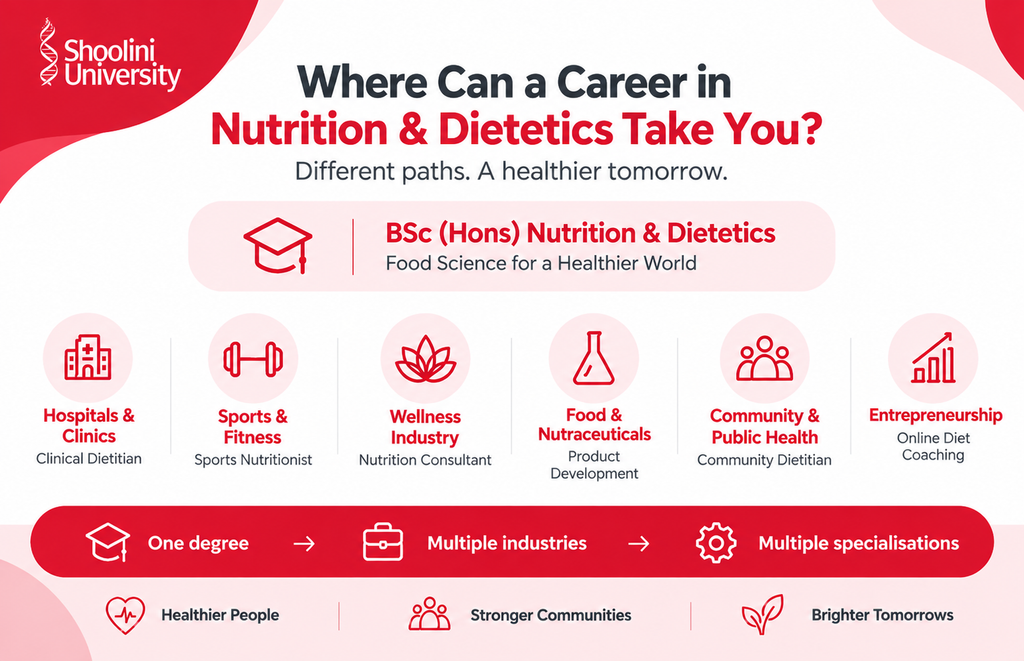
Graduates are not restricted to one type of job. Career options after BSc Nutrition and Dietetics include:
- Clinical Dietitian in hospitals and nursing homes
- Community or Public Health Dietitian
- Corporate Wellness Consultant
- Sports Nutritionist for athletes and fitness clients
- Nutrition Consultant for food and pharma companies
- Diet Coach or Educator, including online practice
- Food product development roles in the food industry
Sports Nutrition is one of the fastest-growing areas among these. As India’s fitness and sports industry keeps expanding, teams, gyms, and athletes increasingly hire dedicated nutrition experts instead of treating diet as an afterthought.
What Is the Salary After BSc Nutrition and Dietetics?
Salaries in this field depend on specialisation, city and whether you work for an employer or build a private practice.
Salaries in nutrition depend on your experience, role and workplace. Freshers such as clinical dietitians and junior nutritionists can earn around ₹2.5–4 LPA. With 3–5 years of experience, salaries can increase to ₹5–8 LPA. Experienced professionals, including sports nutritionists and senior nutrition managers, can earn ₹10–12 LPA or more.
These figures cover salaried roles. Nutritionists who build an independent or online consulting practice can earn different amounts, since income depends on client volume rather than a fixed pay scale.
Pay in this field also tracks the growth of the surrounding industry. India’s clinical nutrition market was valued at nearly USD 2.1 billion in 2024, and India’s nutritional supplements market stood at nearly USD 23 billion in 2025, with both segments projected to grow well into the next decade. As more hospitals, food companies, and wellness platforms invest in nutrition, demand for trained professionals is growing.

What Is the Scope of Nutrition and Dietetics in India?
The scope is wide because the underlying need won’t go away. Lifestyle diseases such as diabetes, obesity and heart disease are rising steadily across India, and hospitals need trained dietitians to help manage them.
- Alongside hospitals, this degree also opens doors in:
- Diagnostic and wellness chains
- Food and pharmaceutical companies developing nutrition products
- Sports academies and fitness centres
- Government public health programs
- Research roles in nutrition science, usually after a master’s degree
As interest in health and fitness grows across Indian cities, this field is expected to remain in demand for years to come.
Can PCB Students Pursue BSc Nutrition and Dietetics?
Yes. This course is one of the most direct life-science options for PCB students who don’t get an MBBS seat or who prefer a health-related career outside clinical medicine. Most universities do not require a NEET score for this course, so PCB students can apply directly using Class 12 marks or other entrance exams.
Students who enjoyed biology in school, especially human physiology and biochemistry, tend to do well here, since these subjects form the base of the course.
Why Study BSc (Hons) Nutrition and Dietetics at Shoolini University?
Shoolini University is ranked 452nd in the world and 10th in India, and it is the No. 1 private university in India for the fourth consecutive year, according to the QS World University Rankings 2027. In the THE World University Rankings by Subject 2026, Shoolini is ranked No. 3 in India for Life Sciences.
Beyond the rankings, a nutrition degree should also give you practical experience, not just classroom learning. At Shoolini, this program sits within the School of Bio-Engineering and Food Technology, and faculty members have worked at institutions including the University of Oxford, the National Cancer Institute and NIH in the United States, IISc, JNU, DU and ZSI.
Students also get access to a wider network of 104+ laboratories and 11 Centres of Excellence across campus. For this program, that includes the Food Quality Control Lab, Biosensor Lab, Bakery and Confectionery Lab, Fruit and Vegetable Technology Lab and Food Processing Lab, where students work directly with food quality, safety, processing and product development rather than only reading about them.
There is also a NABL-accredited and APEDA-recognised Commercial Food Testing Laboratory on campus, set up with support from the Ministry of Food Processing Industries. It runs testing equipment such as UHPLC, ICP-OES and GC-MS/MS, the kind of instruments used for real food testing and quality analysis in the industry.
Students who want to work on original ideas can do so through the university’s One Student, One Patent policy, which encourages every student to develop a project with patent potential during their time on campus.
Research areas within the program include Sports Nutrition, Child and Women Nutrition, Weight Loss and Gain Management, Nutraceuticals, Ethnic Food Nutrition, Diet Therapy, Diet Planning and Nutrition Counselling, so students can choose a focus area early instead of studying nutrition as one broad subject.
For international exposure, students can apply for exchange opportunities at the University of Reading, Sheffield Hallam University and Western Sydney University.
The program is UGC-certified, and graduates can pursue master’s degrees, clear competitive exams, or move directly into nutrition and wellness roles.
Conclusion
BSc (Hons) Nutrition and Dietetics is a good career choice for students who want a health-focused degree without needing a NEET score. Lifestyle diseases are rising across India, and hospitals, sports teams, wellness platforms and food companies all need trained nutrition professionals. Graduates can choose between clinical dietetics, sports nutrition, wellness consulting and several other paths, based on what interests them most.
Sources
- ICMR-INDIAB study, published in The Lancet Diabetes & Endocrinology, 2023 — https://www.thelancet.com/journals/landia/article/PIIS2213-8587(23)00119-5/fulltext
- IMARC Group, India Clinical Nutrition Market Report — https://www.imarcgroup.com/india-clinical-nutrition-market
- IMARC Group, India Nutritional Supplements Market Report — https://www.imarcgroup.com/india-nutritional-supplements-market
- AAFT Online, Nutritionist Salary in India — https://aaftonline.com/blog/nutritionist-salary-in-india/
- PayScale, Nutritionist Salary in India — https://www.payscale.com/research/IN/Job=Nutritionist/Salary
FAQs
Q1. Is BSc (Hons) Nutrition and Dietetics a good career choice?
Yes. As lifestyle diseases like diabetes and obesity rise across India, hospitals, wellness companies and sports teams all need trained nutrition professionals. The degree also offers several career paths, not just one.
Q2. What jobs can you get after BSc Nutrition and Dietetics?
Graduates can work as clinical dietitians, community dietitians, sports nutritionists, wellness consultants, diet coaches or nutrition consultants for food and pharma companies. Some also move into food product development or public health roles.
Q3. What is the scope of Nutrition and Dietetics in India?
The scope is strong and growing. Rising lifestyle diseases, growing hospital demand for dietitians, and expanding wellness, fitness, and food industries are driving steady, long-term demand for trained nutrition professionals.
Q4. What is the salary after BSc Nutrition and Dietetics?
Entry-level roles typically start between ₹2.5 and ₹4 LPA. With three to five years of experience, pay usually rises to ₹5 to ₹8 LPA, and senior roles can exceed ₹10 to ₹12 LPA. Independent or online nutrition practices can earn differently, based on client volume.
Q5. Why study BSc (Hons) Nutrition and Dietetics at Shoolini University?
Shoolini University ranks 452nd globally and 10th in India in the QS World University Rankings 2027. It is India’s No. 1 private university for the fourth consecutive year. The School of Bio-Engineering and Food Technology offers the program, supported by faculty with academic and research backgrounds at institutions such as Oxford, the National Cancer Institute, NIH, IISc, JNU, DU and ZSI. The university has 104+ labs, including a NABL-accredited Commercial Food Testing Laboratory. Students also have opportunities to participate in international exchange programs.
Q6. Can PCB students pursue BSc Nutrition and Dietetics?
Yes. Most universities admit students to this course based on Class 12 marks or entrance exams, without requiring a NEET score, making it a practical option for PCB students who want a health-related career outside clinical medicine.
Q7. What are the career opportunities in Sports Nutrition?
Sports Nutrition is a growing specialisation within this field. Graduates can work with athletes, sports academies, gyms and fitness brands, helping plan diets that support performance, recovery and long-term health.