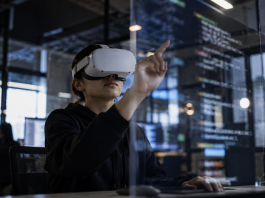

You have probably used AR/VR today without realising it. Tried on a pair of glasses on Lenskart before buying them? That is AR. Checked how a sofa would look in your living room on Pepperfry, tested a lipstick shade through your phone camera on Nykaa, or used Myntra’s virtual try-on feature to see how sunglasses or makeup would look on you? That’s augmented reality, working in the background of apps millions of Indians use every day.
AR/VR stopped being just a gaming buzzword a while ago. It is now one of the fastest-growing emerging technology careers, and most people have no idea how big it has already become.
What Is AR/VR, in Simple Terms?
AR (Augmented Reality) adds digital elements to the world you can already see. VR (Virtual Reality) replaces it entirely.
When you point your phone at your room and see a virtual sofa placed inside it, that is AR. Your real room is still visible, with something added to it.
When you put on a headset and find yourself standing inside a fully digital environment, your actual surroundings gone, that is VR. Both technologies use cameras, sensors, and software, but they solve different problems. AR enhances the real world. VR builds a new one.
Where Is AR/VR Being Used in India Right Now?
Shopping, training, and healthcare are three areas where AR/VR is already in everyday use in India. Shopping is the easiest one to relate to. Lenskart uses AR to let you virtually try on glasses. Myntra’s Virtual Try-On lets you test full makeup looks on your own face before you order. Jewellery brands like CaratLane let you see how a necklace looks on you before you buy it. These try-ons reduce returns for companies and give shoppers more confidence before spending money, according to Glance AI’s 2026 report on virtual try-on in India.
Training is where the bigger shift is happening. Companies in mining, manufacturing, and construction across India are first using VR to train workers for dangerous tasks in a safe, simulated environment, according to a 2026 industry report by CHRP-India. A worker can practise handling heavy machinery or responding to an emergency inside VR before ever doing it for real. This lowers training risk and speeds up how quickly new employees become productive.
Healthcare is changing too. Hospitals are beginning to use VR for surgical planning, allowing doctors to walk through a procedure digitally before performing it on a patient. It is already changing how some operations are planned.
Is AR/VR Only About Gaming?
No. Gaming is where AR/VR became popular, but it is now a small part of a much bigger picture.
According to a 2026 careers analysis by Analytics Insight, gaming, healthcare, retail, manufacturing, education, automotive, and defence are all hiring AR/VR professionals — and struggling to find enough trained people to fill the roles. This matters for students choosing a career path. You do not have to be interested in video games to build a career in AR/VR. If you like healthcare, retail, or engineering, there is likely an AR/VR application already growing in that space.
The global AR/VR market is projected to reach USD 118.79 billion in 2026, according to Imaginovation’s 2026 industry report. Around 75% of Fortune 500 companies are already using VR in some form, mostly for training and collaboration. Enterprise use, meaning companies using AR/VR for work rather than entertainment, is expected to drive 60% of total VR revenue by 2030.
In simple terms, most of the money in AR/VR today is not coming from gamers. It is coming from businesses using AR/VR technology to train people, sell products, and solve real problems.
How Is AI Changing AR/VR?
AI is making AR/VR experiences smarter and much quicker to build.
A few years ago, building a realistic AR/VR environment took a large team and months of work. AI tools are now helping developers generate 3D environments, recognise objects in real time, and personalise experiences based on the user in front of them. A shopping app can now recognise your face shape and instantly recommend how glasses will look on you, combining AR with AI in a way that feels effortless to the user but relies on heavy engineering behind the scenes.
This combination of AI and AR/VR is one of the reasons the field is growing so quickly. Companies do not just need people who understand AR/VR. They need people who understand how to combine it with AI, data, and design.
What Career Options Are Available in AR/VR?
More than most students expect, and not all of them require you to be a hardcore programmer.
- AR/VR Software Developer – builds the actual applications and experiences using tools like Unity and Unreal Engine
- Spatial Computing Engineer – works on how digital objects understand and interact with physical spaces
- Computer Vision Engineer – builds the systems that let cameras and sensors recognise faces, objects, and environments
- 3D Artist and Designer – creates the visual environments, characters, and objects used in AR/VR experiences
- UX Designer for AR/VR – designs how users interact with these experiences so they feel natural, not confusing
- AR/VR Product Manager – decides what gets built and how it solves a business problem
- Game Designer – still a strong path, but now just one of many available roles
AR/VR software engineers, spatial computing engineers, and computer vision engineers are currently among the highest-paid roles in the field.
Studying AR/VR gives you a foundation that applies across industries, not just one narrow job title.
Students can move into gaming studios, retail tech companies building shopping experiences, healthcare technology firms developing training and surgical tools, or defence and manufacturing companies working on simulation systems. Many also move into broader tech roles later, since the underlying skills in 3D design, coding, and problem-solving transfer well.
A B Tech in Game Design & AR/VR is one of the more direct routes into this field, since it develops both the technical and creative skills needed from the start rather than requiring students to piece it together later.

What Is the Average Salary of an AR/VR Professional in India?
Salaries vary by role and experience, but AR/VR is currently one of the better-paying specialisations within technology.
| Experience Level | Typical Role | Salary Range |
| Fresher (0 to 2 years) | AR/VR Developer, 3D Artist | ₹4 to 8 LPA |
| Mid-level (3 to 5 years) | Spatial Computing Engineer, Senior Developer | ₹10 to 18 LPA |
| Senior (6+ years) | AR/VR Architect, Computer Vision Lead | ₹20 to 35 LPA |
Roles that combine AR/VR with AI or computer vision pay at the higher end of these ranges, since fewer people have both skill sets.
Why Study B Tech CSE Game Design & AR/VR at Shoolini University?
Shoolini University offers a dedicated B Tech CSE specialisation in Game Design & AR/VR, backed by its own labs, global certifications, and a QS-ranked research environment.
The program is offered under the Yogananda School of AI, Computers and Data Science, alongside specialisations in Artificial Intelligence, Cloud Computing, Cyber Security, DevOps, Data Science, Blockchain and IoT, UI/UX, and Graphics and Animation. AR/VR students are trained inside a school built entirely around emerging technology, not as an isolated elective in a general engineering department.
What Labs and Infrastructure Do AR/VR Students Get Access To?
- AI & Futures Centre, with high-GPU computing and Apple labs for building real projects
- AR/VR and IoT Labs, developed with iHub IIT Roorkee, giving students access to specialised hardware and mentorship from one of India’s premier engineering institutes
- Sirenatech Robotics Lab, connecting AR/VR work with real robotics and intelligent systems
Students with an idea worth building on can access the university’s startup incubator and funding support, which means an AR/VR project built in a lab does not have to stay a college assignment. It can become a company, with the university backing early-stage ventures.
What Global Certifications and Study Abroad Options Come With the Degree?
Students can earn certifications from IBM (AI Foundations, AI Developer, AI Engineering), AWS (Solutions Architect, Practical Data Science), Google (Google AI Certificate), Microsoft (Cybersecurity Analyst), Stanford (Machine Learning), NYU (Cybersecurity Overview), Vanderbilt (Prompt Engineering), DeepLearning.AI (Deep Learning, NLP), and ISC² (Cybersecurity Certification), through the university’s global learning partners.
Shoolini offers dual degree and semester abroad pathways with partner universities, including University of Melbourne (Australia), Royal Holloway University of London and University of Edinburgh (UK), University of Windsor (Canada), Constructor University (Germany), Federico II (Italy), National Dong Hwa University (Taiwan), USW (South Korea), and University of Dayton (USA).
What Are the Placement Outcomes for B Tech CSE Students?
Shoolini has placements across 250+ top companies, including on-campus recruiters and off-campus hires. The highest package recorded for B Tech CSE is ₹42 LPA, at Algo8. Companies recruiting from campus include Hughes Systique, Accenture, Cisco, Dell, Capgemini, Cognizant, Sirenatech Robotics, and Teleperformance, among others.
How Does Shoolini Rank in India and Globally?
In the QS World University Rankings 2027, Shoolini is ranked 452nd globally and 10th in India, the only private university in the country’s top 10 alongside seven IITs, IISc, and Delhi University. It is also NAAC A+ accredited and has been the No. 1 private university in India for the fourth consecutive year.
B Tech CSE Admissions 2026 at Shoolini University is open. Apply now at shooliniuniversity.com or call 701 800 7000.
Is AR/VR a Good Career Choice for You?
If you like the idea of building things people use, whether that is a shopping experience, a hospital training tool, or a game, AR/VR gives you a wide set of directions to choose from.
You do not need to in coding or design to start. If you are weighing AR/VR after 12th, what matters is picking the right course, working on, and staying curious about how AR/VR is combining with AI, since that is where most of the growth is.
Sources
- Glance AI – Virtual Try-On in India, 2025–26 https://glance.com/blogs/glanceai/ai-shopping/virtual-try-on-in-india
- Analytics Insight via Dailyhunt – Top High Paying Careers in AR/VR, May 27, 2026 https://m.dailyhunt.in/news/india/english/analytics+insight-epaper-anycinst/top+high+paying+careers+in+virtual+reality+and+augmented+reality+in-2026-newsid-n713356791
- CHRP-India – Top Industries Using AR/VR in India in 2026, May 6, 2026 https://www.chrp-india.com/blog/top-industries-using-ar-vr-in-india-in-2026/
- Imaginovation – AR and VR Applications 2026, April 28, 2026 https://imaginovation.net/blog/ar-and-vr-applications/
FAQs
Q1. What career opportunities are available in AR/VR?
Roles include AR/VR software developer, spatial computing engineer, computer vision engineer, 3D artist, UX designer, product manager, and game designer, across industries like retail, healthcare, manufacturing, and gaming.
Q2. What is the difference between AR and VR?
AR adds digital elements on top of the real world you can still see, like trying on glasses through your phone camera. VR replaces the real world entirely with a digital environment through a headset.
Q3. How is AI transforming the AR/VR industry?
AI helps generate 3D environments faster, recognises faces and objects in real time, and personalises AR/VR experiences for each user, making the technology more useful and quicker to build.
Q4. What are the best career paths after studying AR/VR?
Students can move into gaming, retail technology, healthcare training tools, defence simulation, and manufacturing, or transition into broader tech roles using the same design and coding skills.
Q5. Is Game Design the only career option in AR/VR?
No. Gaming is one of several paths. Retail, healthcare, manufacturing, education, and defence are all actively hiring AR/VR professionals today.
Q6. What is the average salary of an AR/VR professional in India?
Freshers typically earn ₹4 to 8 LPA. Mid-level professionals earn ₹10 to 18 LPA. Senior specialists, particularly those combining AR/VR with AI or computer vision skills, earn between ₹20 and 35 LPA.