





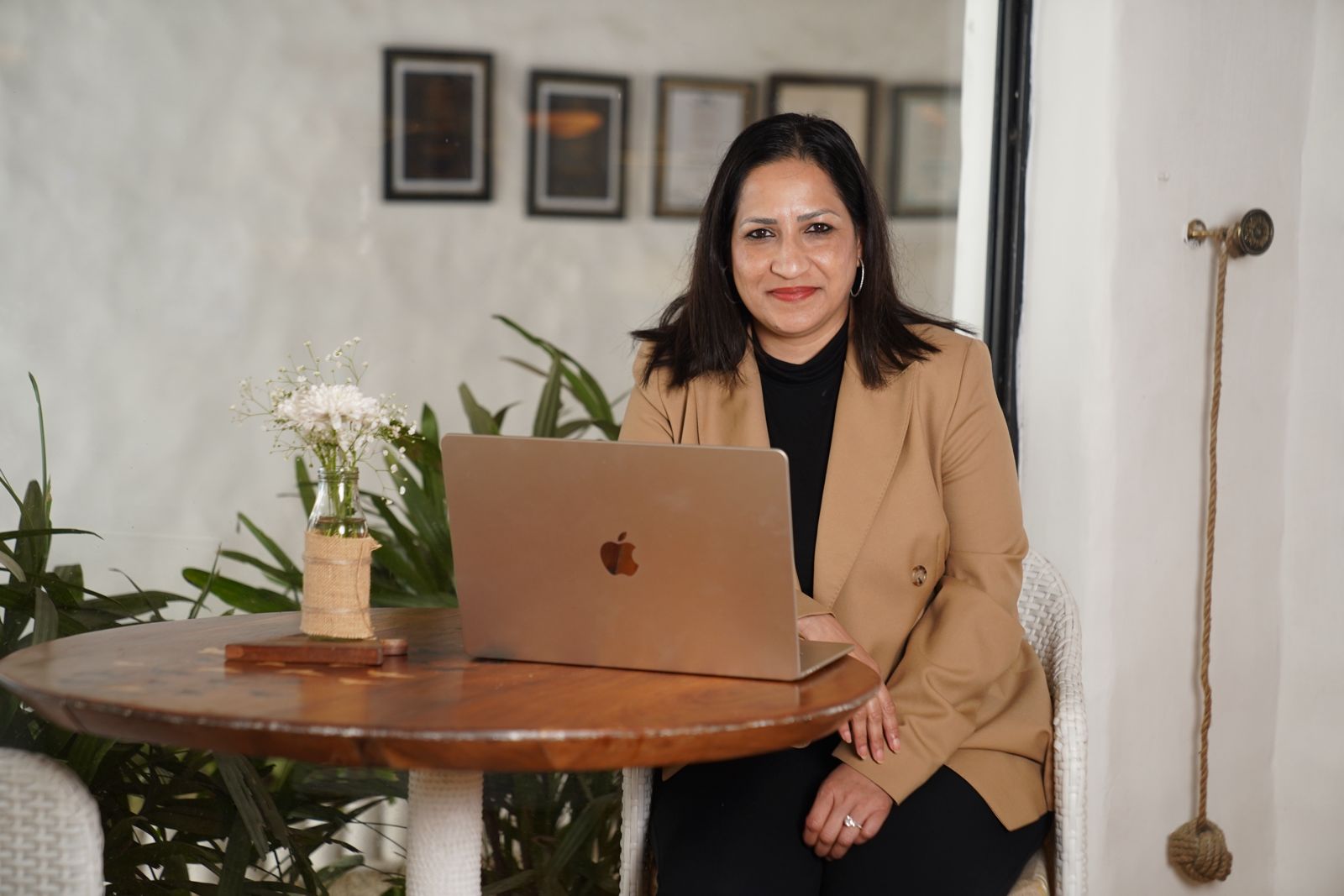
PROF NISHTHA SHUKLA ANAND
President and Dean, Faculty of Media and Liberal Arts
Prof Nishtha Shukla Anand leads the Faculty of Media and Liberal Arts at Shoolini University, bringing a rare blend of newsroom experience, brand-building, and entrepreneurial insight. A journalist and media agency founder, she has worked at the intersection of storytelling, strategy, and digital culture. Her work now focuses on preparing students for the evolving creator economy by combining media practice with liberal arts thinking, design-led learning, and emerging technologies such as AI and synthetic media. In a conversation that spans storytelling, technology and careers, she breaks down what media education means today.
Q1. You've been a journalist and also built brands — what was the moment you decided that building a school was the next frontier?
I've always lived at the intersection of industry and ideas. As a journalist, brand builder and agency founder, I learned how to make stories that move people. But the more I worked with young talent, the more I saw the same gap repeating itself. People were either deeply technical with no cultural or editorial instinct, or they were humanities graduates with brilliant minds and no idea how to make their work visible in a digital world.
I've always believed that the best educators are practitioners — people who've made mistakes, pivoted, built things, and broken things. When the opportunity came to build a school at Shoolini, I saw it not as leaving the industry, but as the most impactful form of industry participation I could do.
Q2. How does combining Media with Liberal Arts make sense in 2026 — isn't that a counterintuitive pairing when everyone's chasing technical skills?
I'd actually argue the opposite — this is exactly the right pairing for 2026, and the industry data backs it up. Here's what I believe: design is at the centre of everything. Whether you're designing a news package, a brand identity, a social campaign, or a game narrative, design thinking is the discipline that holds it all together. And design thinking is, at its core, a liberal arts practice. It asks you to empathise, to question assumptions, to imagine alternatives, and to test them against the real world.
Q4. Are journalism schools even relevant to a 16-year-old who already has a million YouTube subscribers?
That's the most important question we need to ask ourselves — and most schools still aren't asking it. The honest answer is: a traditional journalism school is probably not relevant to that 16-year-old. But as a school, our role is to give them the intellectual and strategic tools to scale their work, teach them to be sustainable and ethical creators. The creator economy is now a $500 billion global industry. Brands are moving budgets from traditional advertising to creator partnerships. Even the government is now acknowledging what the market already knows -- the creator is the new professional.
Q5. How do you design a curriculum that's useful for both the student who wants to work at a media outlet and the one who wants to be a full-time independent creator on Instagram?
The answer is flexibility built on shared foundations. You design it so neither student feels like they're in the wrong room. We've structured the program around core competencies that every media professional needs regardless of their destination: storytelling craft, design thinking, media ethics, audience intelligence, and digital production. These are the bones of the curriculum. On top of that, we've built a system of majors and minors that allows students to shape their own trajectory.
Q7. How much of your curriculum is dedicated to AI fluency — prompt engineering, synthetic media, AI ethics — versus traditional storytelling craft?
Based on where the industry is heading and what employers are telling us, AI fluency is not a module you slot in alongside journalism ethics or narrative writing. It has to be woven through everything.
That said, we offer dedicated tracks in prompt engineering, AI content strategy, and the emerging space of synthetic media production. These areas are growing fast, with roles that barely existed two years ago now becoming part of hiring plans across agencies and media companies. The focus is clear — students should not just use these tools, but define how they are applied in real-world contexts.
Q8. When a student can generate a polished article or video in minutes using AI, what becomes the irreplaceable human skill you're training them for?
Some recent researchers are coming towards a common answer: the irreplaceable human skills are empathy, cultural intelligence, ethical judgement, and genuine curiosity. A Workday global study from 2025 found that 83% of professionals believe AI will elevate the importance of uniquely human skills — specifically naming empathy, relationship building, and ethical decision-making as the most critical differentiators.
Q9. India produces thousands of mass communication graduates every year, yet media companies constantly say they can't find good talent. Why does that gap exist, and how are you solving it differently?
The gap exists because most media education in India was designed for a world that no longer exists — and has been very slow to admit it. Traditional mass communication programs were built around the job of the journalist or PR professional as it existed in the 1990s and early 2000s: linear career paths, stable platforms, and clearly defined roles. Today, none of those conditions hold. Roles are hybrid, platforms shift every two years, and the skills that matter most — critical thinking, creative problem-solving, digital literacy, cross-disciplinary collaboration — are precisely the ones that our rote-learning-heavy higher education system has consistently underinvested in. That’s the learning gap we are trying to solve with the Media & Liberal Arts School at Shoolini.
Q10. What are the three careers that will matter most in media by 2030 that barely exist today — and how is your school already preparing students for them?
Based on where the industry and research are pointing, I would say: AI Content Architect, Immersive Narrative Designer and a Creator Economy Strategist.
Q11. Your graduates are being placed across roles — so is 'media school' even the right frame anymore, or are you building something closer to a creative industries school?
I think the whole sector is grappling with this. "Media school" conjures images of newsrooms and broadcast studios. And while those remain real and relevant, they represent a fraction of where our graduates are actually going and where the creative economy is generating the most opportunity. Gaming, animation, UX writing, brand strategy, synthetic media production, creator economy management, immersive experience design — these are all media disciplines. What we're building is closer to a Creative Industries school in its scope.
April 2, 2026