






The Centre for Energy and Environment Sustainability (CEEST) at Shoolini University was established in 2019 to advance research, innovation, and education in the energy sector. The Centre has gained national recognition, being ranked 2nd in India in Energy as per the SCIMAGO Institutional Rankings 2025. CEEST offers advanced academic programmes, including M.Tech in Energy Technology and Ph.D. in Energy, designed to nurture skilled professionals and researchers.
Within a short span of its establishment, the Centre has developed strong linkages with leading national and international institutions, as well as industry partners, fostering collaboration in research, education, and technology transfer. It is supported by a highly specialised faculty with expertise across diverse domains of energy and equipped with state-of-the-art laboratories for teaching, research and development, and consultancy.
The Centre operates within a robust sustainability framework led by a Director – Sustainability and a dedicated Sustainability Committee, ensuring direct oversight by the Vice-Chancellor and strong institutional alignment. Anchored by CEEST, a team of 9 members under the supervision of Prof. Shyam Singh chandel drives sustainability initiatives across research, academics, infrastructure, and outreach, with a special focus on the Himalayan region.
The University demonstrates measurable impact through key operational initiatives, including a 400 kWp solar power plant, solar steam cooking facilities serving over 500 students, and solar water heating systems catering to approximately 3000 residents. A forward-looking policy mandates that 100% of new buildings adopt solar passive and energy-efficient designs, reinforcing the University’s commitment towards a carbon-neutral future.
The Centre further focuses on addressing contemporary energy and environmental challenges through innovative approaches. It emphasizes energy efficiency and promotes the adoption of clean and renewable energy sources such as solar, wind, hydro, geothermal, and biomass, while also engaging with policy frameworks at local, regional, and national levels.
Following are the 6 degree programs and 56 courses curated by CEEST:
|
Educational Programs in Climate and Environmental Studies in AY 2024-25 |
Vision
To achieve excellence in research and technology development in the area of sustainable energy.
Mission
- To provide multidisciplinary education, research & development solutions with focus on clean energy sources
- To identify energy, environmental and climate change concerns & policy issues to provide local and global solutions, mainly focussed on the Himalayan Region
- To carry out detailed energy resource assessment with focus on solar, wind, bio-mass and other clean technology applications to improve the living conditions of people
- To promote energy education, environmental awareness, entrepreneurship development and National & International collaboration for technology development and transfer
- To provide high quality trained professionals for the Institutions/Energy Industry in the country and worldwide
Key areas of Energy Education, Research, Technology Development & Consultancy
Solar photovoltaics | Solar Thermal | Concentrated Solar Power | Solar PV power generation |Micro Grid |Smart grid Power | Wind | Wind resource Assessment| Solar Wind based hybrid Systems | Energy Storage Systems Pump Hydro |Battery research: Electrical Vehicle applications| Geothermal | Passive Solar Building Technology | Thermal comfort | Net-zero Energy Buildings | Green Building Rating, Policies | Ocean | Tidal | Fuel Cells | Bio-Energy | Bio-fuels | Hydrogen Energy | Energy & Environment related research & Policy Issues | Artificial Intelligence: Machine learning Applications for Renewable Energy | Smart Grid | Energy Management Systems | Renewable Energy Source assessment, Integration | Energy Storage Systems | Electrical Grid | Stability | Renewable Power Penetration in Grid | etc,
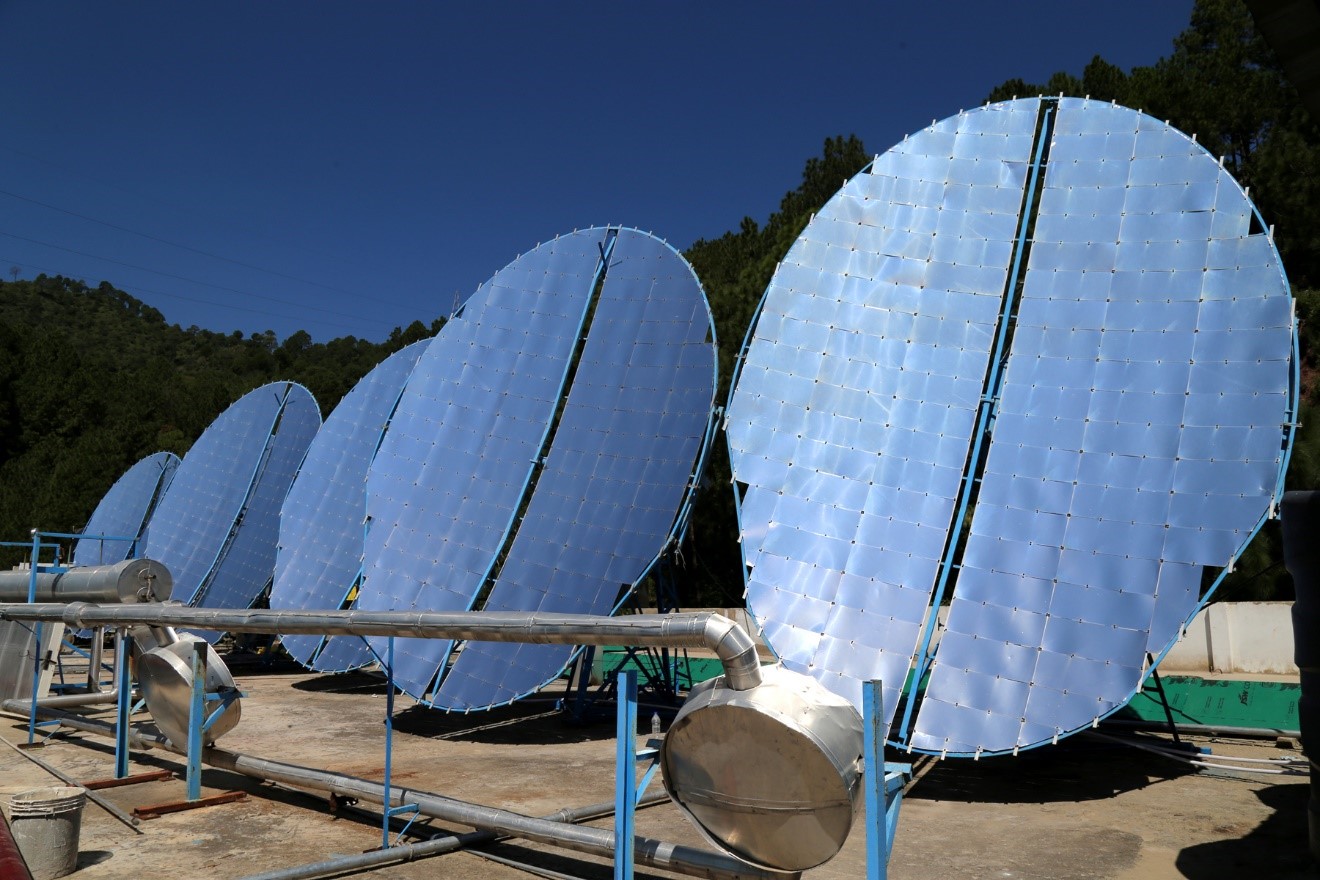
Concentrated Solar Power Steam Cooking System for 500 at Girls Hostel, Shoolini University, Solan, Himachal Pradesh
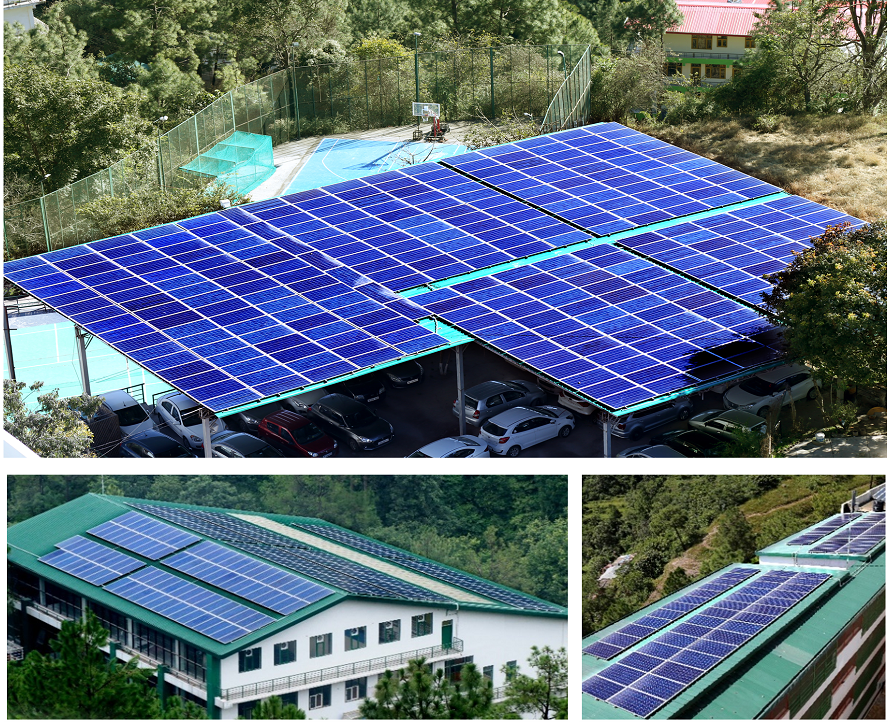
View of 400kWp grid-connected Solar Photovoltaic Power Plant at Shoolini University
Energy Efficiency Standards
New Initiatives of the Centre:
Policy on Energy-Efficient Solar Passive design & Construction of Buildings at Shoolini University
As per a decision taken by the management of Shoolini University in Feb 2021, all the new buildings at Shoolini University are to be designed and constructed as per the Solar passive building technology and other environment-friendly measures. This will improve thermal comfort, energy efficiency, water conservation, etc., along with enhancing energy efficiency in existing buildings to reduce consumption of conventional energy. The CEEST is coordinating this effort in collaboration with the construction division of the university.
Energy Research Facilities
The Centre is well-equipped with energy research labs and other facilities:
Shoolini Innovation Technology Incubation Centre for Entrepreneur development
- The Ministry of Small and Medium Entrepreneurs (MSME), GoI, sanctioned the Shoolini Innovation Business Incubation Centre (SIBI) on January 5, 2020, with Prof SS Chandel as Principal Coordinator.
- Under Shoolini Innovation Business Incubation Centre, 10 innovative projects (5 from University & 5 by startup companies/ entrepreneurs were submitted in Feb 2020 to the Ministry of Small, Medium Entrepreneurs (MSME), Govt of India, which are under consideration.
Solar Steam Generating Cooking Systems (Scheffler Type) in Girls Hostel of Shoolini University
A solar steam generating system based on Concentrated Solar Technology Solar radiation falling onto the dish is concentrated onto the receiver, which heats the water which is converted into steam to cook food for 500 students.
400kWp grid-connected Solar Power Plant
Shoolini University has a grid-connected solar power system of 400kWp which meets the partial electricity needs of University.
Solar Water Heating Systems for hostels
Flat Plate Collector and Evacuated Tube Collectors are installed in all hostels of the University to provide hot water for about 3000 students.
Green Energy Campus
Under the Ministry of New & Renewable Energy, Govt of India, the Campus of Shoolini University is a Green Campus with Solar Energy utilisation & environmentally friendly technology use.
Collaboration
Linkages with International Institutions & Organisations
- International Collaboration in Research with University of New South Wales (UNSW), Sydney, Australia in Passive Solar Building Technology, Built Environment & Renewable Energy
- Shoolini University signed an MoU with the Fitchburg State University Fitchburg, USA, on 20 February 2020 to promote Education & Training in Energy
- CEEST is collaborating with the University of Exeter, UK, on Renewable Energy Research
Collaboration with National Institutions
- The centre is already collaborating with NTPC-NETRA, National Institute of Solar Energy (NISE), MNRE GOI, IITs, NITs for R&D and training
- Shoolini University is approved as Host Institution by Ministry of Small and Medium Enterprises (MSME), Govt of India. A Project for Entrepreneur Development & startups has been approved
Core Faculty
1. Dr. Shyam Singh Chandel, Professor & Director
Dr SS Chandel is Professor (Energy Technology) and Director Centre of Excellence in Energy Science and Technology, at Shoolini University. His research interests are: Renewable Energy Technologies, including Solar Photovoltaics, Solar Thermal, Solar Passive Building Technology; Solar Power Generation; Wind Energy, Bio-Energy, Hybrid power systems, IPR, GIs with vast R&D, Industrial experience of coordinating National (DST/MNRE) & International Aus-Aid, World Bank, UNDP.GEF Energy Projects.
Prof SS Chandel got worldwide recognition among the top 2% Researchers in Energy as per Stanford University World Ranking of Scientists. Ranked Top %: 1.5536465 among top 100,000 scientists across all fields as Researcher in Energy in Lifetime Research Career-long Category on October 16, 2020. Previously, he worked as Professor (Energy & Environment and founder Head of the Centre for Energy Environmental Engineering, National Institute of Technology, Hamirpur (2009-2018), Principal Scientific Officer & Head, Science Technology Division, & HP Patent Information Centre at HP State Council for Science, Technology Environment, Govt. of Himachal Pradesh (1992-2009). He has more than 100 research publications, books in International Journals of repute.
2. Dr. Rahul Chandel
Assistant Professor (Energy): Photovoltaics, Thermoelectric Systems, Solar Tracking Systems. Industry expert with corporate and R&D experience in the Solar Photovoltaic Industry. Has over 12 papers in SCOPUS listed journals of high Impact Factor on Photovoltaics and Thermoelectric Technology.
3. Mr. Pankaj Kapoor
Assistant Professor (Energy): Solar Pumping Systems and Applications in Energy.
Other Faculty Members of CEEST:
|
S. No. |
Faculty Name |
Designation & Energy Research Area |
|
1 |
Dr. Ram Prakash Dwivedi |
Professor (IT/Electronics): Applications in Energy |
|
2 |
Dr. Raj Kumar Saini |
Associate Professor (Electrical Engineering): Electric Grid |
|
3 |
Dr. Robin Thakur |
Associate Professor (Mechanical Engineering): Hydropower; Micro hydro turbines |
|
4 |
Dr. Ashwani Sharma |
Assistant Professor (Electronics): Applications in Energy |
|
5 |
Dr. Nitin Kumar |
Assistant Professor (Mechanical Engineering): Heat Transfer |
|
6 |
Dr. Sonia |
Assistant Professor (Computer Science): Artificial Intelligence Applications in Energy |
|
7 |
Mrs. Poonam Nanda |
Director, Sustainability and Community Engagement |
| Training on Environmental Aspects | Click Here |
Operational Policies of CEEST
|
Energy and Environment Policy |
|
|
Sustainable Procurement Policy |
|
|
Sustainable Investment Policy |
Monitoring of Greenhouse Gas (GHG) Emissions under CEEST (2024-25)
|
Carbon Emissions Report align with GHG Protocol |
|
|
Carbon Emissions Report of Shoolini University |