

In 2026, the world of technology education is evolving fast — and so are the choices students make after Class 12. While engineering has long been one of India’s most trusted career paths, many students today are also opting for BCA Over B Tech for reasons that go beyond tradition. The rapid rise of digital technologies, artificial intelligence (AI), cloud computing, data analytics, and software development has changed how students see tech careers.
India recently hosted the India AI Impact Summit 2026 in New Delhi — the first major global AI summit held in the Global South — bringing world leaders, policymakers, tech CEOs, and innovators together to shape the future of digital growth. The event highlighted India’s ambition to democratise AI, expand computing infrastructure, and build talent for the future — signalling strong opportunities for graduates across the technology landscape.
As tech industries expand rapidly, students are evaluating their options along both breadth and depth: whether to pursue a four-year engineering path, such as a B Tech degree, or a more application-focused three-year route, such as a BCA degree. Both paths lead to rewarding careers — but in 2026, the differences between them are influencing choices in ways we haven’t seen before.
What BCA and B Tech Really Offer
At the core, both BCA and B Tech are valuable technology degrees — but they serve slightly different educational goals:
- A BCA course after 12th is typically three years long and focuses strongly on software development, programming languages, database systems, and modern applications like web and mobile technologies.
- A B Tech course is usually four years and blends computer science knowledge with deeper engineering foundations, including hardware, algorithms, system design, and computing theory.
The choice doesn’t come down to one program being better than the other — it’s about what suits a student’s career interest, learning style, and long-term goals.
Technology Trends Shaping Student Choices
In the past few years, India’s tech landscape has seen some major shifts:
- The AI Impact Summit 2026 in New Delhi brought together industry leaders, including CEOs of major tech firms, and global policymakers to discuss inclusive and ethical AI development.
- Events like these spotlight the growing importance of skills in AI, software, and data technologies, sparking enthusiasm among students eager to engage directly with cutting-edge digital roles.
- India aims to attract significant AI and technology investments in the coming years, boosting its data infrastructure and the potential of its digital workforce.
As a result, students are thinking strategically: they want faster skill acquisition, early industry exposure, and practical training while staying adaptable in a sector that’s changing by the day.
Why Students Are Considering BCA Over B Tech
Here are several reasons we’re seeing a rise in students choosing BCA Over B Tech — not because one is superior to the other, but because of how students connect their goals with the strengths of each path:
1. Strong Focus on Software from Day One
BCA programs focus on coding, application development, databases, and software tools right from the first semester. For students passionate about building software, apps, websites, or data-driven solutions, this can feel more aligned with their interests.
2. Faster Entry into Tech Careers
The three-year duration of BCA means students can enter internships, industry projects, freelancing, or job roles sooner — without waiting for a fourth year. Many students see this as an advantage for early experience.
3. Skill-Driven Hiring Culture
Today’s tech recruiters increasingly prioritise skills and project portfolios in coding, AI tools, cloud computing, and problem-solving — areas where BCA students build strong hands-on experience.
4. Flexibility to Upskill
Students with a BCA degree often continue their learning through certifications, master’s programs, or specialised courses in data science, AI, cybersecurity, and more. This means they can adapt their career direction over time without feeling locked into a single path.
Why B Tech Continues to Be a Strong Path
At the same time, B Tech remains highly respected and rewarding for students who want a deep foundation in engineering and computing principles. Many employers prize the analytical and technical rigor that a B Tech degree offers, especially for roles in systems engineering, advanced software design, and research.
Importantly, industry demand for well-trained engineering graduates remains strong as well. Recent reports show that employability for engineering graduates continues to rise, reflecting a healthy demand for technical skills across sectors.
What Students Should Think About
Choosing between BCA and B Tech isn’t about picking the ‘better’ degree. Instead, it’s about clarity of goals:
- If you are excited by software tools, app development, programming languages, practical coding, or data technologies, a BCA degree might be well suited to you.
- If you want a deep engineering foundation with broader exposure to computer science theory, systems, and hardware-level design, a B Tech degree could be your perfect choice.
Both degrees prepare you for the future — and today’s industry values what you can do, not just what title your degree has on paper.

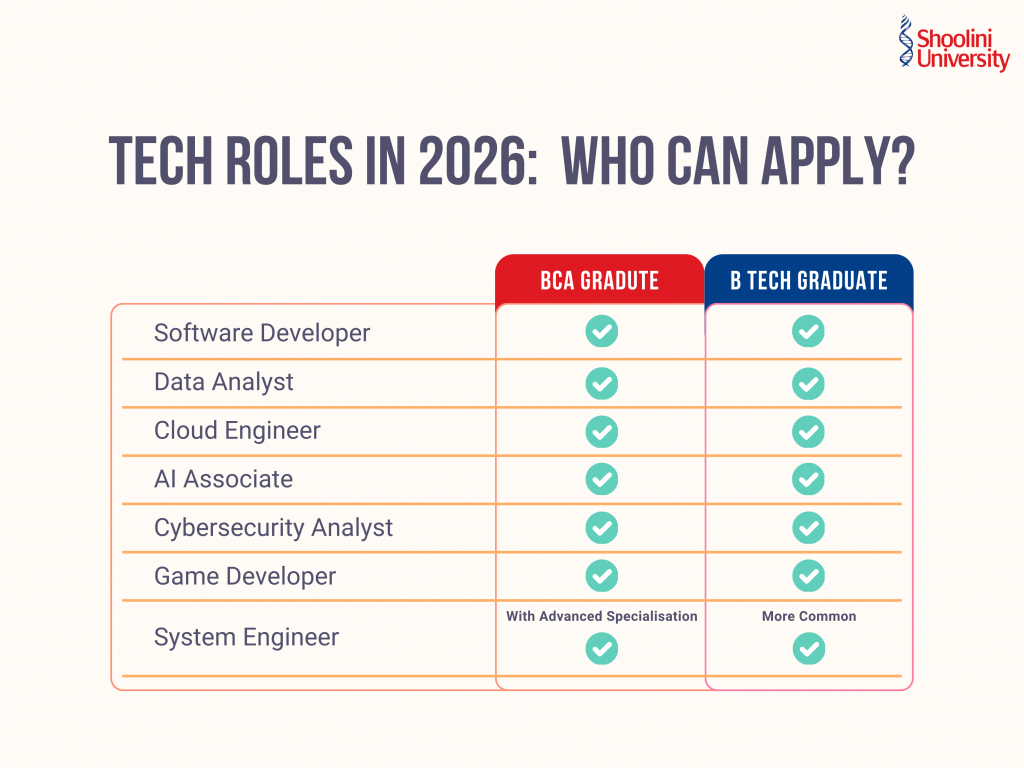
India’s Tech Ecosystem: A Big Opportunity for Graduates
The attention India is receiving from major global tech organisations — including large investments, strategic partnerships, and growth of the AI ecosystem — means talent development is a key priority. Whether you pursue BCA or B Tech, developing practical skills, strong project experience, and adaptability will give you a competitive edge.
This is evident in events like the India AI Impact Summit 2026, which highlighted India’s role in shaping global AI norms and collaborations.
BCA and B Tech at Shoolini University
When choosing between BCA and B Tech, the university environment plays a big role. At Shoolini University, students do not just earn a degree — they become part of a technology-driven ecosystem that prepares them for real-world industry challenges. Importantly, the university offers both programs, allowing students to select the path that best aligns with their interests and career plans.
Shoolini is ranked No. 3 in India (Private) in Engineering as per the Times Higher Education Subject Rankings, reflecting its strong academic and research foundation. Both BCA and B Tech students benefit from this academic excellence and industry-focused approach.

The university has valuable collaborations with global technology leaders, such as IBM, AWS, Microsoft, and IKIGAI Academy. It also works closely with NASSCOM, Anudeep Foundation, the PEC-SIEMENS Centre of Excellence at Punjab Engineering College, and Aaddoo for advanced training and learning exposure. These partnerships ensure that students from both programs gain hands-on experience aligned with current industry standards.
Shoolini offers cutting-edge engineering programs based on the latest industry-relevant pedagogies, with a strong emphasis on research and innovation. Students can choose specialisations in AI, Cloud Computing, DevOps, Blockchain, IoT, Game Design, Cyber Security, and more. Whether pursuing a BCA degree or a B Tech degree, learners are exposed to emerging technologies from early semesters.
A major highlight is the state-of-the-art XR and AI Research Centre, where students work on live industry projects. Here, they collaborate in small teams under the guidance of assigned mentors to conceptualise and build breakthrough applications. This practical exposure bridges the gap between classroom learning and real-world problem-solving.
Shoolini also introduced Asia’s First One-Student, One-Patent Policy for Engineering, encouraging innovation and original thinking. Students are guided to file patents and develop research-backed solutions during their academic journey.
The faculty strength further enhances learning. Professors and mentors come from IITs, NITs, and globally renowned institutions such as UPenn, Columbia University, Stanford, Oxford, IISc, and IIMs. Their diverse expertise ensures strong academic mentorship for both BCA and B Tech students.
To support career readiness, Shoolini provides AI-powered Interview Coaching Prep through Siqandar, known as one of the world’s most advanced interview preparation coaches. Combined with merit-based scholarships and placements with top companies like L&T, Eicher, Havells, Reliance Jio, Microtek, Onida, Vardhman, Window IT, and more, students graduate industry-ready and confident.
Whether a student chooses BCA for its application-focused learning or B Tech for its engineering depth, Shoolini ensures that both paths lead to strong technical foundations, innovation opportunities, and real career growth.
Final Thoughts
In 2026, the question isn’t about which degree is universally better — it’s about what fits your ambitions best. Both BCA vs B Tech continue to open doors in technology and innovation. Students choosing BCA Over B Tech are doing so because they see strengths in practical, application-oriented learning and early industry exposure. Meanwhile, those choosing B Tech are gaining deep engineering foundations for complex technical roles.
The most important thing? Choose the path that matches your curiosity and career direction, build strong skills, and stay open to learning — because the future of tech rewards capable, creative, and adaptable thinkers.
Sources:
- https://timesofindia.indiatimes.com/education/careers/news/are-engineering-graduates-back-in-demand-computer-science-and-it-drive-b-tech-employability-surge-in-india/articleshow/127798524.cms
- https://indianexpress.com/article/education/btech-computer-science-vs-bca-cse-careers-ai-iot-blockchain-the-right-choice-jee-main-2026-advanced-10315154
- https://www.thenationalnews.com/future/technology/2026/02/17/india-targets-200-billion-in-ai-investments-over-next-two-years
- https://www.ndtv.com/india-news/india-ai-impact-summit-2026-live-updates-bharat-mandapam-new-delhi-global-tech-leaders-pm-modi-to-inaugurate-ai-impact-summit-day-4-emmanuel-macron-11056518


