

Every app on your phone runs on a server. Someone builds that server. Someone keeps it running. Someone pushes out updates without breaking anything. This is the work of Cloud Computing and DevOps engineers, and it is one of the fastest-growing fields in Computer Science Engineering.
Shoolini University offers B Tech CSE Cloud Computing & DevOps as part of a wider redesign of its engineering programs. The redesign is built around applied labs, industry partnerships, and interdisciplinary training. It moves away from a fixed set of textbook subjects. This blog answers the questions students most often ask before choosing this program. What do you learn? How does Shoolini teach it? What can you get out of it?
What is B Tech CSE Cloud Computing & DevOps at Shoolini University?
It is a four-year B Tech in Computer Science Engineering course with a specialisation in cloud infrastructure and DevOps practices. The program combines core CSE fundamentals with hands-on training in cloud platforms, automation tools, and containerisation.
You start with the same foundation every CSE student builds. That means programming, databases, and core computer science theory. From there, the specialisation moves you into the tools the industry uses to build, deploy, and maintain software at scale.
Behind this specialisation is a broader shift at Shoolini. Engineering education here is being restructured. The idea is that graduates need to work with AI, data, hardware, and domain-specific systems. Writing code alone is no longer enough. The goal is to prepare engineers who can build across systems, industries, and technologies. Students learn their core subject well and use emerging tools from day one.
What Do You Study in B Tech CSE Cloud Computing & DevOps?
You study core skills in cloud platforms, DevOps automation, containers, and cloud security, each mapped to a specific job role.
| Skill area | What you learn | Career impact |
| Cloud platforms | Basics of cloud infrastructure setup and management | Cloud Engineer, Cloud Support roles |
| DevOps tools | Automating software builds and releases | DevOps Engineer, Release Engineer |
| Containers | Docker and Kubernetes | Site Reliability Engineer, Platform Engineer |
| Cloud security | Keeping cloud systems safe | Cloud Security Analyst |
Beyond this specialisation, Shoolini’s CSE curriculum has expanded further. It now includes Artificial Intelligence, Machine Learning, Gaming, Data Science, Bioinformatics, Blockchain, IoT, Cyber Security, Smart Manufacturing, Electric Vehicles, and VLSI Design. Shoolini also offers a dedicated B Tech in Artificial Intelligence. The boundaries between engineering disciplines are becoming less rigid. A cloud and DevOps student today needs more than infrastructure knowledge. Automation, intelligent systems, and data-driven decision-making matter too.
Why is Cloud Computing & DevOps in Demand Right Now?
Almost every industry now depends on cloud infrastructure, and AI growth is pushing that need even higher.
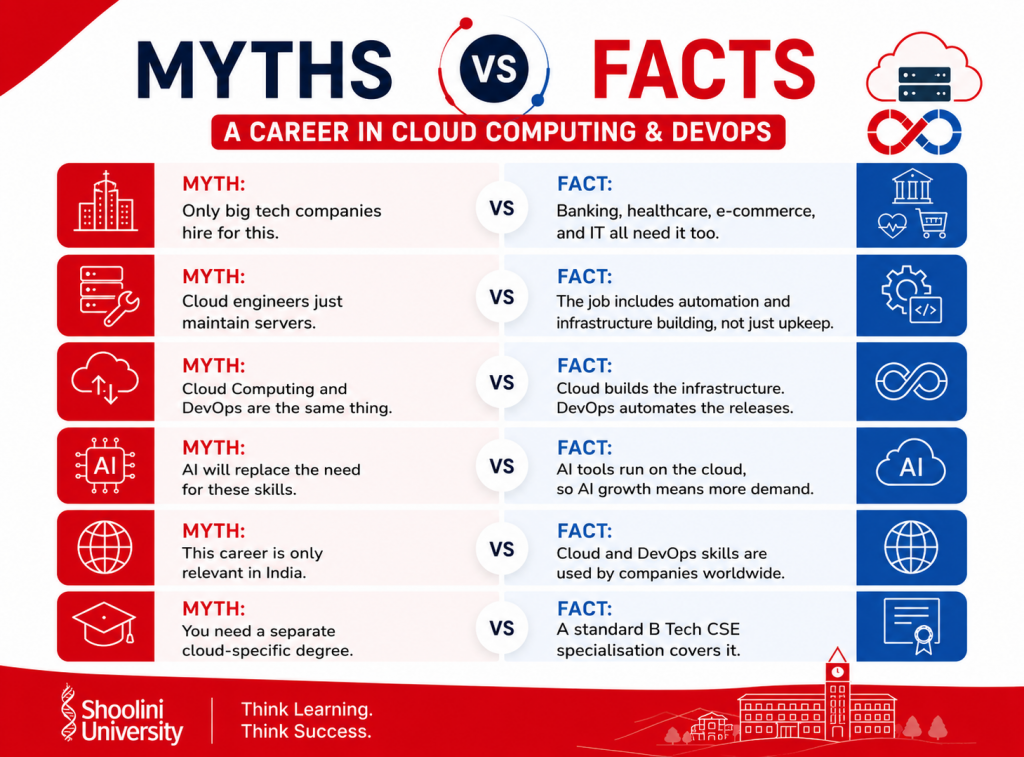
- More businesses shift to the cloud every year, in banking, e-commerce, healthcare, and IT
- AI adoption adds to the load, since AI tools also run on cloud servers
- Businesses need DevOps engineers to release software updates quickly and safely
- Hiring for cloud talent is happening at scale, in nearly every sector, not just traditional tech firms
A B Tech CSE Cloud Computing & DevOps degree prepares you for this. It builds the skills employers want now.
How Does Shoolini University Teach Cloud Computing & DevOps?
Learning here is application-driven, built on dedicated labs, national research partnerships, and direct industry collaborations, rather than classroom instruction alone.
Applied Research Partnerships
Shoolini works with IIT Ropar and AWaDH, the Technology Innovation Hub. This partnership includes a Cyber-Physical System Laboratory, known as the CPS Lab. It also includes a joint 15-credit Minor in Artificial Intelligence + X, which treats AI as a layer running over fields such as Agriculture, Biotechnology, and Management, not as a standalone subject. The CPS Lab supports student work in AI, robotics, data science, and AR-VR. Students take on interdisciplinary problem-solving early in their degree, before they pick a specialisation.
Industry Partnerships
Shoolini’s industry network includes AWS, IBM, Microsoft, Google Digital Academy, Bosch, and NASSCOM. It has also partnered with Sirena Technologies Private Limited, a firm working in humanoids and IoT systems. This brings robotics directly into student learning at Shoolini’s AI & Futures Centre. Students gain exposure to humanoid systems and automation frameworks and build robotics applications in electronics, construction, and education. Live projects and industry internships are also a part of this.
Students learn in working labs, on current systems, and tackle real problems while still on campus, so they graduate familiar with technology that changes fast.
Infrastructure and Labs
Shoolini has expanded its infrastructure and facilities in several ways. These include the AI & Futures Centre and the Yogananda XR and AI Research Centre. There are also specialised labs for computational models, DevOps, Artificial Intelligence and Natural Language Processing, and big data analytics. Students use VR systems, simulation tools, and high-performance computing, and work with 3D printers. This lets them test ideas in immersive environments and move from concept to physical design.
These facilities help students master the basics using the same technologies companies use today. This builds understanding and confidence.
Research and Innovation
Shoolini follows a One-Student-One-Patent policy, embedding innovation directly into the academic structure. Patents and product thinking are not optional here. Students take part in hackathons and research-driven projects that connect theory with practice.

What Jobs Can You Get After B Tech CSE Cloud Computing & DevOps?
Graduates work as cloud engineers, DevOps engineers, and platform reliability specialists. The average DevOps salary in India ranges from ₹4 to ₹8 LPA.
Top career options:
- Cloud Engineer
- DevOps Engineer
- Site Reliability Engineer (SRE)
- Cloud Security Analyst
- Cloud Architect
- Platform Engineer
Which B Tech CSE Specialisation Should You Choose At Shoolini?
Cloud Computing & DevOps is one of several CSE specialisations at Shoolini. Choose it if you want to work on the systems behind every app, not just the app itself.
Popular B Tech CSE specialisations at Shoolini include:
- Cloud Computing & DevOps
- Artificial Intelligence
- Data Science
- Cyber Security
- Blockchain & IoT
- Game Design & AR/VR
- UI/UX
Why Choose Shoolini University for B Tech CSE?
Shoolini holds specific national and global rankings in engineering, access to global certifications, applied labs, and a strong placement record.
- No. 1 private university in India for the fourth consecutive year, ranked 452nd in the world (QS World University Rankings 2027)
- No. 3 for Engineering in India (THE World University Rankings by Subject 2026) in Highlights section
- NAAC A+ accredited
- Access to certification tracks from AWS, IBM, Google, Microsoft, and Stanford, among others
- Placements with 250+ companies through recruiting drives on campus
- Study abroad options with universities in Australia, the UK, Canada, Germany, and other countries
Is B Tech CSE Cloud Computing & DevOps a Good Career Option?
Yes. Cloud and DevOps skills are needed in nearly every industry, not just traditional technology.
- Growing openings for cloud and DevOps professionals
- Competitive starting salaries compared to many other engineering fields
- Job opportunities in banking, healthcare, e-commerce, and IT
- Skills that stay relevant as AI grows, since AI infrastructure also runs on the cloud
- Backed by a university that keeps expanding its labs, research collaborations, and industry connections
Should You Choose B Tech CSE Cloud Computing & DevOps at Shoolini?
Yes. You get a solid engineering base along with skills employers value right now. Training is hands-on, through labs and industry exposure. Placements have reached 250+ companies. If you are considering engineering admission in 2026, start with Shoolini.
FAQs
Q1. Is Cloud Computing & DevOps a good career choice in 2026?
Yes, cloud and DevOps skills are in demand across almost every industry, and that demand keeps growing as more companies move to the cloud.
Q2. How does hands-on learning improve Cloud Computing & DevOps skills?
Hands-on learning through labs and real projects helps students build confidence with tools they will use on the job, not just theory.
Q3. Will students learn AWS, Microsoft Azure, and Google Cloud during the course?
The program covers core cloud platform skills and includes certification tracks from AWS, IBM, Google, and Microsoft, among others.
Q4. Can Cloud Computing & DevOps graduates work internationally?
Cloud and DevOps skills are used by companies worldwide, so the career path itself is international, and Shoolini also offers study abroad options with universities in Australia, the UK, Canada, and Germany.
Q5. How does Shoolini University prepare students for careers in Cloud Computing & DevOps?
Shoolini combines core CSE training with applied labs, industry partnerships, and certification access to prepare students for real cloud and DevOps roles.
Q6. What is the difference between Cloud Computing and DevOps?
Cloud Computing is about building and managing the infrastructure software runs on, while DevOps is about automating how that software is built, tested, and released.
Q7. What are the latest trends in Cloud Computing & DevOps?
Containers, automation, and cloud security remain central skill areas, alongside growing demand tied to AI systems that also run on cloud infrastructure.