

A few years ago, we tolerated unreliable software. Slow apps, confusing buttons, too many steps. But if it worked eventually, we adjusted. Today, we don’t. If an app makes us think too much, we close it. If a payment screen takes too long to load, we switch to another app. If a feature feels confusing, we assume the product is poorly built. That shift in user behaviour is exactly why UI/UX CSE skill development has become essential for Computer Science Engineering students.
This change has quietly redefined what engineers are expected to do. Writing correct code is still important, but users never see the code — they experience the product. Engineers now need to understand why users hesitate, where they get confused, and why they abandon a task halfway through. That’s where UI/UX skills for engineers matter. And with technologies like Artificial Intelligence and VLSI becoming more powerful — and more complex — the gap between ‘smart systems’ and ‘usable systems’ is widening. UI/UX is what bridges that gap, turning advanced technology into something people can actually use without frustration.
How UI/UX and Computer Science Work Together
Most successful digital products today are strong examples of engineering and design working together. Take Google Maps. Behind the simple interface lies advanced computer science — graph algorithms, real-time data processing, and AI-based traffic prediction. But what users remember is how easily they can understand routes, traffic signals, and alternate paths. Engineers who built this system had to think beyond logic and consider how information appears on a small screen while someone is driving.
A similar example is Paytm. The technical backend handles encryption, databases, and financial protocols, but the UI/UX ensures users can complete payments in mere seconds. Poor interface design here would lead to confusion, failed transactions, and a loss of trust. This shows how product design and CSE are inseparable in real-world applications.
This shift is also visible in the tools engineers use today. Design platforms like Figma are expanding their presence in India to support a rapidly growing design and developer community. Increasingly, developers are using these tools alongside designers, not just to execute layouts but to collaborate on flows, logic, and user journeys.
UI/UX and Product Thinking in Engineering Teams
In modern tech companies, engineers are involved in product decisions from the beginning. UI/UX skill helps CSE professionals think in terms of user journeys rather than isolated functions.
For example, in streaming platforms like Netflix, engineers constantly test how users browse content, resume shows, or receive recommendations. The recommendation engine is a complex AI system, but its success depends on how naturally users discover content. If the interface feels cluttered or confusing, even the best algorithms fail to deliver value.
This is why user experience design education is becoming relevant for engineering students. It trains them to design systems that feel logical to users, not just to machines. Engineers with this mindset often build cleaner architectures and anticipate edge cases early in development.
Recent leadership moves, such as Apple’s long-time head of UI design joining Meta to lead cross-product design strategy, show that design thinking and UI/UX leadership are now seen as strategic assets in tech organisations.
UI/UX in AI-Based Systems: Making Intelligence Usable
AI systems are everywhere today — from chatbots to fraud detection tools. However, users don’t interact with models; they interact with interfaces. A fraud detection system may be accurate, but if alerts are unclear or explanations are missing, users won’t trust it.
This is visible in AI dashboards used in healthcare, finance, and logistics. Engineers must decide how predictions are displayed, how uncertainty is communicated, and how users can act on insights. These decisions are part of UI/UX, not just design.
This growing overlap has created new UI/UX technology roles in which engineers work closely with AI teams to convert complex outputs into understandable experiences. For CSE students, learning UI/UX skill alongside AI makes them better equipped to build systems that are not only smart but also usable.
The Overlooked Role of UI/UX in VLSI and Hardware Tools
VLSI may seem far removed from UI/UX, but modern chip design relies heavily on software tools for simulation, verification, and performance analysis. These tools often involve dense data, multiple views, and long workflows.
When interfaces are poorly designed, engineers spend more time navigating tools than solving problems. Well-designed VLSI tools, on the other hand, allow engineers to visualise data clearly and detect errors faster. This is where UI/UX thinking improves productivity even in deep-tech domains.
As hardware and software integration increases—especially in AI chips and embedded systems—engineers who understand usability gain an edge. This has expanded the UI UX career scope India beyond traditional app design into core engineering and research environments.
Industry leaders in India have stated that despite rapid technology adoption, the country still lacks enough senior UX professionals to lead complex digital experiences. This gap emphasises the need for more structured education and training in UI/UX.
Why UI/UX Is Now Built into Engineering Education
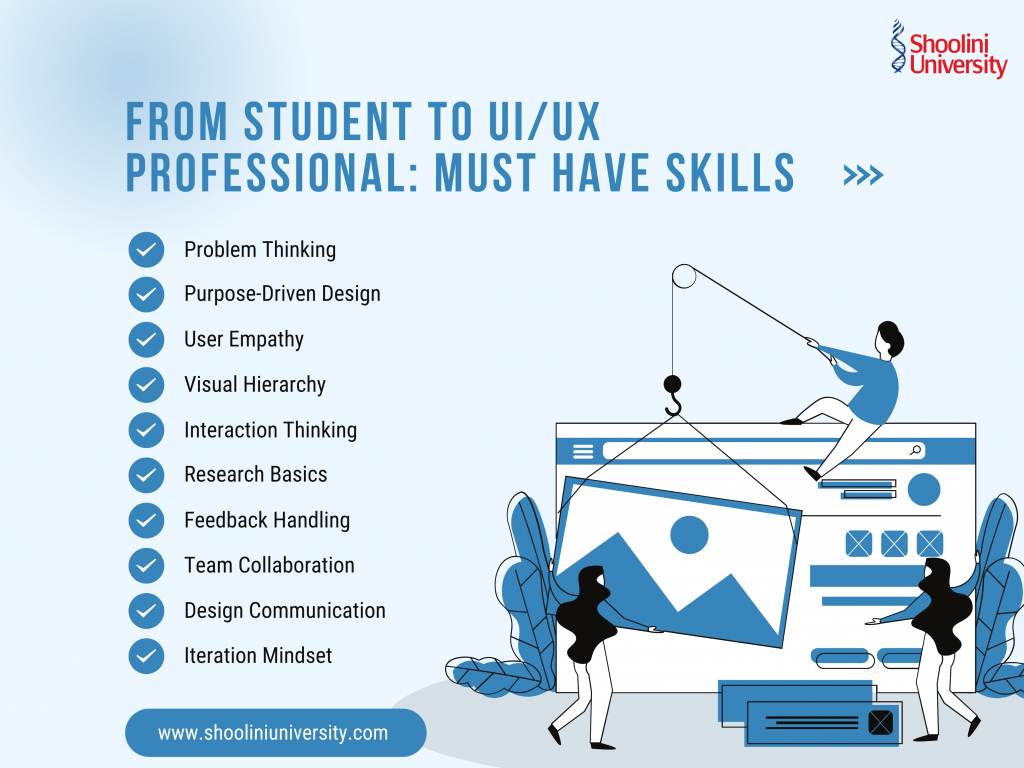
Because of these industry shifts, universities are rethinking how they teach engineering. Programs like B Tech CSE UI/UX acknowledge that design thinking strengthens technical ability rather than distracting from it. A structured course that teaches UI/UX skill within engineering helps CSE students apply design principles directly to software systems they build.
Over time, this integrated learning approach can also lead students towards advanced study options such as a UI/UX degree, where technical depth and design experience evolve together instead of separately.

How Shoolini University Is Building UI/UX-Ready Engineers
As UI/UX becomes a core expectation for computer science graduates, universities play a key role in preparing students for this shift. Shoolini University has positioned itself strongly in this space by integrating design thinking with engineering education.
Shoolini University is ranked No.3 in Engineering by THE World University Rankings by Subject 2026 and No.7 in Engineering by QS World University Rankings 2025. For students interested in UI/UX alongside computer science, the Yogananda School of AI, Computers, and Data Science offers specialised pathways that align technology with user experience.
The university currently offers two dedicated programs for students aiming to build UI/UX expertise within a computing foundation: B Tech CSE UI/UX and BCA UI/UX. These programs are designed to help students understand not only how systems are built, but also how users interact with them in real-world scenarios.
A key strength of Shoolini’s UI/UX-focused education lies in its faculty ecosystem. The Faculty of Engineering and Technology includes academicians and professionals from globally recognised institutions such as Berkeley, UPenn, Columbia University, Stanford, Oxford, IISc, and IITs. This exposure helps students learn design and technology from both global and Indian perspectives.
The university offers state-of-the-art infrastructure with the XR and AI research centre and AI and Futures Centre that gives students an access to all the latest technology.
Industry integration is another major focus area. Students receive certifications through collaborations with organisations like AWS, IBM, Google Digital Academy, and Bosch. In addition, support from Microsoft and AWS Academy ensures learners stay aligned with current industry tools and platforms. These partnerships help bridge the gap between classroom learning and industry expectations.
Shoolini also encourages innovation beyond coursework. Through its One Student One Patent Policy, students are actively supported in filing patents for original ideas. This innovation-driven approach is further strengthened by collaborations with over 250 international universities, enabling student and faculty exchange programmes that expose learners to global design and technology practices.
Students from Shoolini have been recruited by companies such as Ericsson, HCL, Trident, Citrix, Genpact, Cognizant, and IBM, reflecting the industry relevance of its programs.
Students also benefit from industry-recognised certifications, particularly through long-standing collaborations with IBM.
Learning at Shoolini goes beyond large lecture formats. Students often work in small teams under faculty mentorship, handling real-world projects that address industry problems. To support placement preparation, learners also gain access to Siqandar, described as the world’s best AI interview preparation coach, which helps students strengthen their interview readiness.
Closing Thought
More than visuals, UI/UX is all about how people experience technology at every step. For computer science students, developing strong UI/UX CSE skills means building software that works well and feels right. As AI, VLSI, and product-driven development continue to shape the industry, engineers who combine logic with empathy will define the future of technology. This is the right time to pursue a UI/UX course. So, what are you waiting for? Join Shoolini University now!
FAQs
Q1. Is UI/UX relevant for Computer Science students or only for designers?
UI/UX is highly relevant for Computer Science students. Engineers are expected to understand how users interact with systems, not just how code works, making usability a core part of software development.
Q2. Do CSE students need prior design knowledge to learn UI/UX?
No. UI/UX is taught from the basics, and CSE students can learn it using the same problem-solving and logical skills they already use in engineering.
Q3. How is UI/UX integrated into a CSE curriculum at Shoolini University?
UI/UX is taught alongside core computer science subjects in programs like B Tech CSE UI/UX, where students apply design thinking directly to technical projects.
Q4. Does learning UI/UX help CSE students build better software products?
Yes. It helps students design clearer interfaces, reduce user confusion, and create software that is easier to adopt and use.
Q5. Can UI/UX skills be applied across different CSE domains?
Yes. UI/UX is useful across web and mobile apps, AI systems, data dashboards, embedded tools, and enterprise software.
Q6. Why are universities treating UI/UX as a core technical skill now?
Because the industry now expects engineers to combine technical skills with usability and product thinking as software systems grow more complex.
Sources
- https://timesofindia.indiatimes.com/city/bengaluru/design-firm-figma-taps-indias-creator-economy/articleshow/125282311.cms
- https://www.theverge.com/news/837654/apple-meta-alan-dye-designer
- https://economictimes.indiatimes.com/tech/technology/ux-makes-tech-edible-but-india-lacks-senior-design-resources-jay-dutta-designup-founder/articleshow/124852359.cms?


