


Times have changed. Biotechnology is no longer confined to classrooms. It now plays a direct role in shaping industries and economies. This is evident in how careers after BSc Biotechnology are evolving today. What was once limited to lab-based roles has expanded into research, industry, and technology-driven paths.
As per the India BioEconomy Report (IBER) 2026, India’s bioeconomy has crossed $195 billion, supported by strong government policies, growing startup ecosystems, and the integration of artificial intelligence into biology. This growth is not just about numbers — it reflects the increasing demand for skilled professionals who can work across science, technology, and industry.
For students, biotechnology is no longer a narrow field. It is a space where multiple career paths exist, and choosing the right one depends on your interests and skills. So, let’s find out some of the top career options that you can pursue after a BSc Biotechnology.
Research Careers: Driving Scientific Innovation
Biotechnology research careers remain one of the most important paths, especially for students interested in discovery and long-term impact. In today’s landscape, research is becoming more application-focused. Projects like GenomeIndia are building genetic databases to improve disease prediction and personalised medicine. At the same time, advances in synthetic biology are allowing scientists to design biological systems for industrial and environmental applications.
As a graduate, you typically begin by supporting ongoing projects in labs, where you learn how experiments are conducted, analysed, and documented. Over time, with higher education such as an MSc or PhD, you can move into independent research roles and lead projects in areas like genetics, microbiology, or molecular biology.
What makes research different today is the integration of technology. With the rise of Bio-AI, researchers are increasingly expected to understand how data and computational tools can support biological discoveries. This makes research a good option for those who enjoy both science and analytical thinking.
Industry Careers: Applying Biotechnology at Scale
While research focuses on discovery, industry jobs after BSc Biotechnology focus on real-world applications. The biotechnology industry in India is expanding across pharmaceuticals, agriculture, food technology, and healthcare. One of the key drivers of this growth is the rising demand for biosimilars and advanced drug development, especially as global patents expire and Indian companies step in as major producers.
At the same time, the industry is also focusing on sustainability. Under initiatives like the BioE3 Policy, biotechnology is being used to develop eco-friendly materials, improve manufacturing processes, and support environmental goals. This has created roles in production, quality control, and regulatory functions.
Another important development is the rise of Global Capability Centres (GCCs) in life sciences. These centres are now working on core areas like digital health, clinical data analysis, and bioinformatics, moving beyond traditional support roles.
Industry careers are ideal for students who prefer structured environments and want to see direct outcomes of their work. They are faster-paced than research and involve working in teams to deliver results.
Emerging Biotechnology Career Options in 2026
The most important shift in careers after BSc Biotechnology is the rise of new, interdisciplinary roles. These Biotechnology career options are shaped by the merging of biology with data science, sustainability, and advanced technology.
One of the most prominent roles is that of a bioinformatics analyst. This field involves working with large biological datasets, especially genetic information, using computational tools. With the rise of Bio-AI, bioinformatics professionals are now playing a key role in drug discovery, disease prediction, and personalised medicine. It is one of the fastest-growing areas within biotechnology because it connects biology with data-driven decision-making.
Another important career path is genetic engineering. With technologies like CRISPR, scientists can now edit genes to treat diseases or improve crop quality. This has opened up opportunities in both healthcare and agriculture, making genetic engineering one of the most impactful and future-focused roles in biotechnology.
Environmental biotechnology is also gaining attention due to global concerns around climate change. Professionals in this field work on solutions like carbon capture, waste management, and bio-based energy production. These roles are becoming increasingly important as industries look for sustainable alternatives.
In addition, there is a growing demand for professionals in biomanufacturing and synthetic biology. With support from policies like BioE3, India is focusing on producing biological products at scale, including biodegradable materials and bio-based chemicals. This has created opportunities for those interested in combining biology with industrial processes.
These emerging roles show that biotechnology is no longer limited to traditional lab or industry work. It is expanding into areas that require adaptability, continuous learning, and a willingness to work across disciplines.

The Role of Higher Studies in Career Growth
A BSc (Hons) Biotechnology degree provides a foundation, but many advanced roles require further specialisation.
An MSc allows you to focus on specific areas such as genetics or microbiology, while a PhD is often needed for research-intensive careers. For students interested in moving towards business or management roles, an MBA can open up opportunities within biotech companies.
Higher studies are not mandatory, but they can help you move into more specialised and leadership positions over time.
Why Pursue BSc in Biotechnology Today
Understanding why to enrol in a BSc in biotechnology becomes clearer when you look at the direction the field is heading. Biotechnology is directly connected to some of the most important global challenges, including healthcare innovation, food security, and environmental sustainability. It also offers flexibility, allowing you to move between research, industry, and emerging technology-driven roles.
Skills That Matter in Biotechnology Careers
To build strong careers after BSc Biotechnology, skill development is essential.
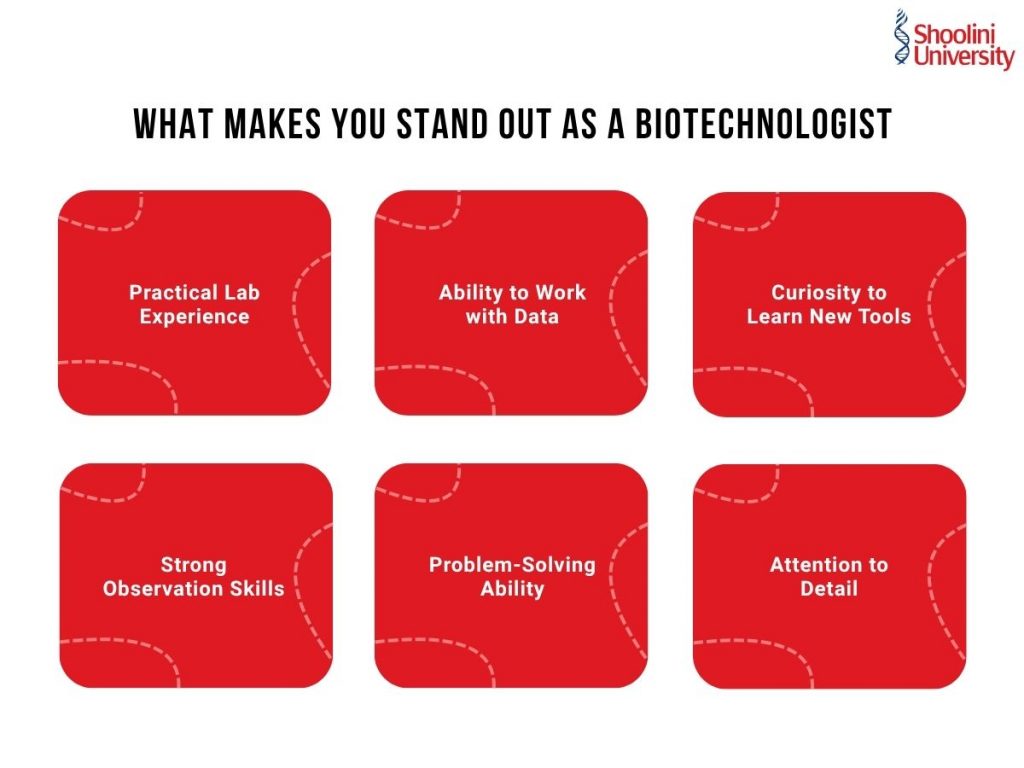
You need a strong understanding of laboratory techniques and biological concepts. At the same time, the growing role of technology means that basic knowledge of data analysis and computational tools can give you an advantage.
Soft skills such as communication, teamwork, and problem-solving are also important, especially in industry roles where collaboration is key.
Shoolini University: A Strong Choice for Biotechnology Students
If you are looking for the best private BSc biotechnology colleges in India, Shoolini University is one name that stands out. Known for its strong focus on research and innovation, it has built a reputation as a leading place to study biotechnology in India.
The School of Biotechnology at Shoolini offers a wide range of programs, including BSc Biotechnology, B Tech Biotechnology, MSc Biotechnology, M Tech Biotechnology, and PhD. These programs are designed to give students both theoretical knowledge and practical exposure, which is important for building strong Biotech career opportunities.
One of the most unique aspects of studying here is the focus on research from the beginning. Through its Summit Research Program, students start working in labs early in their academic journey. This helps them gain real-world experience, which is very useful when exploring jobs after BSc Biotechnology in India or planning higher studies.
Shoolini also follows a ‘One Student One Patent’ approach, encouraging students to work on ideas and innovations. With more than 1,900 patents already filed, students can build strong profiles even before they graduate.
The university has advanced facilities with over 104 laboratories and 11 Centres of Excellence. These spaces allow students to work with modern equipment and understand how biotechnology is applied in real-world situations. This kind of exposure is especially helpful for those interested in biotechnology research careers or industry roles.
Another advantage is the faculty. Many professors come from top institutions and bring real research and industry experience into the classroom. Students also benefit from global exposure through international collaborations with universities around the world.
Graduates have been placed in companies like Biocon, Cipla, and Serum Institute, which shows how the university connects education with real industry opportunities.
Final Thoughts
The future of careers after BSc Biotechnology is not limited to one path. With advancements in research, industry growth, and the rise of new technologies, students today have more options than ever before.
The key is to understand the evolving nature of the field and choose a path that aligns with your interests. So, if you are also interested in studying Biotechnology, Shoolini University is the place to be.
FAQs
Q1. Is a BSc Biotechnology enough to get a job, or is a master’s degree necessary?
Yes, a BSc Biotechnology is enough to get entry-level jobs in labs, healthcare, or industry. However, a master’s degree helps you move into better and more specialised roles, especially in research.
Q2. Which industries hire BSc Biotechnology graduates besides pharmaceuticals and research labs?
Apart from pharma and labs, graduates can work in food processing, agriculture, environmental companies, healthcare, diagnostics, and biotech startups.
Q3. What skills should students develop during a BSc Biotechnology to improve job prospects?
Students should focus on lab skills, data analysis, and basic computer knowledge. Communication, teamwork, and problem-solving are also very important.
Q4. What are the highest-paying career paths after BSc Biotechnology in India?
Some of the top career paths include bioinformatics, genetic engineering, clinical research, and roles in biotech companies. Higher studies can help you reach these roles faster.
Q5. Can BSc Biotechnology graduates work in AI, bioinformatics, or data science roles?
Yes, but you need to learn additional skills like programming and data analysis. Bioinformatics is one of the most common paths where biology and technology come together.
Q6. How does Shoolini University help biotechnology students gain research or industry exposure during their degree?
Shoolini offers early research opportunities, advanced labs, and programs like the Summit Research Program. Students also get industry exposure through internships and projects.
Q7. What makes Shoolini University one of the best private colleges for BSc Biotechnology in India?
Shoolini stands out for its strong research focus, modern labs, experienced faculty, and good placement support. It also encourages innovation through initiatives like ‘One Student One Patent’.


