

The idea of building a career in tech industry is exciting for many young people in India because technology now touches everything we do — how we communicate, how we shop, how we travel, how businesses operate, and how nations compete globally. India’s tech job market continues to show strong demand for talent: demand for IT roles in India grew by about 16% in 2025, with companies hiring across cloud, cybersecurity, analytics, and product development areas. This growth isn’t accidental — it reflects how businesses and public systems are becoming digitally advanced and relying on technology to stay competitive.
But there’s a gap between what companies need and what students learn. Industry surveys show that while demand for digital and tech skills grows fast, many employers struggle to find people with current skills like cloud, AI, and cybersecurity. That means students who focus on learning, adapting, and building real skills have a strong advantage. A successful career in tech doesn’t start with fancy certificates; it starts with curiosity, practical experience, and a long-term mindset toward learning.
In this blog, we’ll explore how you can choose the right direction, build real skills, and make strong progress in your technology career path — step by step.
Why Choosing a Career in Tech Industry Still Matters
Technology still plays an outsized role in global job creation, including in India. While some parts of the sector have slowed hiring, overall demand remains strong, especially for specialised roles like AI, cloud computing, and cybersecurity. Even companies that use technology differently — from banks to healthcare to manufacturing — need professionals who understand tech.
This means jobs in the technology sector are not limited to software coding alone. You can work in roles like data analysis, cloud support, cybersecurity, system design, UX design, product support, and even technology strategy. Many of these roles demand logical thinking, problem-solving, creativity, and communication — not just coding.
Because tech roles continue to evolve quickly, being adaptable and ready to learn is often more important than any single skill you start with.
Knowing the Tech Industry Landscape — Why It Helps
One reason many students feel confused is the diverse career paths. You have areas like:
- Software and app development
- Cloud and DevOps engineering
- Data analytics and AI
- Cybersecurity and digital safety
- UI/UX and product design
- IoT (Internet of Things) and embedded technologies
All of these are part of the broader technology career path, and you’ll grow better if you understand the industry’s structure rather than chase trends. For example, a software engineer still needs core logic and problem-solving skills. Similarly, a data analyst must understand statistics and how to work with datasets, not just dashboards.
Seeing the big picture helps you decide where you can add value — and where you enjoy working.
Build a Strong Foundation Before Anything Else
Whether you’re thinking of software engineering, data work, cloud infrastructure, or cybersecurity, fundamentals always matter.
Begin with:
- Logical understanding of problems
- Basic programming ideas (if you’re on the development path)
- Understanding of databases and data flow
- How networks and systems communicate
These basics provide a solid base so that when you learn new tools or languages later, you grasp why things work, not just how to use them.
Students who only jump into advanced tools without strong fundamentals often struggle when something changes — and in tech, change is constant.
Skills Employers Actually Look For
Today, technology hiring is skill-led. Companies often look for people who can apply their learning, solve problems, and work collaboratively in teams. Employers also prioritise soft skills like communication and adaptability — especially because many roles require working across departments.
The current tech job market sees high demand for roles requiring:
- Cloud and infrastructure basics
- Cybersecurity awareness
- Data science fundamentals
- Automation and AI understanding
- Digital problem-solving mindset
In fact, companies report that only a small percentage of open roles have candidates who fully match their skill needs. This proves the importance of building industry-ready skills.

What High-Demand Tech Jobs Look Like in 2026
According to industry trends, the most sought-after roles in India in 2026 include areas where companies are building new capabilities:
- AI and machine learning support
- Cloud computing and solutions engineering
- Data analytics and large-scale data handling
- Cybersecurity essentials and risk analysis
- Full-stack product development
These fields are expanding because businesses rely on digital transformation and secure systems to operate efficiently. So, if you learn the right skills in these areas, you’ll be ready for where industry demand is moving.
Engineering at Shoolini University: A Strong Launchpad for Tech Careers


If you are planning a career in the tech industry, your college choice matters because it shapes your learning environment, exposure, and career readiness. Engineering at Shoolini University helps students build both strong technical fundamentals and practical industry skills.
Shoolini is ranked No. 3 in Engineering in the Times Higher Education World University Subject Rankings, which reflects its academic performance and research strength. The university also focuses strongly on placements and career outcomes.
Students also benefit from Shoolini’s unique One-Student One-Patent policy, which encourages innovation and real-world problem solving. This is especially useful for students who want to build projects, research ideas, and stand out in interviews.
For students exploring tech industry career opportunities, Shoolini offers modern specialisations such as AI, ML, Game Design, and more. These options are relevant for students aiming for future technology careers in India, especially in areas like automation, data, and next-generation digital systems.
The university has strong industry connections, with access to technology platforms and certifications through partners like AWS, IBM, Google Digital Academy, and Bosch. It also has partnerships with Ikigai Lab, Punjab Engineering College, and IIT Kanpur, giving students stronger academic and skill exposure.
Shoolini’s infrastructure supports hands-on learning through 11 Centres of Excellence, 104+ state-of-the-art laboratories, and dedicated spaces like the XR and AI Research Centre and the AI and Futures Centre.
Students in B Tech programs at Shoolini University can choose from key engineering paths, including B Tech CSE and B Tech Civil Engineering, depending on their interests and long-term goals. With 250+ partnerships with leading international universities, students also get exchange opportunities and global exposure that help them understand how technology works across industries worldwide.
Placement partners include companies such as L&T, Eicher, Havells, Reliance Jio, Microtek, Onida, Vardhman, Window IT, and others. The university also supports students through merit-based scholarships, helping deserving students access quality education.
With experienced faculty from institutions like NCI, NIH, Berkeley, UPenn, Columbia University (USA), Stanford, Oxford, IISc, IITs, and IIMs, Shoolini offers strong mentorship and guidance for students who want to grow in technical and research-driven careers.
For students looking for the best engineering university in Himachal Pradesh, Shoolini offers a blend of strong academics, modern specialisations, research support, and career-focused training. This helps students build the skills needed for tech jobs and prepare confidently for careers in the technology sector.
Final Thoughts
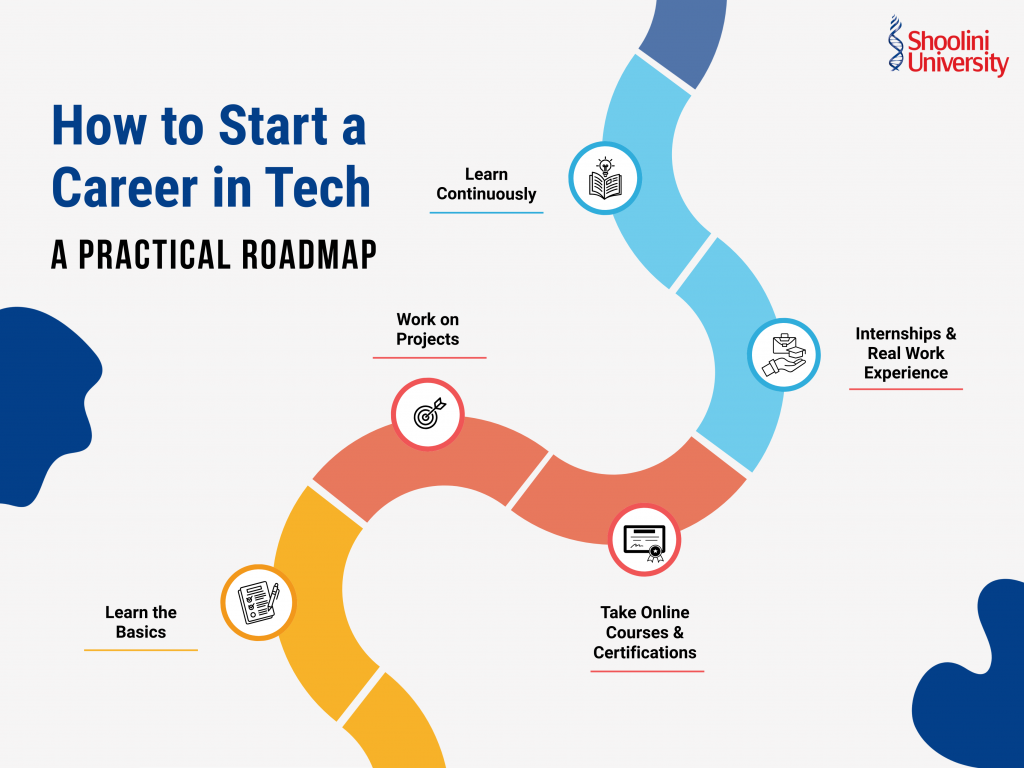
Choosing a career in the tech industry means choosing a future that evolves constantly. If you focus on building real skills, working on meaningful projects, and nurturing a strong learning mindset, you stand a good chance of success — not just today, but throughout your career.
Stay curious. Practice consistently. And don’t be afraid to explore paths that excite you — because that’s how long-term growth in tech really happens.
Admissions Open. Apply Now!
Sources:
- https://economictimes.indiatimes.com/jobs/indias-it-job-demand-grows-16-in-2025-quess-corp/articleshow/126119717.cms
- https://taggd.in/blogs/it-hiring-trends
- https://www.robertwalters.in/insights/hiring-advice/e-guide/global-tech-skills-gap.html
- https://www.ciodive.com/news/demand-tech-talent-robert-half-IT/812261


