

Until a few years ago, a career in technology followed a clear and familiar route. Students studied computer science, learned programming, joined a tech company, and built products. Research felt distant—limited to universities or specialised labs. But today, that thinking is changing rapidly. More students and professionals in technology are now choosing PhD over high-paying jobs and actively moving towards research careers.
This shift is closely linked to what people are seeing around them. Artificial intelligence tools are everywhere—ChatGPT answering questions, GitHub Copilot helping developers write code, Google’s AI transforming search, image tools like Midjourney and Stable Diffusion creating visuals, and systems like AlphaGo outperforming world champions. These technologies did not appear suddenly. They are the outcome of years, often decades of research, experimentation, and academic work.
As this becomes clearer, many students are realising that the most influential work in technology does not begin with products. It begins with research. This blog explains why this shift is happening and what it means for students interested in computer science and AI.
Top Reasons Why Tech Researchers Are Choosing PhD Over High-Paying Jobs
1. Foundational Technology Research Starts Long Before Products
One of the main reasons behind this shift is a simple realisation: most breakthrough technologies are born in research environments, not product teams.
Companies like Google, Meta, and Microsoft build powerful products used by millions. But the core ideas behind many of these products —like language models, recommendation systems, reinforcement learning, and neural networks—were developed through academic research.
For example, large language models that power tools like ChatGPT have emerged from years of university-led research in natural language processing and machine learning. Research papers on transformers, attention mechanisms, and large-scale training laid the foundation long before these ideas reached users.
Students aiming for careers in computer science research increasingly understand this difference. This distinction is one of the strongest reasons many students now see doctoral study as essential.
2. AI Is Becoming More Complex and Needs Deep Research


Artificial intelligence today is not just about speed or automation. It involves questions of reliability, bias, safety, and long-term impact. As AI systems enter healthcare, finance, education, and governance, their design and behaviour matter more than ever.
This is where an AI research PhD becomes relevant. Doctoral researchers spend years studying how models learn, where they fail, and how they can be improved responsibly. Many students interested in shaping future AI systems realise that this level of work cannot be done solely through short development cycles.
3. Doctoral Study Builds Authority and Research Independence
A key difference between research and early industry roles lies in how expertise is built. A PhD trains individuals to ask original questions, design experiments, analyse results, and defend conclusions before experts.
This training is why doctoral programs in computer science continue to hold strong value worldwide. Researchers with doctoral experience are trusted to lead investigations, contribute to global knowledge, and guide future technological directions.
When students compare PhD vs industry jobs in tech, many recognise that industry roles often focus on execution, while doctoral research builds long-term authority. For those who want to influence how technology evolves, this difference matters.
4. Industry Research and Academic Research Follow Different Goals
Research within companies usually aligns with business priorities. Timelines, markets, and product strategies influence what is studied and how results are used. This does not make industry research less important, but it does limit its scope.
Academic research works differently. Researchers are encouraged to explore unanswered questions, publish openly, collaborate globally, and take intellectual risks. Failure is part of learning, not a setback.
This environment attracts students who value depth and exploration. It explains why many are choosing PhD over high-paying jobs, even when industry options are available.
5. Research Careers Today Go Beyond Universities
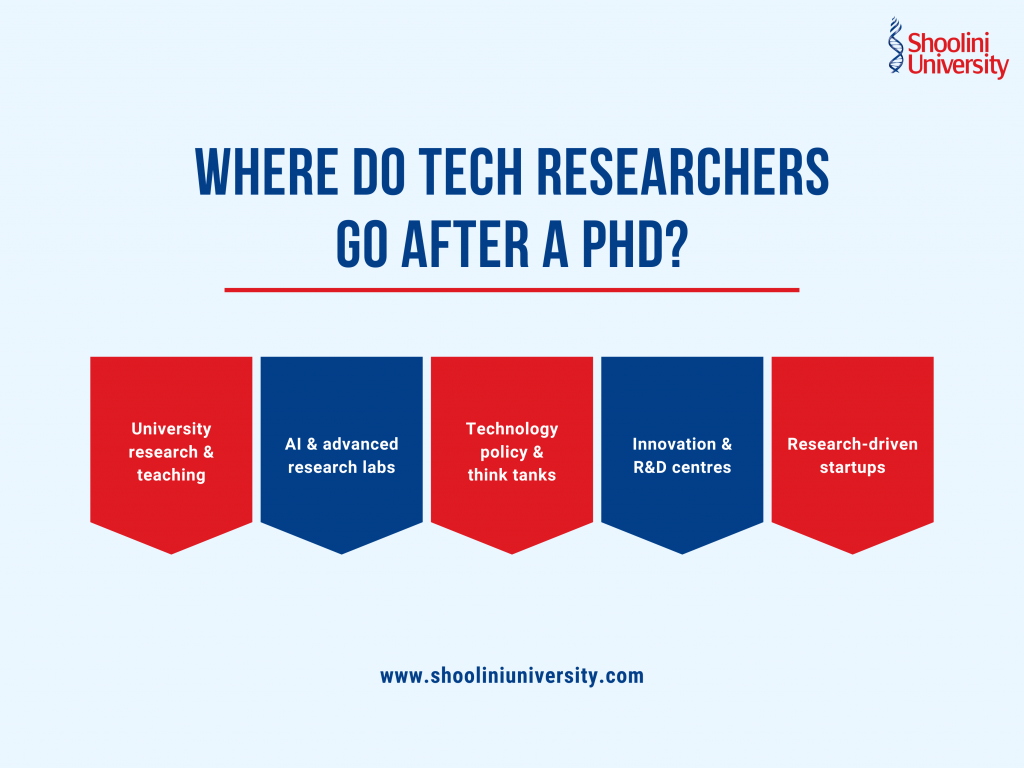
Earlier, doctoral study was seen mainly as a path to becoming a professor. That view has changed. Today, PhD holders work in research labs, technology policy, innovation centres, advanced R&D teams, and interdisciplinary roles.
This expanded landscape has reshaped how students see the PhD CSE scope. A PhD is no longer a narrow academic route. It is advanced research training that supports diverse career paths.
As a result, more students now see doctoral study as a foundation rather than a limitation.
6. India’s Research Ecosystem Is Growing Rapidly
According to NITI Aayog’s research outlook, India is expected to require more than 10 lakh researchers over the coming decade to keep pace with expanding research and development efforts in critical fields, including biotech, pharma, AI, renewable energy, and climate science.
India is now among the world’s leading contributors to scientific publications, with strong growth in computer science, engineering, and AI research. According to global publishing data from Springer Nature, India’s research output has increased sharply over the past decade, reflecting stronger academic participation and collaboration.
Innovation is growing alongside publications. Patent filings and grants in India have risen significantly, showing that research is moving toward real-world applications. Reports from India Brand Equity Foundation highlight how Indian institutions are increasingly contributing to innovation and intellectual property. For students considering PhD CSE India, this context is essential.
7. Students Want to Be Creators, Not Just Users
Another clear mindset shift is visible among students. Many no longer want to use advanced technology. They want to understand how it is built.
Seeing how technologies like AI assistants, code generators, and intelligent systems evolved through research has made doctoral study aspirational again. Students now connect research with influence and long-term impact.
This desire to move from usage to creation is a major driver behind choosing PhD over high-paying jobs.

Shoolini University PhD CSE: A Research-Focused Ecosystem
Shoolini University has built a strong reputation as a research-driven institution, backed by consistent national and international recognition. It is ranked No. 1 in Asia for citations per paper by the QS World University Rankings Asia. It is also recognised as the No. 1 private university in India by the QS World University Rankings. In engineering, Shoolini is ranked No. 3 in India under the Times Higher Education Subject Rankings.
The PhD in Computer Science and Engineering is offered through the Yogananda School of AI, Computers and Data Science, providing scholars with a focused academic environment for advanced research. PhD researchers benefit from access to 11 Centres of Excellence and more than 104 state-of-the-art laboratories, including specialised facilities such as the XR and AI Research Centre and an AI and Futures Centre, which supports innovation in emerging technologies.
To ensure exposure to the latest technology platforms, Shoolini collaborates with leading global organisations, including AWS, IBM, Google Digital Academy, and Bosch. These partnerships provide students with access to industry-relevant tools, platforms, and certification opportunities alongside their research work.
Shoolini’s research ecosystem is further strengthened by support from national funding agencies such as DST, DBT, SERB, and ICMR, along with 250+ international academic partnerships that enable global collaboration and exchange. Faculty members bring experience from globally respected institutions, including NCI, NIH, Berkeley, the University of Pennsylvania, Columbia University, Stanford, Oxford, IISc, IITs, and IIMs, offering PhD scholars strong academic mentorship and global perspectives.
A key indicator of Shoolini’s applied research focus is its ‘One Student One Patent’ policy, under which the university has filed over 1,800 patents. This reflects a culture that encourages research to move beyond theory and towards real-world impact. Each PhD scholar is guided by a dedicated Research Advisory Committee, ensuring personalised supervision throughout the doctoral journey, and all PhD programmes are conducted strictly in accordance with UGC guidelines.
Beyond research, Shoolini also emphasises career readiness. Placement partners include organisations such as L&T, Eicher, Havells, Reliance Jio, Microtek, Onida, Vardhman, Window IT, among others. The university also maintains active academic and research partnerships with Ikigai Lab, Punjab Engineering College, and IIT Kanpur, further strengthening its innovation and research network.
Conclusion
The growing interest in doctoral study reflects a bigger change in how technology careers are understood. As systems become more complex and impactful, the need for research-driven thinking continues to rise. This is why choosing a PhD over high-paying jobs is no longer unusual; it is now a thoughtful decision.
If you want to be part of the ideas that shape future technologies, exploring research-focused education at institutions recognised as the best university for PhD in India can be a strong place to begin.
Explore research. Explore possibilities. Join Shoolini University.
FAQs:
Q1. Why are engineers choosing a PhD in Computer Science instead of corporate roles?
Engineers are prioritising PhDs because breakthrough technologies like AI are born in research labs, not product teams. A PhD allows them to move from being users of technology to creators, providing the depth needed to solve complex problems like AI safety and reliability.
Q2. Does a PhD in Computer Science limit career options?
No, it expands them. Beyond academia, PhD holders are in high demand for Industry R&D labs (Google, Meta), tech policy think tanks, and specialised startups. It transitions a career from execution-based roles to high-level leadership and innovation.
Q3. Can PhD CSE students work on industry-relevant research topics?
Yes. Modern research focuses heavily on real-world applications. Through collaborations with partners like AWS, IBM, and Google, students work on scalable, industry-relevant challenges while maintaining the intellectual freedom to explore original ideas.
Q4. What makes Shoolini University a strong choice for PhD in Computer Science?
Shoolini is a research powerhouse ranked No. 1 in Asia for Citations per Paper (QS World University Asia Rankings). It offers a unique ‘One Student One Patent’ policy, access to 104+ advanced labs (like the XR and AI Research Centre), 11 Centres of Excellence, mentorship from faculty trained at institutions like Oxford, Stanford, IISc, and more.
Sources:


