


Before a new medicine reaches a pharmacy shelf, it goes through years of research and testing. This includes clinical trials involving patients and, in some studies, healthy volunteers. Clinical research professionals help plan these studies, monitor their conduct and ensure that the data is recorded accurately. For B Pharmacy graduates, the field offers roles that draw on their knowledge of medicines and patient safety.
India’s contract research organisation market was valued at USD 6.74 billion in 2025 and is projected to reach USD 12 billion by 2035, with an annual growth rate of 6%, according to Market Research Future. Grand View Research valued India’s clinical trials market at USD 1.42 billion in 2024 and expects it to grow at 8% annually from 2025 to 2030. This expansion could increase demand for professionals trained in clinical operations, data management, drug safety and regulatory affairs.
If you are studying B Pharmacy or have recently completed your degree, this blog explains what clinical research involves, the skills and training employers look for and the roles available to graduates. Depending on your career goals in clinical research, you could work in trial monitoring, data management, regulatory affairs or pharmacovigilance. The clinical research industry in India offers several entry points for pharmacy graduates.
What Is the Career Scope in Clinical Research?
Clinical research is the systematic study of medicines, treatments, medical devices and other health interventions in people to assess their safety and effectiveness. B Pharmacy graduates may begin in roles such as clinical trial assistant, clinical data associate, regulatory affairs associate or pharmacovigilance associate. With suitable training and experience, they can progress to positions such as clinical research associate.
A B Pharmacy degree provides a foundation in drug formulation, pharmacology and biochemistry. This knowledge is useful when reviewing study protocols, dosage information, laboratory findings and drug-safety data. Additional training in clinical research practices and regulations can prepare graduates for entry-level B Pharmacy clinical research roles.
A pharmaceutical research career can begin after graduation, although qualifications vary by position. Students interested in a clinical data management career can specialise in handling and reviewing trial data. Others may move into pharmacovigilance, regulatory affairs or the wider drug-development process.
Each role handles a different part of the clinical research process, from managing trial sites and reviewing data to monitoring drug safety and preparing regulatory submissions. Together, these professionals help trials run correctly and support the clinical research industry in India.
Salary ranges are indicative and may vary by employer, location, qualifications and experience.

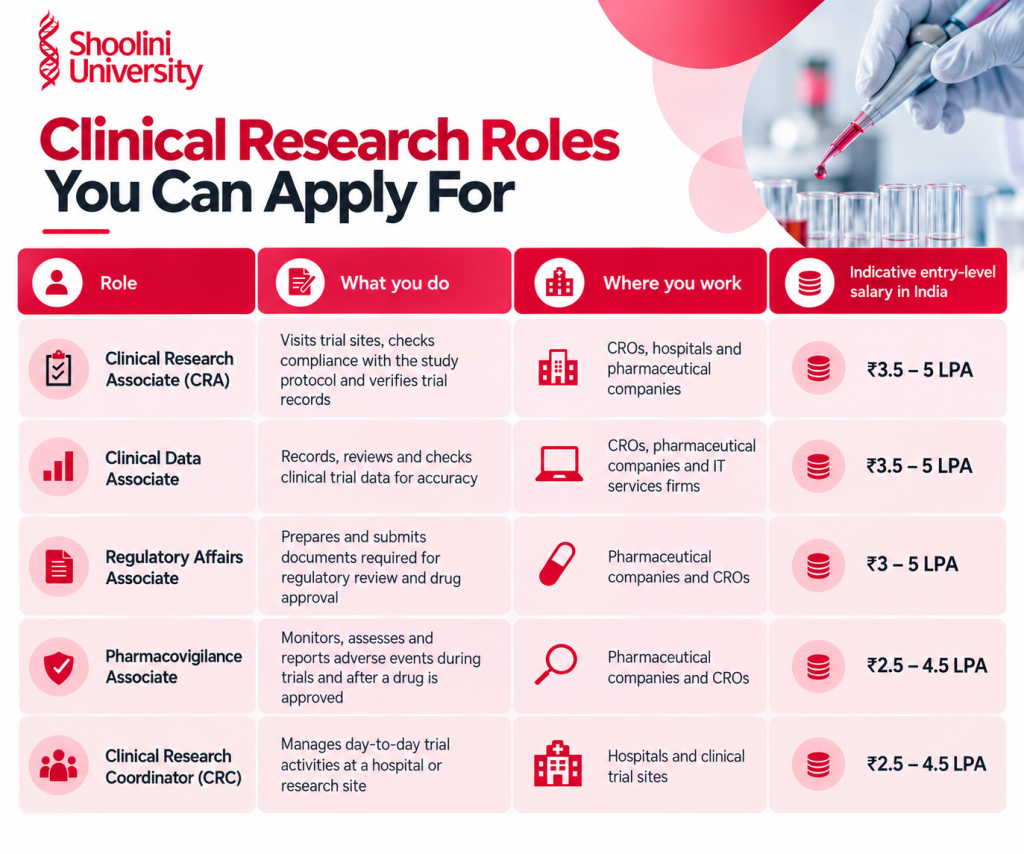
Each role handles a different part of the clinical research process, from managing trial sites and reviewing data to monitoring drug safety and preparing regulatory submissions. Together, these professionals help trials run correctly and support the clinical research industry in India.
Salary ranges are indicative and may vary by employer, location, qualifications and experience.
Why Clinical Research Is Growing in India
India’s clinical research sector is expanding as regulatory changes, its large patient population and investment in pharmaceutical research make the country an important location for drug development.
Faster approvals: Under the New Drugs and Clinical Trials Rules, 2019, the Central Drugs Standard Control Organisation generally has 90 working days to decide on a clinical trial application. The timeline is 30 working days when the drug is being researched and developed in India and is also proposed to be manufactured and marketed here. These defined timelines give sponsors greater clarity when planning trials and support India’s wider drug development career ecosystem.
Cost and scale: India’s large and varied patient population, lower trial costs and established pharmaceutical sector have made the country an important base for global clinical research. CROs and research organisations such as IQVIA, Parexel, Syngene and Lambda Therapeutic Research have operations in India. Bengaluru, Hyderabad, Mumbai and Pune are among the cities where clinical research and life sciences employers recruit. This gives B Pharmacy graduates possible entry points into internships, trainee positions and B Pharmacy clinical research roles.
Government support: Government initiatives are also supporting pharmaceutical research. The Scheme for Promotion of Research and Innovation in Pharma MedTech Sector focuses on research, innovation and collaboration between industry and academic institutions. Such measures can strengthen the wider ecosystem in which clinical research, regulatory affairs and data-management professionals work.
Skills and Training That Help After B Pharmacy
A B Pharmacy degree provides relevant subject knowledge, but employers may also look for training and practical skills related to clinical trials.
ICH-GCP training: Good Clinical Practice training introduces the ethical and scientific standards used to design, conduct, record and report clinical trials. Familiarity with current ICH-GCP guidelines can strengthen an application for roles in trial coordination or monitoring. It is particularly relevant if your career goals in clinical research include becoming a clinical research associate. Requirements vary by employer and position.
Medical terminology and regulatory writing: Clinical documents follow defined formats and procedures. Knowing the language used in protocols and case report forms can help you understand and prepare trial documentation. This is useful for regulatory affairs and medical writing roles connected with a pharmaceutical research career.
Data tools: Familiarity with the Medical Dictionary for Regulatory Activities, or MedDRA, is useful for data-focused roles. A basic understanding of Excel, electronic data capture systems and safety databases can also help if you are planning a clinical data management career.
Attention to detail: Trial data is checked repeatedly, and errors can affect data quality and regulatory compliance. Employers therefore value candidates who can review documents and data carefully—an important ability in any drug development career.
Not every entry-level role requires all these skills. However, relevant training and practical exposure can strengthen an application and support progression into monitoring, data management or regulatory affairs.
Salary in Clinical Research After B Pharmacy
Clinical research salaries vary by role, employer, location, qualifications and experience. Salary portals and career guides generally place many entry-level roles in India within a broad range of approximately ₹2.5–5 LPA. These figures should be treated as indicative rather than guaranteed.
Pay may increase as professionals gain experience and move into trial monitoring, clinical data management, project management, regulatory affairs or specialised drug-safety roles. However, job titles are not standard across employers. For example, a clinical data associate and a clinical data manager have different responsibilities and salary levels.
Large pharmaceutical and CRO centres such as Bengaluru, Hyderabad, Mumbai and Pune may offer a wider range of positions. For B Pharmacy graduates, the clinical research industry in India provides several career options beyond conventional pharmacy practice.
How to Start Your Career in Clinical Research
A B Pharmacy student or recent graduate can begin with the following steps:
- Finish your B Pharmacy degree with a solid grounding in pharmacology and pharmaceutical chemistry. These subjects provide useful background for understanding medicines, dosage, adverse events and drug safety in a pharmaceutical research career.
- Take ICH-GCP training or a relevant clinical research course during or after your final year. Check the course content, provider and current guideline version before enrolling. Such training is particularly useful if your career goals in clinical research include trial coordination or monitoring.
- Apply for internships or trainee roles at CROs, pharmaceutical companies or hospital trial sites to gain practical exposure. Experience with documentation, study coordination or data handling can strengthen your application for B Pharmacy clinical research roles.
- Look for entry-level positions such as clinical trial assistant, clinical research coordinator, data associate, pharmacovigilance associate or regulatory affairs associate. With experience and suitable training, you can move into monitoring, data management or other areas of a drug development career.
- Build skills according to the area you want to enter. Students planning a clinical data management career can learn about electronic data capture systems and data review. Those interested in pharmacovigilance or regulatory affairs can seek role-specific training and experience.
Your first position does not have to determine your entire career. As you gain experience, you can move into monitoring, data management, drug safety, regulatory affairs or other areas of clinical research.
Studying B Pharmacy at Shoolini University
Shoolini University is ranked 452nd globally and 10th in India in the QS World University Rankings 2027. According to the rankings, it is also India’s No. 1 private university for the fourth consecutive year. The university holds NAAC A+ accreditation with a CGPA of 3.33.
B Pharmacy admission 2026 at Shoolini is offered through the School of Pharmacy, which is approved by the All India Council for Technical Education (AICTE) and recognised by the Pharmacy Council of India (PCI). The programme includes industrial training at a pharmaceutical company, giving students practical industry exposure before graduation.
Students also have access to the Shoolini Intellectual Property Rights Office, which supports patent filing and commercialisation. Shoolini scientists have also featured in Stanford University and Elsevier’s list of the world’s top 2% of scientists. The university’s placement team works with pharmaceutical and other employers for internships and recruitment.
For students planning a pharmaceutical research career or a drug development career, the combination of industrial training and research infrastructure provides relevant academic and practical exposure.
B Pharmacy admission 2026 at Shoolini University is open.
Conclusion
Clinical research allows B Pharmacy graduates to apply their knowledge of medicines, pharmacology and patient safety to the testing and development of treatments. The expanding clinical research industry in India includes roles in trial coordination, monitoring, pharmacovigilance, regulatory affairs and data management.
If your career goals in clinical research include trial monitoring or a clinical data management career, begin by building a strong foundation during your B Pharmacy degree. Relevant training, practical exposure and familiarity with Good Clinical Practice can help you prepare for entry-level roles and identify the area that suits your interests.
Sources
FAQ
Q1. Can B Pharm graduates build a career in clinical research?
Yes. B Pharm graduates are among the most preferred candidates for clinical research roles such as clinical research associate, clinical trial coordinator, and clinical data associate, since their degree already covers pharmacology and drug formulation. This makes a B Pharmacy clinical research path very accessible.dheya+1
Q2. How can B Pharm graduates enter clinical research?
Most graduates start as a clinical research coordinator or trainee CRA. A GCP certification, an internship with a CRO, and strong attention to detail help you get your first role and move up faster in your career goals in clinical research.
Q3. What is the future of clinical research careers in India?
India's CRO market is projected to grow from USD 6.74 billion in 2025 to USD 12 billion by 2035. Faster trial approvals under CDSCO's 2019 rules and growing investment from global pharma companies point to steady, long-term demand for trained professionals in the clinical research industry in India.
Q4. What clinical research jobs are available after B Pharm?
Common entry points include clinical research associate, clinical research coordinator, clinical data associate, regulatory affairs associate, and pharmacovigilance associate. Each role can lead to more senior positions such as clinical project manager in a pharmaceutical research career or drug development career.
Q5. What skills are required for a career in clinical research?
A GCP certification, knowledge of medical terminology, basic data management tools, and attention to detail are the skills recruiters look for most, along with the pharmacology foundation from a B Pharm degree. These are especially important for a clinical data management career or regulatory track.
Q6. Why choose B Pharm at Shoolini University for a career in clinical research?
Shoolini's B Pharmacy program is AICTE-approved, includes industrial training in a pharmaceutical company, and is backed by QS World University Rankings 2027 (452nd globally, 10th in India) and NAAC A+ accreditation, giving students both academic standing and practical exposure. This is ideal for B Pharmacy admission 2026 aspirants targeting the clinical research industry in India.
Q7. What is the future of clinical research as a career in India?
Beyond India, trained professionals can also find opportunities with global CROs and pharma companies, since GCP-certified clinical research skills are recognised internationally. Within India, the field is expected to keep expanding as more global trials move here, strengthening the clinical research industry in India and creating more B Pharmacy clinical research opportunities


