

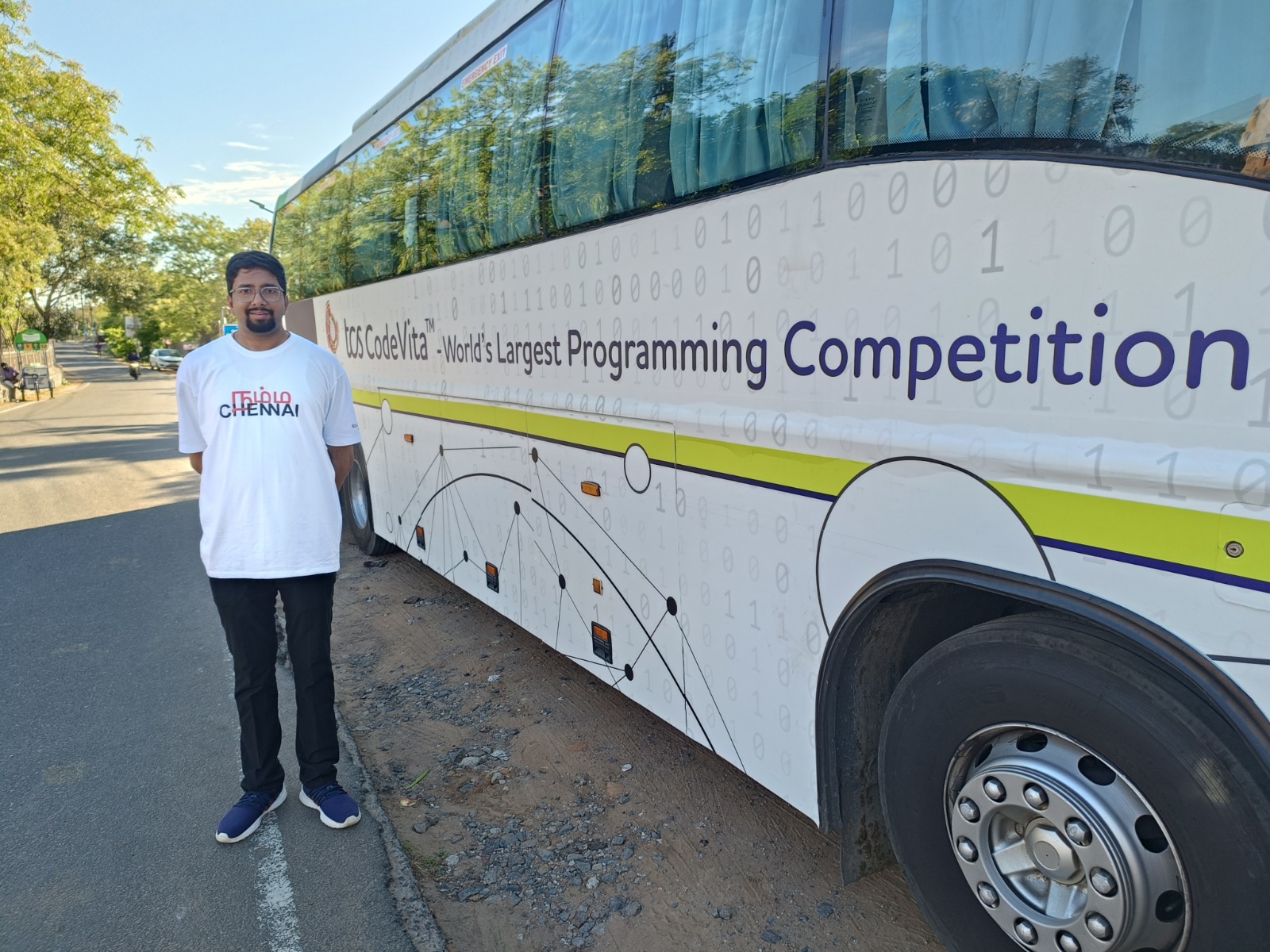
In his first semester at Shoolini University, Divya Mohan was asked to build a webpage for a social cause. He chose accessible education. A few years later, that same instinct for building things that work took him to 7th place in the world at TCS CodeVita, one of the largest programming contests anywhere.
Divya, one of the Shoolini University CSE alumni, specialised in Cybersecurity during his Computer Science Engineering (CSE) degree. He also won PromptWars at Google Gurugram and grew that first assignment into dmj.one, a platform that widens access to quality education in India. He went on to intern at TCS Gurugram on enterprise Identity and Access Management (IAM), and now works on securing IAM systems for the AI-driven enterprise.
We asked him how a classroom exercise became a global coding rank, what shaped his computer science career, and what he would tell students new to CSE.
From a first-year student at Shoolini to the world’s top coders — how did that happen?
It began with a classroom assignment. In my first semester, we had to build a webpage for a social cause, and I chose quality and accessible education, aligned with SDG 4 and SDG 10. That project later grew into dmj.one. It also gave me a habit: build something practical out of every concept I learned.
When AI tools became mainstream, I started experimenting beyond the syllabus, discussing ideas with faculty and learning through projects and feedback. That habit became my real preparation. Years of coding, building, failing, and fixing gave me confidence and changed how I approached problems. That is what took me to CodeVita.
When did you realise problem-solving was your strength?
Gradually. At first, I enjoyed breaking a confusing problem into smaller parts. Then dmj.one started getting steady traffic, and bugs and performance issues began to surface. Real users brought real problems, and those forced me to research, test, debug, and think hard. AI tools were still weak at serious debugging then, so I leaned on fundamentals and persistence. Building, breaking, and fixing, over and over, showed me that problem-solving was something I was good at.
Was there one project or experience at Shoolini that changed your direction?
No single moment. It was a chain of experiences, and not all of them technical. Minor courses broadened what I knew. Flower Fest brought me face to face with people like Padma Shri Surendra Sharma and three-time Grammy winner Ricky Kej. The culture of Himachal, the hills around campus, and a close bond with my classmates all influenced how I think and connect ideas. Together they taught me that a good computer science student solves problems, but also observes people, reads context, and builds things that matter.
CodeVita is one of the world’s biggest coding contests. How did you crack it?
I focused on recognising patterns. For each topic, I solved enough problems to understand the pattern, then enough variations to spot it under pressure. Around 10 questions got me to understand a pattern; roughly 50 got me comfortable with it. CodeVita problems are built to look unfamiliar, but with strong fundamentals you start seeing the structure underneath.
After that, it comes down to implementation speed, because knowing the idea is not enough when everything is timed. Sometimes I could think of an approach but couldn’t code it correctly within the time limit, so I focused on speed, debugging, and reviewing my mistakes after every hard problem. One small mistake can break a whole solution, so debugging and patience matter as much as the idea. That cycle of solving, analysing, and improving was my preparation, and it is what I would tell any student to build. Above all, you need the hunger to improve and win.
How can CSE students prepare for an AI-driven future?
Students should stop treating AI as a shortcut and start treating it as a system they have to understand. It is not only about writing prompts. CodeVita gave me confidence in clear thinking, PromptWars sharpened how I frame problems, and my IAM work taught me accountability and security. That mix of AI skills is what every software developer now needs. AI can generate a whole block of code, but it cannot take responsibility for the system. You still have to build strong fundamentals, check what AI produces, understand risks like prompt injection, and design reliable systems around it.
How did Shoolini help you grow, both technically and personally?
Living in the hostel turned Shoolini into a round-the-clock learning hub. The classroom gave me the foundation, but much of my growth happened outside it… through talks with faculty, input from classmates, and being around people who were also trying to build something. Professors were easy to reach, so I could take an idea from a lecture, test it, improve it, and get feedback fast.
What I value most is the freedom to explore. The CSE program did not lock my learning into one narrow track. I could study cybersecurity, experiment with AI, get exposure to quantum computing, take minors in other subjects, and tie it all to projects with real outcomes. That flexibility let me see computer science as an applied, connected discipline, not just a set of subjects in a degree.
Many students find coding intimidating. What would you tell someone just starting CSE?
Do not start by memorising solutions. Start by learning to break problems into smaller, understandable pieces. That skill matters far more than knowing a hundred answers. Then set a weekly habit: pick one new concept, make something small around it, and publish it. Turn it into a GitHub project, share it on LinkedIn, or show it to classmates. The next week, improve it or add to it. That loop compounds faster than most students expect. It builds your confidence, creates proof of work, and slowly turns coding from something intimidating into something natural.
Anything you’d say to students considering CSE at Shoolini?
A CSE career is not only coding. It is understanding how technology works, how systems are built, and how problems get solved. Use everything Shoolini offers: join communities, take part in events, build projects, ask questions, and talk to faculty without hesitation. Do not follow the crowd. Find your own direction and keep at it. The university gives you the environment, the exposure, and the opportunities, but how far you go depends on how seriously you use them. Come with curiosity, contribute to Atmanirbhar Bharat 2047, and let us get there together.
Vaishali Thakur
3 June 2026


