
The role of universities in research is being redefined across India. The focus is steadily shifting from volume to value — from how much is published to how widely that research is read, cited, and applied. Questions around impact, innovation, and relevance now sit at the centre of the academic conversation, shaping how institutions contribute to national progress and global knowledge.
Within this changing landscape, 2025 marked an important phase for Shoolini University. Over the year, research activity reflected a system that had gained clarity and confidence — supported by strong infrastructure, active faculty leadership, early student engagement, and a growing emphasis on interdisciplinary work. Together, these elements strengthened the Shoolini University research ecosystem, allowing it to produce research that resonated well beyond the university.
This growing influence was reflected internationally when the QS Asia University Rankings 2026 were released in 2025. Shoolini University was ranked No. 1 in Asia for citations per paper, a recognition that directly points to research quality and global relevance. More than a single achievement, it was a marker of how the university’s research efforts had matured — and how 2025 helped consolidate that progress.
The Shoolini University Research Ecosystem: How 2025 Strengthened the System
In 2025, research at Shoolini University became more focused and organised. Research work followed clear goals and addressed real-world problems.
Faculty members worked together across departments. Students were introduced to research early in their courses. Projects were designed to create practical outcomes, not just academic papers.
This progress was visible in the global research data. In 2025, Shoolini University achieved an h-index of > 150, the highest among Indian universities established after 2008. This showed that the university’s research was widely read and cited worldwide.
The developments that followed during the year—from new research facilities to stronger student involvement — were built on this growing research culture.
Infrastructure That Enabled Deeper and More Reliable Research
A strong research ecosystem depends on infrastructure that allows ideas to move beyond theory. In 2025, Shoolini University’s research environment was anchored by facilities designed to support advanced experimentation and long-term projects.
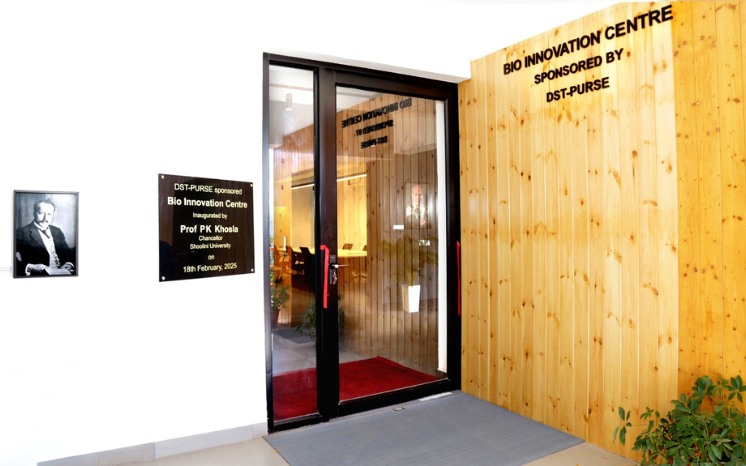
The Bio-Innovation Centre, established through a ₹9-crore DST-PURSE grant, became a key driver of high-end research in biotechnology, health sciences, and cell biology. Equipped with instruments such as confocal microscopes, fluorescence-activated cell sorters, ultra-centrifuges, and X-ray diffraction systems, the centre enabled researchers to conduct work that meets international standards.

Beyond this, more than 104 laboratories and 11 Research Centres of Excellence supported research across disciplines ranging from nanotechnology and omics to biodiversity, disaster management, data analytics, and energy science. This breadth strengthened the Shoolini research infrastructure, allowing researchers to pursue complex questions without structural limitations.
The presence of the E-YUVA Centre, supported by BIRAC, further enhanced the system by supporting early-stage innovation. Through mentoring, funding guidance, and pre-incubation facilities, the centre helped bridge the gap between research ideas and real-world application—an increasingly important aspect of India’s innovation-driven research agenda.
Research in 2025: From Local Questions to Global Relevance
The strength of the Shoolini University research ecosystem in 2025 was most visible in the nature of the research produced — work that was locally grounded, scientifically rigorous, and globally relevant.
Prof Sadanand Pandey from the Faculty of Applied Sciences and Biotechnology was recognised by ScholarGPS®, a global platform that tracks and compares research from universities around the world. He was placed among the top 0.05% of researchers globally, based on how often his research is read and cited by other scholars. His overall global rank of #3,217 shows that his work has made a strong and consistent impact across fields, not just within India.
In materials science, Assistant Professor Itika Kainthla (Physics) demonstrated how fallen Himalayan pine cones, often treated as forest waste, could be converted into high-quality activated carbon. The material achieved over 90 per cent carbon content, comparable to anthracite coal, and performed consistently for more than 30 hours in catalytic trials. This research highlighted how sustainable, low-cost alternatives can emerge from locally available resources—an approach aligned with national priorities on sustainability and resource efficiency. Read more here!
In biomedical sciences, Professor Deepak Kumar from the School of Pharmaceutical Sciences published a high-impact study in Nature Signal Transduction and Targeted Therapy. His work focused on the mTOR signalling pathway and its role in cancer progression, ageing, and chronic metabolic disorders. By examining these connections at a molecular level, the study contributed to global research on targeted therapies and reinforced the standing of research by Shoolini faculty in leading international journals.
Artificial intelligence also played a meaningful role in healthcare research. A team led by Associate Professor Gaurav Gupta developed an AI and machine-learning model for breast cancer detection with an accuracy of 99.6 per cent. Built using an ensemble of high-performing algorithms and validated through rigorous statistical methods, the model demonstrated strong potential for early diagnosis, particularly in regions with limited access to advanced diagnostic tools.
Another important research direction in 2025 focused on nature-based therapeutics. Led by Assistant Professor Rohit Sharma, researchers studied the anticancer and antiviral potential of Himalayan medicinal plants, including Cordyceps sinensis, Arnebia euchroma, Himalayan Mayapple, and Sea Buckthorn. Using molecular docking and computational simulations, the team identified strong biological activity against cancer pathways and HPV-18. This work connected traditional knowledge with modern scientific methods, contributing to India’s growing focus on plant-based drug discovery.
Applied research also addressed practical industrial challenges. Dr Robin Thakur and his team developed a patented automated Tank Cleaner, designed to safely clean industrial water tanks through a rotating, pressure-driven mechanism. By reducing manual labour and health risks, the innovation demonstrated how engineering research can translate directly into safer industrial practices.
Sustainability-driven research extended into food and biotechnology. In collaboration with Cranfield University (UK), researchers from the School of Bioengineering and Food Technology developed a method to convert brewery waste into xylitol, a natural low-calorie sweetener. By repurposing Brewers’ Spent Grain—an underutilised byproduct—the research aligned scientific innovation with circular economy and environmental goals.
Faculty Recognition and Research Depth
The growing strength of the Shoolini University research ecosystem was also reflected in faculty recognition. In 2025, Professor Pardeep Singh crossed the 25,000-citation threshold, reinforcing his standing as a leading researcher in environmental remediation and sustainable materials. Professor Shyam Singh Chandel, Director of the Centre of Excellence in Energy Science and Technology, was recognised among the world’s top 2 per cent scientists for his contributions to energy research.
Importantly, these recognitions reflected broader depth rather than isolated excellence. In the Stanford–Elsevier global list released in 2025, 19 additional Shoolini University faculty members were ranked among the world’s top 2 per cent scientists—highlighting the university’s expanding research base across disciplines. Here is the full list!
Innovation, Patents, and Student Participation
Innovation remains a defining pillar of research at Shoolini University. With over 1800 patents filed, supported by the ‘One Student One Patent’ initiative, the university has built a strong culture around innovation and patents. Students actively participate in identifying problems, designing solutions, and protecting intellectual property — strengthening the overall research culture at Shoolini University.
This approach ensures that research is not limited to academic output alone but extends into application, entrepreneurship, and industry relevance.
Looking Ahead
As India continues to emphasise research-led growth, the progress made at Shoolini University in 2025 reflects a system that is increasingly confident and capable. The Shoolini University research ecosystem today is shaped by strong infrastructure, globally visible research output, faculty depth, and active student involvement.
The year did not simply add achievements — it strengthened the foundation on which future research will be built. With a clear focus on impact, collaboration, and innovation, Shoolini University is well-positioned to contribute meaningfully to India’s research ambitions in the years ahead.