


If you appeared for NEET 2026 and did not get the MBBS seat you wanted, you still have other choices. More than 11 lakh candidates qualified this year, but the number of MBBS seats is far lower. Many PCB students are therefore asking the same question: what should I study next?
Your biology background can lead to careers in biotechnology, microbiology, nutrition, diagnostics, research and public health. This blog covers the courses available, the jobs they can lead to, typical salaries and what to check before choosing one.
Why Do So Many NEET Candidates Miss Out on an MBBS Seat?
Around 11.21 lakh candidates qualified NEET 2026. In comparison, the NMC’s 2026–27 seat matrix lists 1,36,939 MBBS seats across government and private medical colleges. This does not include AIIMS, JIPMER and some other national institutions, but the gap is still huge.
Your score is not the only factor. Cut-offs, category, state quota, college fees and the seats available during counselling can all affect your chances. If MBBS has not worked out, the next step is to find a course that matches your interests and the kind of work you want to do.
What Are the Best Non-MBBS Career Options for PCB Students?
PCB students have more life science courses available after NEET than most people realise, and none of these requires a NEET score.
| Course | Admission Route | Typical Starting Salary |
| BSc Biotechnology | Class 12 marks / entrance exam | ₹2.5 to 4.5 LPA |
| BSc Microbiology | Class 12 marks / entrance exam | ₹2.5 to 4 LPA |
| BSc Nutrition & Dietetics | Class 12 marks / CUET | ₹3 to 4 LPA |
| B Pharm | Class 12 marks / state entrance exam | ₹2.5 to 4 LPA |
| B Tech Biotechnology | JEE / university entrance exam | ₹3 to 5 LPA |
These are entry-level figures. Salaries rise after a postgraduate degree, specialisation, or a few years of experience, as in most science careers.
Is Biotechnology a Good Option After NEET?
Yes, and it is one of the fastest-growing biotechnology courses in terms of both interest and hiring.
Biotechnology sits at the intersection of biology and technology, covering genetics, molecular biology, and increasingly, data-driven work like bioinformatics. India’s biotech sector is currently valued at around USD 100 billion and growing at close to 20% a year, driven by pharmaceutical research, vaccine development, and agricultural biotech.
Graduates aren’t limited to lab work either. Roles today include research scientist, quality control analyst, regulatory affairs associate, and even bioinformatics roles that blend biology with data science. A BSc Biotechnology course can lead directly into industry, or into an MSc for students who want to move into research or academia.
Also read: B Tech Biotechnology with AI: Career, Salary and Future Jobs in 2026
What About BSc Microbiology After NEET?
BSc Microbiology is a strong, often underrated option for PCB students who enjoyed studying microorganisms and infectious diseases in school.
Microbiologists work in diagnostics, food safety, environmental testing, pharmaceutical quality control, and public health research. The pandemic years pushed this field into sharper focus, and hiring in diagnostic labs, vaccine manufacturing, and food industry testing has stayed strong since. A BSc followed by an MSc in Microbiology also opens doors to government research institutions like CSIR and ICMR.
Is Nutrition & Dietetics a Practical Career Choice?
Yes, and its relevance has grown considerably as lifestyle diseases like diabetes and obesity have become more common in India.
A BSc in Nutrition & Dietetics trains students in food science, human nutrition, and diet planning. Career options include clinical dietitian roles in hospitals, nutrition consulting for corporate wellness programmes, and roles with food and pharmaceutical companies working on product development. Admission for this course does not require NEET, and is usually based on Class 12 marks or CUET scores.
Also read: Nutrition and Dietetics Course: Career Paths & Benefits
What Other Courses Can PCB Students Consider?
A few points worth keeping in mind while exploring your options:
B Pharm is a strong, well-established route for students interested in the pharmaceutical industry, from drug manufacturing to regulatory work
BSc Forensic Science suits students drawn to investigation and lab-based evidence analysis, with growing demand from state forensic labs
B Tech Biomedical Engineering is worth considering if you are comfortable with both biology and basic engineering concepts
Higher studies like MSc, M Tech, or a PhD significantly widen career options and salary potential in every one of these fields
None of these routes are dead ends. Many students who start with a BSc later move into an MBA, a specialised master’s degree, or even civil services
Are There Non-Clinical Jobs Available to MBBS Graduates Too?
Yes, and this is worth knowing even if your goal is still MBBS in a future attempt.
Not every MBBS graduate ends up practising medicine full-time. Many move into healthcare administration, medical writing, clinical research, health-tech and telemedicine companies, or public health policy roles. These MBBS non-clinical jobs have grown significantly as India’s health-tech and pharmaceutical sectors have expanded, and they remind you that a medical education doesn’t lock you into a single path.

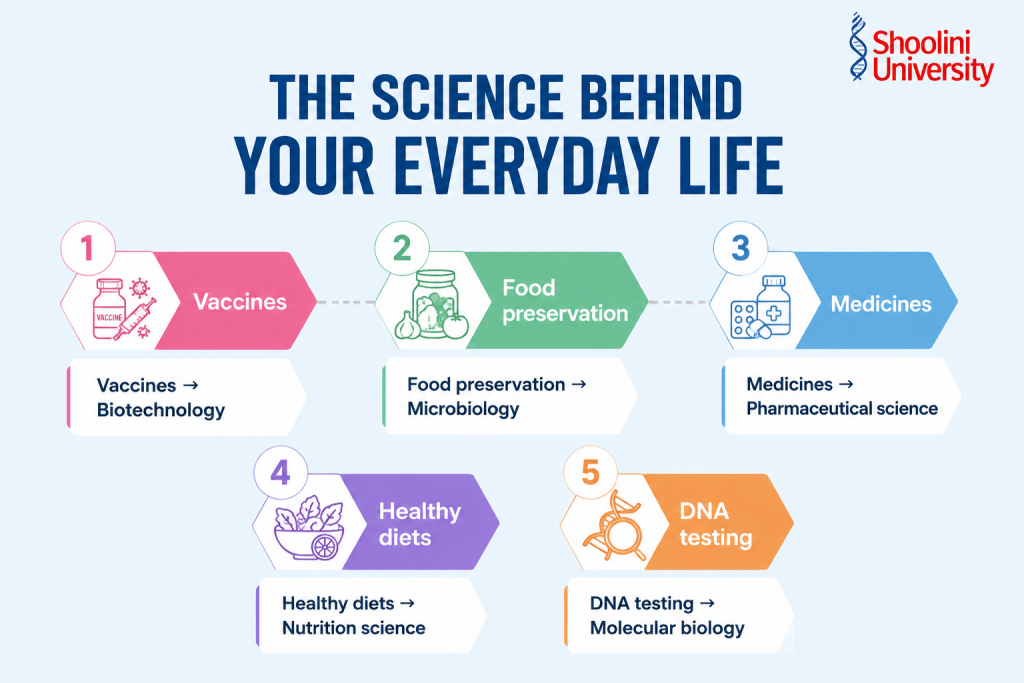
How Should You Actually Choose Between These Options?
Think about what you enjoyed most in your PCB syllabus, rather than only what sounds impressive on paper.
If you liked genetics and cell biology, biotechnology is a natural fit. If you’re interested in microorganisms and infectious diseases, microbiology is worth a closer look. If you are drawn to how food and health connect, nutrition and dietetics offers a growing career. And if you are simply unsure, a general BSc in Life Sciences keeps your options open while you figure out a specialisation later.
Why Study Life Sciences at Shoolini University?
If you are looking at life science courses after NEET, Shoolini offers BSc programs in Biotechnology, Microbiology and Nutrition and Dietetics, as well as B Tech Biotechnology. It is also India’s first biotechnology university.
Students work in dedicated life sciences labs and develop research projects beyond the syllabus. Through the university’s One Student, One Patent policy, undergraduates can pursue patentable research.
Shoolini is ranked 452nd in the world and 10th in India in the QS World University Rankings 2027. It is the only private university in India’s top 10, alongside seven IITs, IISc and Delhi University. For Life Sciences, it is ranked joint No. 3 in India in the THE World University Rankings by Subject 2026.
You do not need a NEET score to apply for these programs. Shoolini accepts scores from CUET, NEET, JEE or SAT, or you can take the university’s multiple-choice entrance test. You must also meet the Class 12 eligibility criteria for your chosen program.
Sources:
- https://www.pw.live/neet/exams/total-mbbs-seats-vs-qualified-students-in-re-neet-2026
- https://collegedunia.com/articles/e-457-neet-ug-seat-intake-2026-5000-new-mbbs-seats-added-total-capacity-now-1-29-lakh
- https://templeguidegujarat01.github.io/margdarshan/nutrition-dietetics.html
- https://internshala.com/blog/biotechnologist-salary-in-india/
FAQs
Q1. What are the best career options after NEET apart from MBBS?
PCB students can explore BSc Biotechnology, BSc Microbiology, BSc Nutrition and Dietetics, B Pharm, B Tech Biotechnology, BSc Forensic Science and BSc Food Technology. Most of these courses do not require NEET, although admission rules vary by institution.
Q2. Which is better after NEET: Biotechnology, Microbiology or Forensic Science?
There is no single answer. Biotechnology covers areas such as genetics, cell biology and product development. Microbiology focuses on microorganisms, disease, diagnostics and food safety, while Forensic Science applies scientific methods to criminal investigation.
Q3. What careers are available after studying life sciences?
Depending on the course, graduates can work in research laboratories, diagnostic centres, hospitals, pharmaceutical and biotechnology companies, food-testing labs, nutrition services and public health organisations. Some roles may require postgraduate qualifications.
Q4. What should students do after NEET counselling if they do not get an MBBS seat?
Keep checking the remaining counselling rounds, but do not wait to look at other courses. Apply before their deadlines so you can compare your options once the results are clear.
Q5. Should students take a drop for NEET or choose another course?
It depends on your NEET score, how much you are likely to improve it and whether you are ready to prepare for another year. Before taking a drop, compare that option with courses that match your interests, career plans and budget.


