

At first glance, BBA and BCom may look like similar routes into business. Their subjects, teaching approach and career focus, however, are quite different. This is what makes the BBA vs BCom choice difficult for many Class 12 students.
The latest enrolment figures show the popularity of both courses. According to the AISHE 2023–24 report, BCom and BCom (Hons) together had 40.8 lakh undergraduate students, while BBA had about 8.8 lakh. Regular-mode BBA enrolment rose from 5.29 lakh in 2019–20 to 7.86 lakh in 2023–24.
BCom remains the larger course, though BBA is growing quickly. But enrolment numbers cannot tell you which one will suit you. BBA covers marketing, HR, operations and business strategy, while BCom goes deeper into accounting, taxation, economics and finance.
There is no single Best Course After 12th Commerce. This blog compares BBA and BCom subjects, careers, salaries and placements to help you choose according to your interests and career plans.
What Is BBA?
BBA, or Bachelor of Business Administration, is an undergraduate management degree that teaches you how different parts of a business work together.
Every company relies on several functions. Marketing brings in customers, HR manages people, finance handles budgets and financial planning, and operations manages day-to-day processes. Managers coordinate these functions and make business decisions.
A BBA course gives you an overview of these areas. The BBA subjects offered vary by university and specialisation, but usually include:
- Principles of Management
- Marketing Management
- Human Resource Management
- Business Economics
- Financial Management
- Organisational Behaviour
- Operations Management
- Entrepreneurship
- Business Analytics
BBA may suit students who enjoy communication, teamwork, problem-solving and learning how businesses operate.
It is also a suitable undergraduate degree if you plan to do an MBA later.
What Is BCom?
BCom, or Bachelor of Commerce, is an undergraduate commerce degree focused primarily on accounting, finance, taxation and related areas of business.
While BBA examines how different business functions are managed, BCom spends more time on financial records, taxation, commerce and business law.
The B Com subjects offered vary by university, but commonly include:
- Financial Accounting
- Cost Accounting
- Corporate Accounting
- Income Tax
- Auditing
- Business Law
- Economics
- Financial Management
BCom may suit you if balance sheets interest you more than marketing campaigns, or if you see yourself working in accounting, taxation, audit, banking or finance.
It also provides a useful academic foundation for professional qualifications such as CA, CS and CMA.
BBA vs BCom: What Is the Difference?
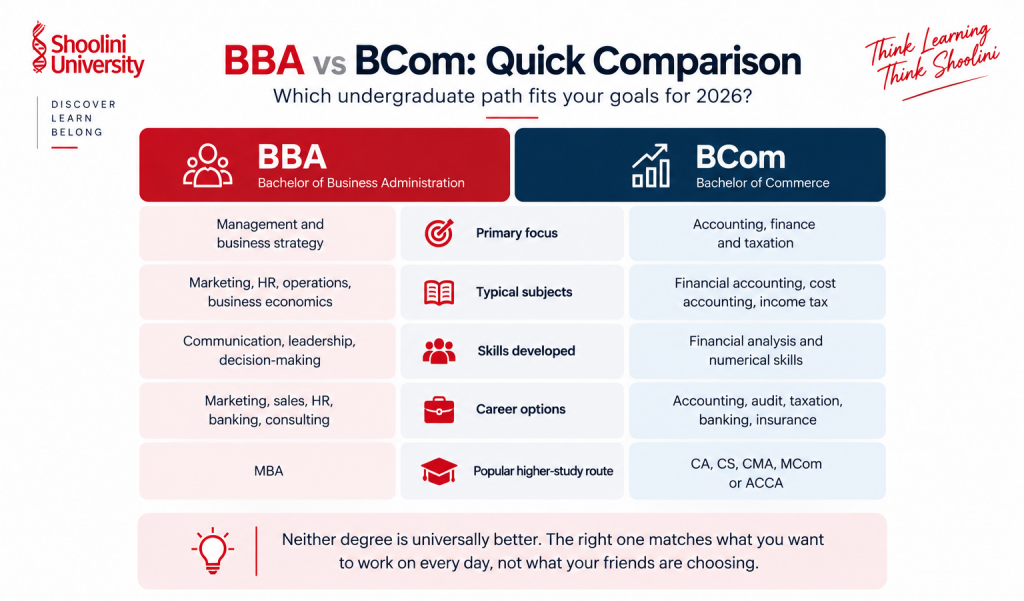
Both degrees cover business and commerce, but they approach the subject differently. BBA focuses on managing different business functions, while BCom concentrates on accounting, finance, taxation and commerce.
| Factor | BBA | BCom |
| Full form | Bachelor of Business Administration | Bachelor of Commerce |
| Main focus | Management and business operations | Accounting, commerce and finance |
| Typical subjects | Marketing, HR, operations, strategy and business economics | Accounting, taxation, auditing, finance and business law |
| Skills developed | Communication, management, teamwork and decision-making | Accounting, financial analysis and numerical skills |
| Common career areas | Management, marketing, HR, operations and business development | Accounting, finance, taxation, audit and banking |
| Popular higher-study options | MBA and specialised master’s degrees | CA, CS, CMA, MCom and MBA |
The BBA and BCom difference can be understood quite simply:
- Choose BBA if you want to learn how different parts of a business are managed.
- Choose BCom if you want to study its financial, accounting and commercial functions in greater depth.
Career After BBA
A Career After BBA is not limited to one business function. Your options will depend on your specialisation, internships, skills and the kind of work you enjoy
Common career areas include:
- Marketing
- Sales and business development
- Human resources
- Operations
- Banking and financial services
- Business analytics
- Consulting support
- Entrepreneurship
Entry-level positions may include Marketing Associate, Business Development Executive, HR Executive, Operations Trainee and Junior Business Analyst.
Students who want to study management in greater depth can later do an MBA in marketing, finance, HR, operations or business analytics.
BBA can provide an advantage during the early stages of an MBA because students have already studied basic management concepts. However, BCom graduates can also apply for an MBA and often bring stronger knowledge of accounting and finance.
Career Scope After BCom
BCom provides a more specialised foundation for careers involving accounts, taxation and finance.
Common career areas include:
- Accounting
- Audit
- Taxation
- Banking
- Financial services
- Insurance
- Corporate finance
- Compliance
Graduates may begin as Accounts Executives, Junior Auditors, Tax Assistants, Finance Associates or banking professionals.
BCom is also a common undergraduate choice for students preparing for professional qualifications. CA focuses on accounting, audit and taxation, CS on company law and corporate governance, and CMA on cost and management accounting.

BBA vs BCom Salary and Placements
A BBA vs BCom Salary comparison needs to be treated carefully. Employers do not set salaries according to the degree title alone. The role, employer, location, university, internship experience and practical skills can make a considerable difference.
The salary of BBA and BCom graduates also varies because they usually apply for different roles. A marketing trainee, junior analyst, accounts executive and tax assistant cannot be compared through a single course-wide salary figure.
When assessing BBA vs BCom Placements, check:
- Companies that recruit from each programme
- Roles offered to graduates
- Median and average salary
- Number of students placed
- Internship opportunities
- Whether salary figures include variable pay
- Whether the data is specific to BBA and BCom students
A professional qualification or postgraduate degree can also affect long-term earnings. BCom graduates may add CA, CS or CMA, while BBA graduates commonly progress to an MBA or a specialised management degree.
BBA or BCom: Which Has Better Scope in 2026?
Neither course has better scope in every field. The answer depends on the kind of work you want to do.
BBA may suit you if you are interested in questions such as:
- How would I market this product?
- How can a company increase sales?
- What helps a team work effectively?
- How are business decisions made?
- Could I start a business of my own?
BCom may be a better fit if you are more interested in questions such as:
- How does a company calculate profit?
- How are businesses taxed?
- How does an audit work?
- How are financial statements prepared?
- How does a company manage its finances?
Your Class 12 stream should not be the only deciding factor. Look at the subjects, the skills required and the careers connected with each course.
What If You Still Don’t Know What Career You Want?
Many students do not have their careers mapped out at 17 or 18. You do not need to make every long-term decision before entering university.
Start by comparing the first-year syllabus of both courses. Would you rather study management, marketing and organisational behaviour, or accounting, taxation and finance?
Also check what the university offers beyond the syllabus:
- Internships and live projects
- Industry interaction
- Relevant specialisations
- Training in analytics and digital tools
- Professional certifications
- Placement preparation
In 2026, a degree title alone may not be enough to distinguish you from other applicants. Internships, projects, certifications and communication skills can provide evidence of what you can do.
Studying BBA or BCom at Shoolini University
When shortlisting the top colleges for BBA and BCom in India, compare the curriculum, specialisations, practical training and placement support.
Shoolini University offers BCom (Hons), BCom (Hons) with ACCA and BBA programmes with specialisations. This allows students to choose between a commerce-focused education and broader management training.
BCom (Hons)
The four-year BCom (Hons) programme covers commerce, accounting, finance, taxation and related business subjects.
Students can also choose BCom (Hons) with ACCA. ACCA is an international accounting and finance qualification recognised in over 180 countries. Under Shoolini’s integrated pathway, eligible students receive exemptions from nine of the 13 ACCA papers and prepare for the remaining four.
This option may interest students planning careers in accounting, finance or international business.
BBA and BBA Specialisations
Shoolini currently offers BBA specialisations in:
- Business Analytics
- Aviation and Management
- Banking and Finance
- Marketing
- Computer Science and Entrepreneurship
The programmes combine management subjects with communication, case studies, projects and industry exposure. Students can select a specialisation based on the business area in which they want to develop deeper knowledge.
Learning Beyond the Degree
Practical experience can make classroom learning easier to apply in the workplace.
At Shoolini, SPRINT supplements academic study through industry interaction, group discussions, mock interviews, case studies, role plays and simulations. The training covers communication, teamwork, interviews and workplace expectations.
This matters for both courses. BCom students need to demonstrate that they can apply financial and accounting knowledge, while BBA students need examples of how they have worked on business problems, campaigns, projects or internships.
Use your undergraduate years to build practical experience alongside your academic record.
BBA or BCom: Which Course Should You Choose?
BBA and BCom provide different academic foundations, although their career paths can overlap. BBA covers management, marketing, HR and business operations. BCom provides greater depth in accounting, taxation and finance.
Choose BBA if you prefer managing people, projects and business functions. Choose BCom if you are more comfortable working with accounts, financial information and taxation.
If you are still undecided, compare the first-year subjects and ask yourself which set you would rather study in depth. That answer will tell you more than the course your friends are choosing.
BBA and BCom Admissions 2026
BBA and BCom admissions for 2026 are open at Shoolini University.
Apply at shooliniuniversity.com or call 701 800 7000.
Sources
FAQ
Q1. Which is better after Class 12, BBA or BCom?
BBA is generally better suited to students interested in management, marketing, HR, entrepreneurship or an MBA. BCom is better aligned with accounting, taxation, finance, banking and professional qualifications such as CA, CS and CMA. Neither degree is universally better.
Q2. BBA vs BCom: which has more scope?
Both offer strong career opportunities, but in different areas. BBA has broader scope across management functions such as marketing, HR, operations and business development. BCom offers greater depth for accounting, finance, taxation, banking and auditing careers.
Q3. Which has a higher salary, BBA or BCom?
There is no fixed BBA vs BCom salary winner. Starting and long-term salaries depend on the role, employer, university, location, internships, specialisation and additional qualifications. An MBA can significantly change a BBA graduate's career trajectory, while qualifications such as CA, CS, CMA or ACCA can do the same for commerce and finance graduates.
Q4. Which course is better for banking and finance?
BCom usually provides greater academic depth in accounting and finance. However, a BBA with a banking and finance specialisation can also prepare students for the sector, particularly for management-oriented roles.
Q5. Is BBA better than BCom for MBA?
BBA offers early exposure to management subjects, which can make the transition to MBA coursework more familiar. However, students from BCom and many other undergraduate backgrounds can pursue an MBA successfully.
Q6. Can a BCom student do an MBA?
Yes. BCom graduates can pursue an MBA after completing their undergraduate degree, subject to the eligibility and admission requirements of the institution they apply to.
Q7. How should I choose between BBA and BCom in 2026?
Start with your interests. Choose BBA if you enjoy management, people, communication and business strategy. Consider BCom if you enjoy numbers, accounting, finance and detailed analytical work. Then compare universities on curriculum, specialisations, internships, industry exposure and skill-development opportunities before making your final choice.