

Artificial intelligence is being adopted across industries, increasing demand for professionals who can understand and build AI-driven systems. According to Precedence Research, the global artificial intelligence market is projected to grow from USD 900 billion in 2026 to approximately USD 4,216.29 billion by 2035, at a CAGR of 18.73%. This growth reflects the increasing adoption of AI across sectors and signals expanding opportunities for students building skills in AI, machine learning, data and software development.
For students choosing engineering in 2026, the question is practical: what should you study today to stay relevant when you graduate?
B Tech CSE (Artificial Intelligence) combines computer science fundamentals with machine learning, data and intelligent systems. For students interested in coding, mathematics and problem-solving, it can be one of the strongest engineering choices in 2026. This blog examines what the course teaches, its scope in India, career opportunities, salaries, skills employers expect, and what students should look for when choosing an AI Engineering Course.
What Is B Tech CSE (Artificial Intelligence)?
B Tech CSE (Artificial Intelligence) is a four-year engineering degree that combines core computer science with specialised study in AI and machine learning.
Students learn programming, data structures, algorithms, databases, operating systems and computer networks, along with machine learning, neural networks, deep learning, data mining, computer vision and analytics.
Studying AI is different from learning to use an AI tool. Building an intelligent system requires understanding how data is prepared, how algorithms learn from it, how models are evaluated and how these models are integrated into software systems. A strong AI Engineering Course therefore combines programming, mathematics and computing fundamentals with specialised AI knowledge.
B Tech CSE vs B Tech CSE (Artificial Intelligence)
Both programs are rooted in computer science. The difference is the depth of AI specialisation.
| Area | B Tech CSE | B Tech CSE (AI) |
| Core focus | Comprehensive, foundation-building program covering computation, hardware-software integration, and algorithmic design | Builds on the same CS base but goes deeper into data, algorithms, AI engineering, and machine learning engineering |
| Core subjects | Data Structures and Algorithms, Database Management Systems, Operating Systems, networks, software engineering | Same core CS subjects, plus dedicated AI/ML tracks from Year 1–2 |
| Mathematics | Discrete math and logic-oriented | Generally more mathematically intensive; requires strong grasp of linear algebra, calculus, and probability vs CSE’s discrete-math focus |
| Machine Learning | Usually an elective or minor module | Core, structured specialisation |
| Deep Learning/CV/NLP | Depends heavily on college and electives chosen | Typically built into the advanced-semester curriculum |
| Breadth vs depth | Broadest option; doesn’t limit you to one technology; builds a base to pivot into almost any tech domain later | Narrower and more targeted, at the cost of some breadth |
| Recruiter pool | Larger pool of recruiters due to broader scope | Attracts AI-specific companies, research labs, and high-paying product firms |
| Salary signal | Baseline tech-industry pay | AI & ML specialists generally command a salary premium of 15–25% over general CSE graduates for AI-specific roles, particularly at product/research firms |
General CSE offers broader flexibility across computing. B Tech CSE (Artificial Intelligence) is more focused on students interested in machine learning, data and intelligent applications while retaining a computer science base.
Why AI Skills Matter for the Class of 2030
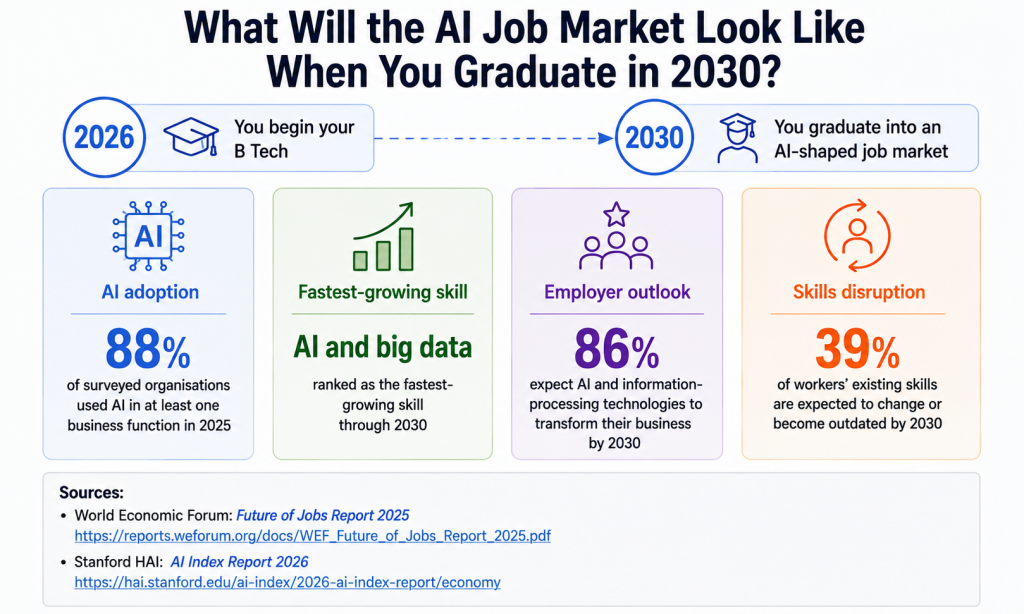
Students beginning engineering in 2026 will graduate around 2030. The World Economic Forum estimates that 39% of workers’ existing skill sets will be transformed or become outdated between 2025 and 2030. It also reports that 86% of surveyed employers expect AI and information-processing technologies to transform their businesses by 2030.
AI adoption already extends beyond technology companies. Banks use machine learning for fraud detection and risk analysis. Manufacturers use computer vision for quality control. E-commerce platforms rely on recommendation systems. Healthcare organisations use AI in medical imaging, while researchers are exploring its use in drug discovery.
The artificial intelligence future is therefore closely linked to AI adoption across established industries.
India is also building domestic AI capacity. The Union Cabinet approved the IndiaAI Mission in March 2024, with an outlay of ₹10,371.92 crore over five years. It covers compute capacity, foundation models, datasets, application development, skilling, startup financing and safe and trusted AI.
Together, industry adoption and public investment can support AI-related work across technology, healthcare, banking, manufacturing, cybersecurity, retail, logistics, agriculture and research.

Scope and Career Opportunities in Artificial Intelligence
An artificial intelligence engineer develops and integrates intelligent systems into products and applications. The work can involve machine-learning models, data pipelines, APIs, cloud services and software development.
The scope of AI work extends beyond building models. Some roles focus on preparing data, while others involve deploying models, monitoring their performance or integrating them into software products.
Machine learning engineers build, train and deploy models that learn from data. Data scientists combine programming, statistics and machine learning to analyse information and solve business or research problems.
Computer vision engineers develop systems that interpret images and video, with applications in medical imaging, manufacturing and autonomous technologies. NLP and generative AI engineers work on search, conversational AI, document analysis and other language-based applications.
Data engineers build pipelines to collect, clean and process data for AI systems. MLOps engineers manage model deployment, monitoring and updates, while software developers add AI capabilities to web, mobile and enterprise applications.
Options for a Career After B Tech AI include data engineering, business intelligence, software development and research. Graduates can also continue to higher studies in AI, data science, computer science or related fields.
Entry-level job titles vary across employers. Graduates may begin as junior AI or machine-learning engineers, data analysts, software developers or research assistants. Some move into specialised AI roles after gaining experience through projects, internships or postgraduate study.
An AI Engineering Career is therefore not limited to companies developing AI products. Organisations across sectors need professionals who can apply AI and data to specific problems.
AI Engineer Salary in India and Skills Employers Look For
The AI Engineer Salary in India varies by job profile, employer, location, experience and technical expertise. As of August 2026, Glassdoor estimates median total pay for AI engineers in India at about ₹11 lakh a year, with a typical range of ₹6.53 lakh to ₹19 lakh. This covers professionals at different experience levels and should not be treated as a guaranteed starting salary.
For students choosing a program, employability is a more useful benchmark than a single salary figure. Programming, particularly Python, is important. Data structures and algorithms develop computational thinking, while probability, statistics and linear algebra help students understand machine-learning concepts.
Other relevant skills include machine learning, neural networks, deep learning, databases, cloud computing, computer vision and NLP. Employers may also assess whether candidates can prepare data, evaluate models, write reliable code, use version-control tools and explain their technical decisions.
Projects show how students can apply this knowledge. An image-recognition system, prediction model or language application demonstrates what a student can design, test and explain. Internships and research can add practical experience before graduation.
How to Choose the Right AI Engineering College
The number of B Tech artificial intelligence colleges in India has increased, but programs with similar names can differ widely in curriculum and practical exposure.
Start with the academic structure. A program should provide a strong grounding in programming, algorithms, databases and mathematics alongside advanced AI subjects.
Students comparing B Tech artificial intelligence colleges should also examine faculty expertise, computing resources, project and research opportunities, internships, industry collaborations, and relevant certifications.
Look beyond placement percentages. Check which companies recruit, the roles they hire for, and whether graduates are hired for technical positions related to AI, data, and software development.
B Tech CSE Artificial Intelligence at Shoolini University
Shoolini University offers B Tech CSE Artificial Intelligence through the Yogananda School of AI, Computers and Data Science. This four-year program pairs core computer science with machine learning, neural networks, signal processing, data mining and data visualisation, along with focused training in Python.
AI Labs and Learning
Students train at the AI & Futures Centre, with access to high-GPU computing, Apple Labs, the Robotics Centre developed with Sirena Technologies, and AR/VR and IoT labs developed with iHub IIT Roorkee. The program also covers large language model development and agentic AI research.
Industry Certifications
Through Global Learning Partners, students can work towards IBM’s AI Foundations, AI Developer and AI Engineering certificates; AWS Solutions Architect and AWS Practical Data Science; Google’s AI Certificate; Microsoft Cybersecurity Analyst; Stanford’s Machine Learning certificate; NYU’s Cybersecurity Overview; Vanderbilt’s Prompt Engineering certificate; DeepLearning.AI’s Deep Learning and Natural Language Processing tracks; and ISC²’s Cybersecurity Certification.
Global Exposure
Study-abroad pathways are available through partner universities such as the University of Melbourne in Australia; Royal Holloway University of London and the University of Edinburgh in the UK; the University of Windsor in Canada; Constructor University in Germany; the University of Naples Federico II in Italy; National Dong Hwa University in Taiwan; the University of Suwon in South Korea; and the University of Dayton in the USA. Options cover dual degrees and semesters abroad.
Placements and Career Opportunities
Shoolini’s engineering placement network spans 250+ companies, covering on-campus recruiters and off-campus hires. The list features Accenture, Cisco, Dell, Capgemini, Cognizant, Infoedge, Algo8, Hughes Systique, Teleperformance and Sirena Technologies. The highest B Tech CSE package on record is ₹42 LPA at Algo8.
| Program Details | Information |
| Duration | 4 years |
| School | Yogananda School of AI, Computers and Data Science |
| Eligibility | 10+2 with Mathematics and two approved subjects; minimum 60% marks |
| Admission | CUET, JEE, SAT, or Shoolini University’s entrance test |
| Global Exposure | Study-abroad pathways with universities in Australia, the UK, Canada, Germany, Italy, Taiwan, South Korea, and the USA |
| Placement Exposure | 250+ companies, covering on-campus recruiters and off-campus hires |
| Highest Package | ₹42 LPA for B Tech CSE, at Algo8 |
For students comparing B Tech CSE Artificial Intelligence colleges in India, Shoolini combines AI-focused coursework, research labs, industry partnerships and international study options. In the QS World University Rankings 2027, Shoolini is ranked 452nd globally and 10th in India, making it the only private university in the country’s top 10. It also holds NAAC A+ accreditation with a CGPA of 3.33.
Should You Choose B Tech CSE (Artificial Intelligence) in 2026?
There is no universal Best Engineering Course in 2026. The right choice depends on aptitude and career interests.
B Tech CSE (Artificial Intelligence) may be a good choice if you enjoy programming, mathematics, logical reasoning and technical problem-solving. Prior AI knowledge is not necessary, but students should be prepared to strengthen these core skills.
The AI tools used in 2030 may differ from those used today. Engineers who understand programming, algorithms, data and machine-learning principles will be better equipped to adapt.
For students interested in developing intelligent systems and understanding the technology behind them, B Tech CSE (Artificial Intelligence) provides a focused route into computing, machine learning and data-driven careers.
Know more about B Tech CSE (Artificial Intelligence) at Shoolini University.
References:
- Precedence Research, Artificial Intelligence (AI) Market — precedenceresearch.com/artificial-intelligence-market— source for the USD 757.58B (2025) → USD 3,680.47B (2034) market-growth figure
- World Economic Forum, Future of Jobs Report 2025 — weforum.org/publications/the-future-of-jobs-report-2025— source for the 39% skills-change estimate, the 86% AI-transformation figure, and AI/big data ranking as fastest-growing skill category
- World Economic Forum, “Future of Jobs Report 2025: The jobs of the future” — weforum.org/stories/2025/01 — source for AI/ML Specialists ranking among fastest-growing jobs through 2030
- Press Information Bureau, Government of India, “Cabinet Approves the IndiaAI Mission” — pib.gov.in/PressReleaseIframePage.aspx?PRID=2012355 — outlay confirmed at ₹10,371.92 crore
- Stanford HAI, The 2025 AI Index Report — hai.stanford.edu/ai-index/2025-ai-index-report — source for the 78% (up from 55% in 2023) AI-adoption figure
- Glassdoor: AI Engineer Salaries in India
FAQs
Q1. Is B Tech CSE (Artificial Intelligence) a good career choice in 2026?
Yes. AI and big data rank among the fastest-growing skills through 2030 according to the World Economic Forum. Career outcomes depend on technical skills, projects, internships and practical experience.
Q2. What are the career opportunities after B Tech CSE (Artificial Intelligence)?
Graduates can pursue roles such as AI Engineer, Machine Learning Engineer, Data Scientist, Computer Vision Engineer, NLP Engineer and Data Engineer, along with broader software and computing roles.
Q3. What is the scope of B Tech CSE (Artificial Intelligence) in India?
AI applications are expanding across IT, banking, healthcare, manufacturing, cybersecurity, e-commerce, agriculture and research. The IndiaAI Mission is also supporting AI infrastructure, skills and applications.
Q4. What is the difference between B Tech CSE and B Tech CSE (Artificial Intelligence)?
B Tech CSE provides broad computer science education. B Tech CSE (Artificial Intelligence) retains core CSE subjects while providing deeper study of machine learning, neural networks, data and intelligent systems.
Q5. What is the average salary after B Tech CSE (Artificial Intelligence)?
There is no single average applicable to every graduate. Salary varies by role, employer, location, experience, technical skills, internships and specialisation.
Q6. Why should I choose B Tech CSE (Artificial Intelligence) after Class 12?
It is suitable for students interested in coding, mathematics and problem-solving who want to understand how AI systems are developed and applied.
Q7. Which engineering branch has the highest demand in 2026?
No branch has the highest demand across every industry. However, the World Economic Forum identifies AI and Machine Learning Specialists, Big Data Specialists and Software and Applications Developers among the fastest-growing jobs through 2030.