

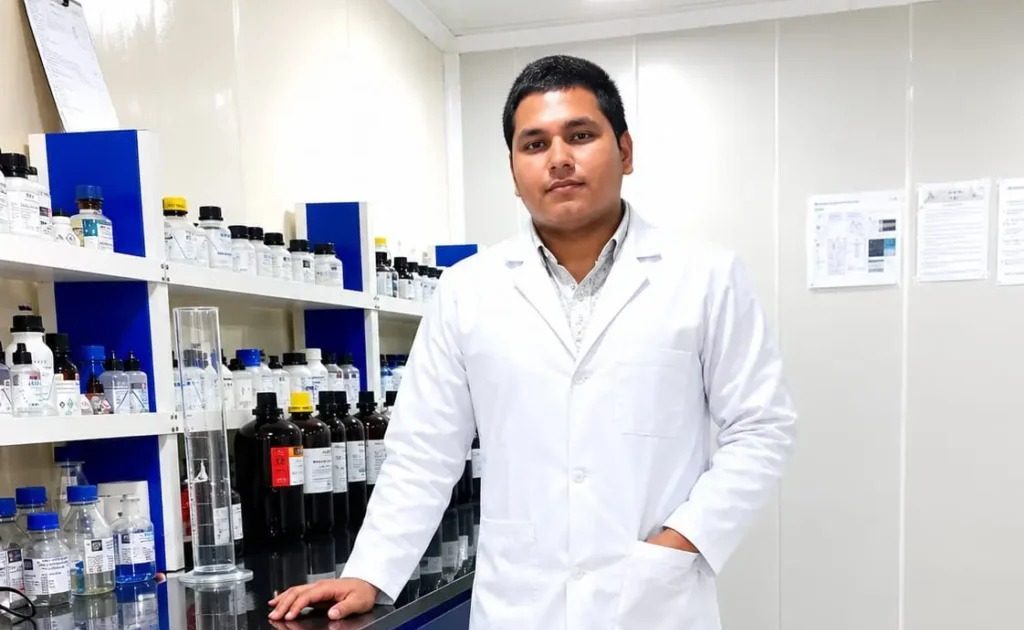
For the past few years, Hemant Singh has worked on making chemical manufacturing cleaner and safer. A PhD scholar at the School of Advanced Chemical Sciences, he has won financial support from the Anusandhan National Research Foundation (ANRF) under its International Travel Support (ITS) scheme.
The grant funds his participation in the Gordon Research Seminar and Gordon Research Conference on Green Chemistry in Barcelona, Spain, from July 25 to 31, 2026. Selected after a rigorous national-level evaluation, Hemant works under Asst Prof Saima Malik on plant-based nanocatalysts, a greener alternative to the toxic solvents and expensive metals used in chemical manufacturing today.
In this conversation, he talks about the research behind the recognition, how the selection process worked, and what he hopes to bring back from Barcelona.
How did you find this opportunity, and what did the selection involve?
I learned about it from my supervisor, Asst Prof Saima Malik, and Asst Prof Sunil Sharma, who had earlier received the ANRF-SIRE fellowship and worked at Hanyang University in South Korea. Their experience encouraged me to apply.
I submitted a research abstract through the ANRF International Travel Support program, focusing on how plant-based materials can be used to develop eco-friendly nanocatalysts for pollution control, chemical synthesis, food safety, and healthcare. The process was competitive — experts reviewed the scientific quality and international relevance of each proposal before shortlisting candidates nationally. The grant covers my economy-class airfare, visa charges, airport taxes, and conference registration, totalling nearly ₹2 lakh.
What is your PhD research trying to solve?
I want to make chemical processes cleaner and safer. Many industries still rely on harmful chemicals and expensive metals to produce medicines and remove pollutants, generating hazardous waste along the way. I work on nanocatalysts — tiny materials derived from natural plant extracts — that enable reactions to occur efficiently in water rather than toxic solvents. They are reusable, too, so the goal is threefold: cut pollution, reduce production costs, and support sustainable manufacturing without sacrificing performance.
What drew you to green chemistry?
Small changes at the molecular level can completely change a material’s properties — that has always fascinated me. Green chemistry drew me in because it combines scientific innovation with environmental responsibility. You solve real problems while protecting nature.
Which research moment do you remember most?
Developing a magnetic iron nanocatalyst using only a natural plant extract. It worked well in water and converted harmful chemicals into safer products. Seeing that work published in a well-known international journal made the effort feel worth it.
This is your first Gordon Conference. What does it mean to attend one?
A great deal. Gordon Conferences are among the most respected scientific gatherings in the world, built around a small, interactive format where researchers share work that is not yet published. You hear science before the rest of the world does. For a young researcher, an invitation is a recognition in itself. I will also attend the Gordon Research Seminar that precedes the main conference, and I hope to return with new ideas, honest feedback on my research, and collaborations that take our work at Shoolini University further.
What has working with Asst Prof Saima Malik taught you?
She has always pushed me to think independently, stay curious, and not get discouraged by failed experiments. One line of hers has stuck: every unsuccessful experiment teaches you something and brings you one step closer to success.
Where do you see your career after the PhD?
I want to continue in green nanotechnology and catalysis through postdoctoral research and international collaborations. In the long run, I want to build practical technologies that help industries cut pollution.
Any advice for PhD scholars hoping for similar international exposure?
Stay consistent, stay curious, and apply. Do solid research, communicate it clearly, and do not let rejection discourage you. Every application teaches you something, and persistence brings the right opening. And use the guidance your mentors and the university offer — fully.


